



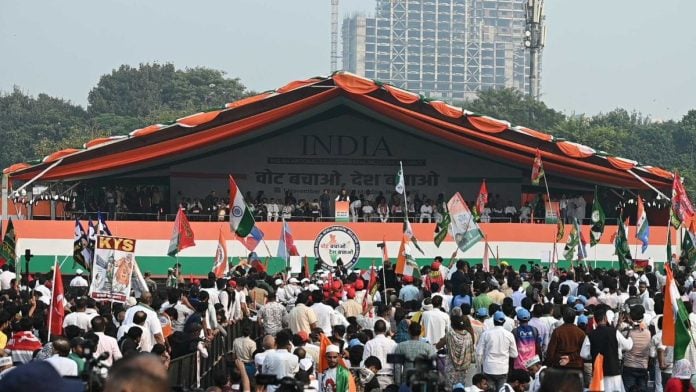
For anyone gifted with the sense of sight, the INDIA bloc rally in Ramlila Maidan on 1 November demanding Gyanesh Kumar’s resignation was a dramatic visual. Huge crowds marched through the streets with Rahul Gandhi and other Opposition leaders, and massed in Delhi’s iconic maidan. So it’s remarkable that the BJP’s line of attack that day was that the rally was a failure, and that far fewer people attended than the Congress party had claimed. Not the challenges raised at the rally, not a defence of Gyanesh Kumar, just quibbles about the size of the crowd.
Most people, including veteran editor Prabhu Chawla, agreed that this was one of the biggest political rallies India has seen since Jayaprakash Narayan’s 24 June 1974 rally in Patna’s Gandhi Maidan. Newslaundry estimated that at least a lakh attended, with many more left outside, including a large number accompanying Rahul Gandhi and INDIA leaders in an hours-long procession from Minto Bridge to Ramlila Maidan. I myself observed many people turning back from the Maidan because they were unable to get in, and others braving the mud and slush on the grounds and seats just to be present there.
This isn’t the only instance of a debate over crowd size at a political event. Donald Trump famously trumpeted the size of the crowd attending his 2017 presidential inauguration, even though photos suggest that many more attended Barack Obama’s swearing-in in 2009. True to his “mine is bigger than yours” style, Trump also declared that his 6 January 2021 rally that led to the attack on the US Capitol was the “biggest I’ve ever seen”.
Ordinarily, the will of the people is expressed through fair elections and representative institutions. But elections are now in doubt. The old intimidation tactics, overconfidence (“aayega to Modi hi”) and predictions of rule until 2047 or the next 50 years are also arousing suspicion — how can you be so sure of winning indefinitely?
When the process is tainted, popular consent is established via street mobilisation. When those attending are not just party workers and traditional supporters but students and the middle class, you know that people are withdrawing their consent. Since the Jantar Mantar protests, I personally know scores of friends and acquaintances who previously wouldn’t have been seen dead at a Congress party march but joined the 12 October march to the Supreme Court and the Ramlila Maidan rally.
Also Read: British Raj called freedom fighters anarchists & foreign agents. Sounds familiar?
Why the BJP is worried
Of course, it makes sense that the BJP would fight over numbers. Its goal is to insist on the idea that Narendra Modi epitomises the will of the people rather than Rahul Gandhi or the INDIA bloc.
And it is deeply worried about three trends moving in the Opposition’s favour:
Legitimacy. Both the JP movement and the Anna Hazare movements gained legitimacy from the size of the crowds that attended. Large crowds make it harder for the ruling party to claim that it alone represents the will of the people. The street here acts as a referendum on an incumbent regime. An Opposition show of force could also encourage undecided voters to bandwagon with it. Conversely, the Modi government wants to prevent any further erosion in its already-diminished political capital by claiming that the rally was a “flop show”.
Momentum. A successful Opposition rally more than three months after the July student protests also conveys Opposition momentum, keeping the issues alive in the eyes of undecided or previously Modi-leaning voters. The student protests were a gateway for middle-class voters whose inhibitions and fear dropped as the crowds at Jantar Mantar swelled. Since then, Rahul Gandhi has kept up the pressure with a series of unpredictable actions culminating in the 31 October symbolic public impeachment of Gyanesh Kumar and the Ramlila Maidan rally. The Opposition calculation is that unrelenting pressure bolstered by widespread support is needed to force Gyanesh Kumar’s resignation. On the other hand, if Modi continues to protect the CEC, his political capital will continue to ebb.
Elite fracture. The student and Vote Chori protests have clearly widened divisions in the ruling establishment. There are reports of differences between Modi and Amit Shah over how to handle the protests. In a sign of weakening authority, some senior Union ministers have reportedly refused to resign to facilitate a long overdue cabinet reshuffle. Some BJP allies even sought clarifications from the ECI on the SIR, while Chirag Paswan criticised the July police crackdown (before reversing course later). And regional party leaders like Jagan Mohan Reddy, Naveen Patnaik and KT Rama Rao, often timid in the past, have spoken out in support of students and joined the chorus demanding Gyanesh Kumar’s resignation.
Arguably most importantly, there are reports that senior bureaucrats have instructed civil servants to put down all decisions in writing, to forestall any charges of acting improperly or illegally. The clearest example was the two Election Commissioners objecting to Gyanesh Kumar’s decision-making in writing 14 times, including to the Cabinet Secretary, over a ten-month period.
Change is in the air. Most people I have spoken to have talked about how successful the rally was regardless of what the BJP says about it. The mood in the Opposition camp is upbeat because of the three trends moving clearly in its favour. And a flailing BJP has so far been unable to do much about it.
Amitabh Dubey is a Congress member. He tweets @dubeyamitabh. Views are personal.
(Edited by Asavari Singh)
Propaganda article by Congress!
Arey Bhai Amitabh Bachann
How do you expect new laundry to report a correct number. The ground itself isnt occupied completely with max Indian capacity of 75000 more than 1/4 was empty.
Really don’t know what you have been smoking, please send some stuff over too it’s been a while.
Ta,
Sid