




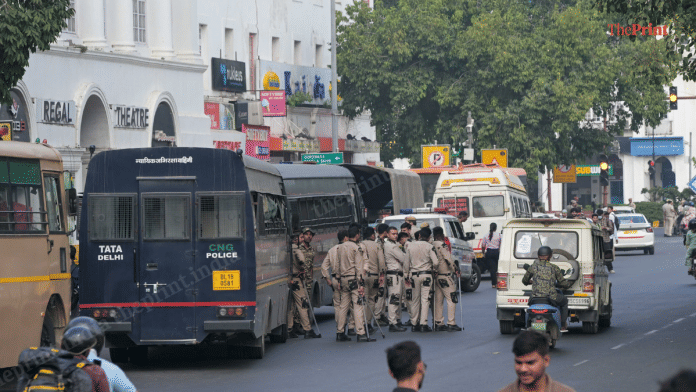

Chinese online commentary has framed New Delhi protests as a symptom of deeper economic anxieties, particularly youth unemployment and the Indian government’s failure to create enough jobs. On Weibo, hashtags such as “Indian police detain hundreds of protesters” and “protests escalate in India” circulated alongside protest footage on Bilibili and Douyin. Some headlines took a more dramatic tone, declaring “New Delhi is in chaos; Modi is in deep trouble”.
Growth without enough jobs
A recurring theme in Chinese discussions is the gap between India’s economic growth and the government’s ability to provide jobs. Commentators argue that the technology sector generates wealth but cannot employ enough people to compensate for the limited expansion of manufacturing. One comment read: “Young people have read a lot of books and taken many exams, but there aren’t enough jobs. IT companies are making money, but factories have not taken off, and the manufacturing industry cannot absorb so many people.”
Chinese commentary links public dissatisfaction to paper leaks, the scarcity of secure jobs, electoral grievances and a sense of political exclusion. Growth, in this reading, means little to young people if it does not bring better wages, stable employment or realistic prospects after graduation.
An article titled “Deconstructing the Myth and Twilight of ‘Modi’s Economics’” identified youth unemployment, sluggish foreign investment inflows and weak private investment as three major obstacles. A Zhihu discussion similarly raised India’s failure to provide its large young population enough jobs and economic opportunities. The discussion pointed to a mismatch between graduates’ skills and employers’ needs, high tuition fees, shortcomings in teaching and a preference among young people for office jobs over factory work. The Zhihu user also cited barriers to manufacturing, including land acquisition difficulties, labour regulations that may discourage permanent hiring and inadequate infrastructure.
Some Chinese commentary pointed to foreign capital outflows, the rupee’s slide as it nears 100 to the US dollar, and allegations of falsified GDP data. Provocative headlines asking whether the economic myth surrounding Modi’s 12 years in power is nearing collapse and challenging the image of India as an unstoppable rising power are widespread.
Also read: How is China reading CJP protests?
Economic grievances and Modi’s political vulnerability
In Chinese commentary, the employment problem quickly becomes a question of political credibility. Observer Network columnist Chen Zhuo suggested that the anti-Gyanesh Kumar protests in Delhi could become one of Modi’s most serious political setbacks in 12 years, as economic growth has failed to meet public expectations. One commentary put it thus: “In hindsight, the Modi government has chosen to strike first. But on the streets, you can arrest people, but you can’t solve all the questions.”
Other Chinese commentary focuses on opposition figures and their use of economic and electoral grievances to challenge Modi. The South Asia Studies Newsletter argued on Weibo that restrictions on protest have fuelled accusations of democratic suppression. In this account, the government faces a problem extending beyond the demonstrations themselves; its claims of economic success are being tested against the experiences and expectations of young people.
This reading of Modi’s domestic difficulties also shapes Chinese commentary on India’s China policy. Some commentators argued that opposition figures have seized on perceived weaknesses in the government’s approach to China, while nationalist rhetoric remains prominent in Indian political debate. One commentator observed: “The word ‘China’ is always the most readily available ammunition in Indian political debates.” Some commentators accused Modi of invoking China to deflect attention from domestic difficulties; others suggested that political opponents are using the issue to question his leadership.
There is also concern that domestic political competition could encourage anti-China sentiment for electoral gain, complicating bilateral relations. Chinese commentators do not generally expect the protests to alter ties immediately, given India’s economic dependence on China and the costs of renewed border tensions. One commentary nevertheless issued a warning: “If anyone tries to gain domestic political benefits by exploiting China’s issues or crossing China’s red lines, China will never allow them to act recklessly.”
The limits of the growth narrative
Chinese commentary also offers a stark assessment of India’s economic challenges and what Modi should do to address them. One commentator argued that India’s problems cannot be masked by GDP growth of 6.5 to 7.4 per cent. Despite these figures, young people struggle to find jobs, infrastructure lags behind and environmental problems persist. The commentator dismissed the supposed economic miracle as “a game on paper”, warning that rising youth anger and inequality could trigger wider consequences, from economic turmoil and migration to geopolitical risks and public health crises. Other Chinese commentators suggested that the Modi government must engage directly with young people and address their anxieties over education and employment.
Interestingly, the wider online discourse goes beyond scepticism about India’s economic rise. Some accounts portray Delhi as paralysed, the government on the verge of collapse and highly educated youth as overwhelmingly unemployed. Chinese government websites have also been circulating reports on Indian unemployment, while the use of the term “unrest” to describe the protests is widespread in online coverage.
The protests are driven by real frustrations over jobs, education, and the prospects facing young Indians. But Chinese online commentary has seized on the protests to push a pointed narrative: India’s demographic dividend is no guarantee of economic success, its manufacturing ambitions are overstated, and its rise as a global power is far less certain than it claims. By portraying youth unemployment and public discontent as evidence of deeper economic failure, Chinese commentary seems to be using the protests to challenge India’s image as an emerging economic powerhouse and cast doubt on the credibility of its growth story.
Sana Hashmi, PhD, is a fellow at the Taiwan-Asia Exchange Foundation and George HW Bush Foundation for US-China Relations. She tweets @sanahashmi1. Views are personal.
(Edited by Prashant Dixit)