







For decades, the economic principles governing oil have been largely influenced by a concept known as Hotelling’s rule. The rule implies that owners of finite resources, such as oil, should refrain from selling their reserves in haste. Instead, they should retain some of the resources, anticipating an increase in their value over time. In this context, oil is perceived not merely as a commodity but as a form of stored wealth.
This rationale hinges on a critical assumption: the future must consistently reward patience. If prices are expected to rise steadily, then deferring sales should be as profitable as selling immediately and investing the proceeds. As a result, in theory, production should gradually decline, with producers withholding supply to capitalise on higher future prices. However, this assumption is currently under scrutiny.
The United Arab Emirates (UAE) appears to be operating under the premise that the traditional rules are no longer applicable. Rather than reducing production, the UAE is increasing its capacity to around 5 million barrels per day by 2027, up from the current level of roughly 3.5 million barrels per day. This is not a minor adjustment; it represents a significant departure from the notion that patience will yield financial rewards.
When the future stops rewarding patience
To comprehend the significance of the UAE’s transition, it is essential to examine the developments within oil markets. Over the past two decades, global oil production has consistently increased, escalating from about 75 million barrels per day in 2000 to over 100 million barrels per day in recent years. This growth has occurred despite significant fluctuations in prices, characterised by periods of both booms and crashes.
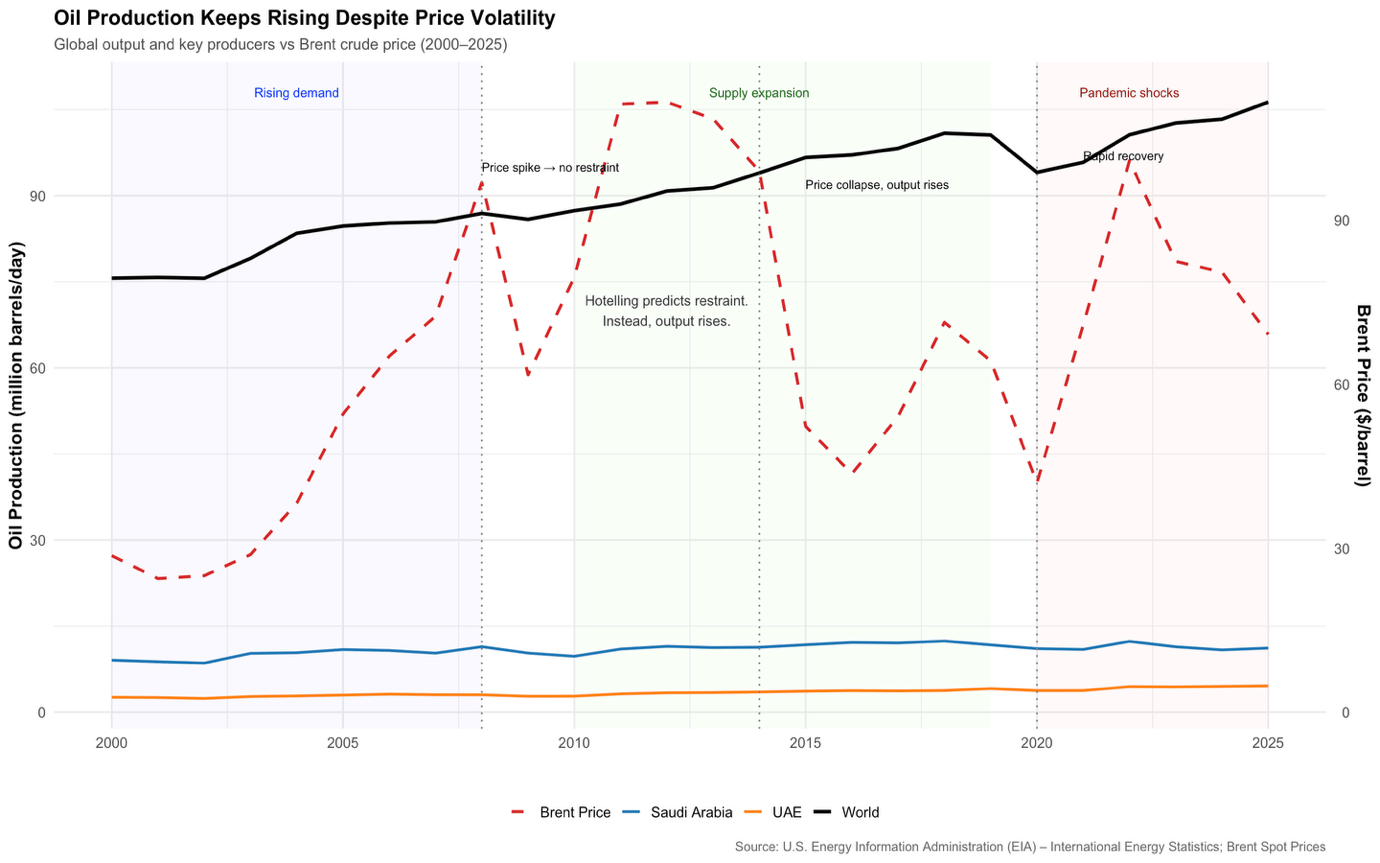
This pattern presents a challenge to Hotelling’s rule. In the presence of price volatility, producers are expected to decelerate production and await more favourable conditions. However, they have persisted in expanding output. This shift is rooted in demand dynamics. The proliferation of electric vehicles, the decreasing cost of renewable energy, and the tightening of governmental climate policies are notable factors. While oil demand persists, its long-term trajectory has become uncertain.
The current risk is not an increase in oil’s value, but rather the cessation of its value appreciation. Once this risk materialises, the incentive to delay extraction diminishes. Retaining oil reserves underground is no longer a safe strategy if future prices are expected to be disappointing. Selling sooner becomes the more rational decision.
Also Read: India’s east coast handles a higher volume. But the west coast has better economic outcome
From conservation to competition
The evolving expectations within the oil industry are significantly influencing behavioural patterns. Oil producers, particularly those within the Organization of the Petroleum Exporting Countries (OPEC), have historically exercised restraint by limiting supply to maintain price stability, operating under the assumption that future benefits justified such patience. However, the UAE is adopting a divergent approach.
Despite the UAE investing approximately $150 billion to enhance production capacity, OPEC quotas have constrained production levels, creating a clear tension: why invest in capacity that remains underutilised? The strategy is to capitalise on this capacity immediately, prioritising output and market share over stringent supply discipline. This approach signifies not merely an internal disagreement within OPEC, but rather a different economic rationale. This rationale is further bolstered by domestic economic conditions, as the UAE can sustain its budget with oil prices below $50 per barrel, a threshold considerably lower than that of some of its counterparts. This financial flexibility allows the UAE to focus on increasing sales volume rather than awaiting higher prices.
At the same time, competitive dynamics reinforce this strategy. If one producer escalates output, others risk diminishing market share by holding back. As a result, what may originate as a unilateral decision can swiftly evolve into a broader industry trend.
A new logic of extraction
Collectively, these developments form a clear and coherent sequence:
- The demand forecast becomes uncertain
- This uncertainty suggests a trend toward stable or declining prices rather than an increase
- Investments in capacity exert pressure to enhance production
- Competitive dynamics compel others to emulate these actions
As a result, there is a strategic shift from conserving oil to expediting its monetisation. This approach transcends short-term opportunism, representing a rational adaptation to a world characterised by increased unpredictability.
The UAE’s comprehensive strategy further substantiates this rationale. The nation is making substantial investments to diversify its economy, encompassing sectors from finance to clean energy. Oil revenues are being strategically allocated to facilitate this transition. Within this context, oil is not merely an asset to be preserved; it is a resource to be transformed into alternative forms of wealth while it retains its value.
Also Read: Japan is doing everything ‘wrong’ with its economy. And it’s working
What this means for the world
The implications of this shift extend beyond the UAE. Should more producers adopt this strategy, global oil supply could remain elevated even as the growth in demand decelerates. This scenario would exert downward pressure on prices and complicate efforts by organisations such as OPEC to regulate the market through coordinated cuts.
Furthermore, the UAE’s decision alters the conceptualisation of oil’s future trajectory. Rather than experiencing a gradual decline dictated by scarcity, there may be a phase of heightened production followed by more abrupt adjustments. As a result, the timing of extraction becomes as critical as the volume extracted.
In this context, the actions of the UAE represent more than a national strategy; they signify a broader transformation in the functioning of oil markets. Hotelling’s rule was predicated on a paradigm where time increased value and patience was rewarded. For much of the previous century, that paradigm prevailed. However, its certainty is now considerably diminished.
The prevailing risk is not that oil will become scarce, but rather that its centrality to the global economy might diminish. In such a scenario, deferring production is no longer the safest strategy. The UAE has astutely recognised this transition. By opting to increase production now, it is not abandoning economic logic; it is adapting to a new one. This may represent the most definitive indication to date that Hotelling’s rule, despite its theoretical elegance, no longer exerts influence over the practical dynamics of the oil industry.
Bidisha Bhattacharya is Consulting Editor (Economy) at ThePrint. She tweets @Bidishabh. Views are personal.
(Edited by Prasanna Jayraj Bachchhav)