



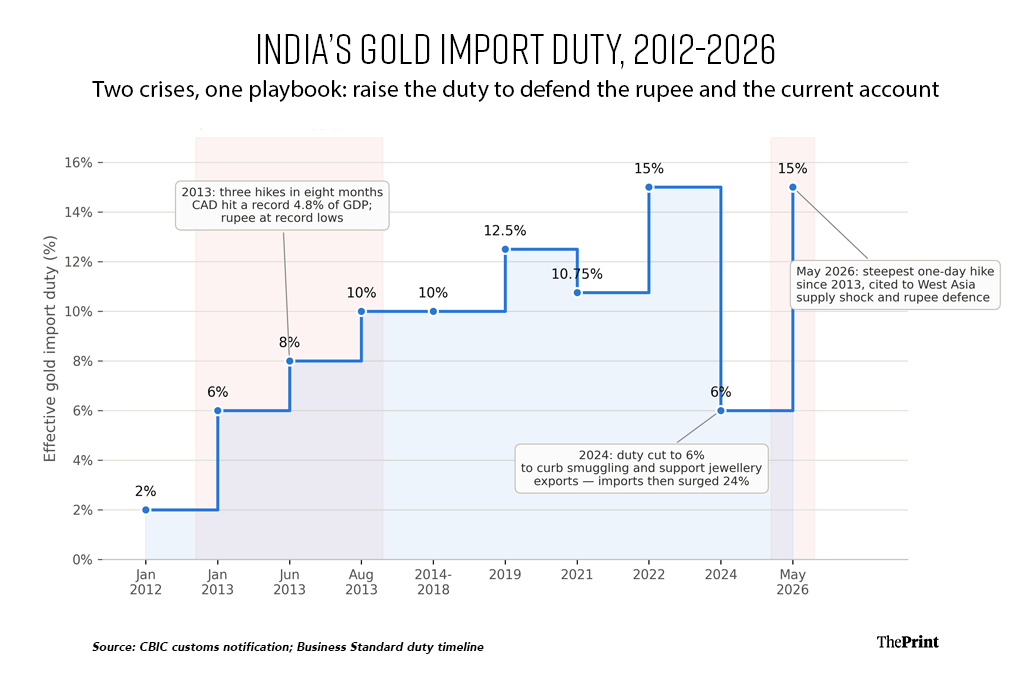
Since 2012, India has adjusted its gold import duty on eight occasions. Each modification was presented as a justified decision at the time. This pattern is the real story in the recent headlines concerning record gold prices and the introduction of a new 15 per cent duty.
The focus is not merely the high cost of gold, which is widely recognised, but rather on India’s fluctuating policy regarding this culturally significant import. The policy has oscillated between rates of 2 per cent, 10 per cent, 6 per cent, and 15 per cent, with each adjustment announced with confidence and subsequently reversed within a few years.
A playbook India keeps rewriting
The configuration of the duty line reveals a discernible pattern. In 2013, three rate hikes occurred within eight months, coinciding with a record current account deficit of 4.8 per cent of GDP and a significant depreciation of the rupee.
Similarly, the rate hike in May 2026, the most substantial single increase since that crisis, occurred under comparable conditions: a depreciating rupee and an expanding trade deficit. This time attributed to an oil shock in West Asia rather than domestic credit expansion. Nobel laureate Douglass North emphasised the importance of institutions in determining economic success or failure, as they establish the transaction costs of conducting business and the reliability of rules.
For stakeholders such as jewellers, bullion importers, or households purchasing gold for weddings, planning is hindered by a duty rate that has fluctuated between 2 per cent, 6 per cent, 8 per cent, 10 per cent, 12.5 per cent, 10.75 per cent, 15 per cent, 6 per cent, and 15 per cent over 14 years. This volatility acts as a tax, not paid to the government but to the uncertainty it creates.
The reduction to 6 per cent in 2024 exemplifies this issue. It was presented as a measure to support the jewellery export industry and curb smuggling. However, it also precipitated a 24 per cent surge in imports, resulting in a record expenditure of $ 71.98 billion in 2025-26, precisely what the May hike aimed to alleviate. India did not face a novel problem this year; rather, it revisited a previously resolved issue that had been inadvertently reintroduced.
The pattern is also evident in the black market. Official data presented in Parliament this July indicated that gold seizures by customs nearly doubled in the six weeks following the May increase. Industry estimates now suggest that illegal gold flows could exceed 100 tonnes this year, reversing the significant decline observed after the 2024 reduction. Each instance of India increasing the duty on legal gold enhances the incentive for smuggling.
Buying for less, spending more
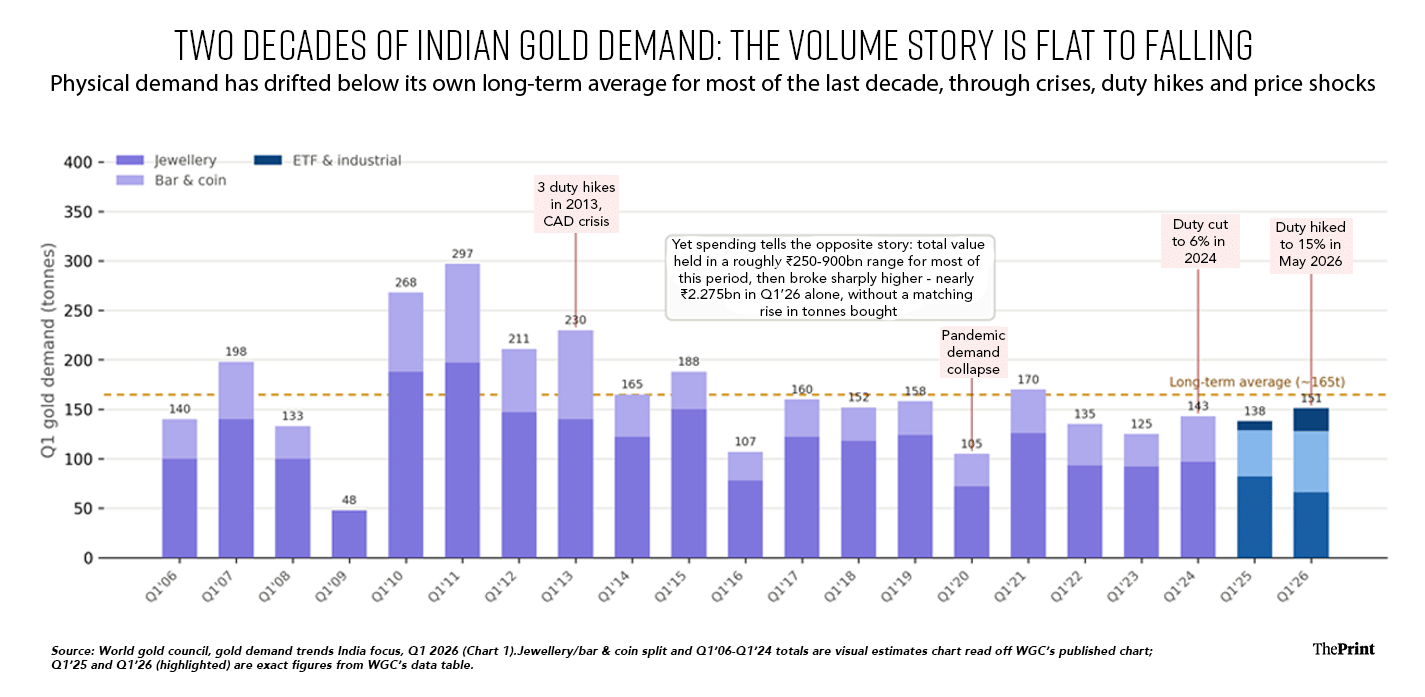
The narrative becomes particularly compelling when considering that the fluctuations in duty are not occurring in isolation. An examination of two decades of first-quarter demand data reveals that the tonnage purchased has consistently fallen below its long-term average for most of the past ten years, encompassing the 2013 crisis, the pandemic-induced downturn, and subsequent years.
Despite this, the total expenditure remained within a modest range for much of this period before experiencing a significant increase, reaching nearly Rs 2,275 billion in the first quarter of this year alone. Without a corresponding rise in the quantity of metal purchased.
This behaviour is not irrational; rather, it reflects the demand curve’s expected response when prices increase more rapidly than income. Households purchase less gold by weight while spending more on it, indicative of an affordability constraint rather than an increased desire for gold. The policy challenge arises from the dual role of gold in India, serving as a consumption good and as a savings instrument for households with limited access to formal financial systems.
Each adjustment in duty affects not only the retail price but also the return on the one asset that a significant portion of Indian households trusts.
The pattern is also evident in the black market. Official data presented in Parliament this July indicated that gold seizures by customs nearly doubled in the six weeks following the May increase. Industry estimates now suggest that illegal gold flows could exceed 100 tonnes this year, reversing the significant decline observed after the 2024 reduction. Each instance of India increasing the duty on legal gold enhances the incentive for smuggling.
Buying for less, spending more
The narrative becomes particularly compelling when considering that the fluctuations in duty are not occurring in isolation. An examination of two decades of first-quarter demand data reveals that the tonnage purchased has consistently fallen below its long-term average for most of the past ten years, encompassing the 2013 crisis, the pandemic-induced downturn, and subsequent years.
Despite this, the total expenditure remained within a modest range for much of this period before experiencing a significant increase, reaching nearly Rs 2,275 billion in the first quarter of this year alone. Without a corresponding rise in the quantity of metal purchased.
This behaviour is not irrational; rather, it reflects the demand curve’s expected response when prices increase more rapidly than income. Households purchase less gold by weight while spending more on it, indicative of an affordability constraint rather than an increased desire for gold. The policy challenge arises from the dual role of gold in India, serving as a consumption good and as a savings instrument for households with limited access to formal financial systems.
Each adjustment in duty affects not only the retail price but also the return on the one asset that a significant portion of Indian households trusts.
Also read: Karnataka is holding the downstream states to ransom: Jayalalithaa
Reading today against 2013, correctly
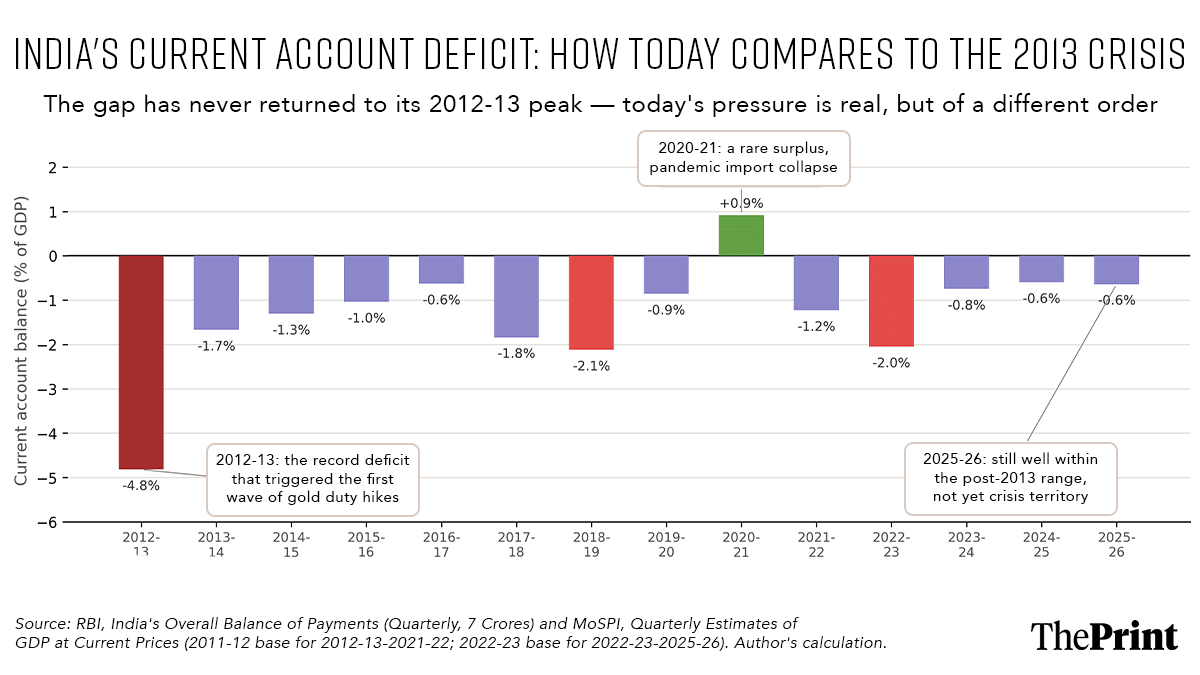
India’s current account deficit has not approached the peak levels observed in 2012-13 over the past 13 years. During the pandemic, the account experienced a rare surplus and has generally remained within a modest range throughout the decade, currently not indicating a crisis. Although there is genuine pressure on the rupee and the trade account this year, it is not comparable in magnitude to the situation that initially led to gold duty hikes.
Treating every fluctuation of the rupee as a recurrence of the 2013 scenario risks inducing the same type of overcorrection that resulted in the 2024-2026 volatility.
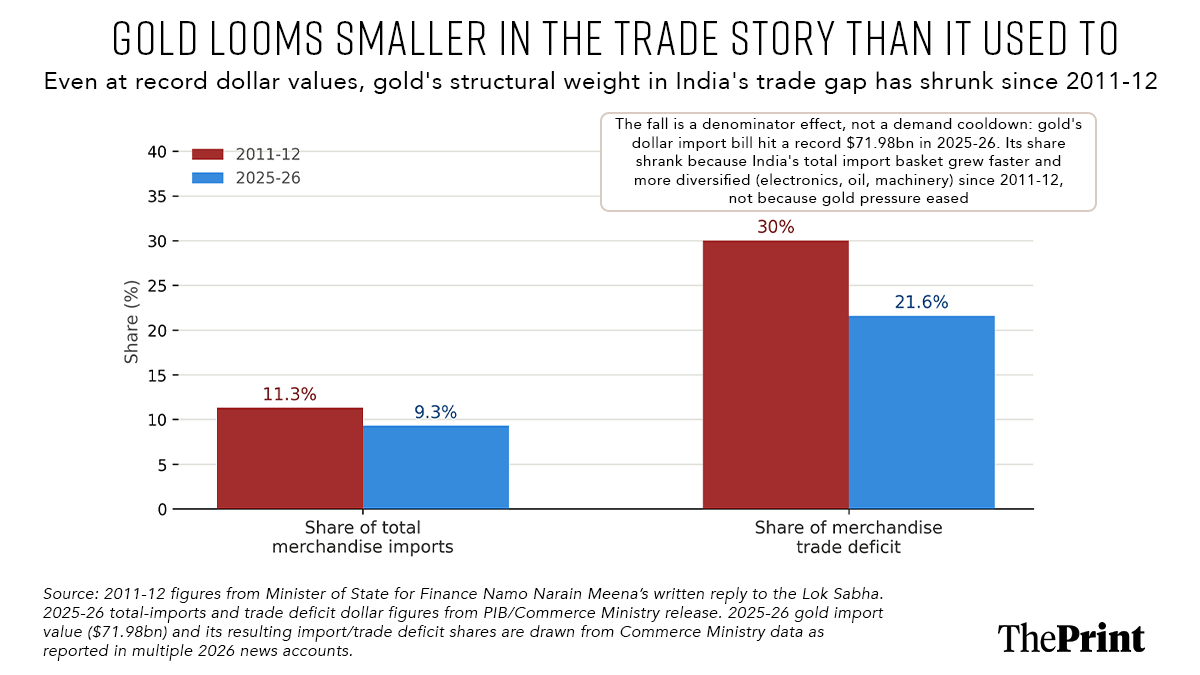
The correction becomes more pronounced when examining the actual structural weight of gold. In the fiscal year 2011-12, gold constituted 30 per cent of India’s merchandise trade deficit and 11.3 per cent of total imports.
Currently, despite a record dollar import bill, gold’s contribution to the trade deficit has decreased to approximately 21.6 per cent, and its share of total imports has reduced to about 9 per cent. This change is attributable to a denominator effect rather than an indication that gold has become insignificant. India’s import basket has expanded and diversified, now encompassing electronics, oil, and machinery, unlike in 2012.
Thus, gold represents a smaller component of a larger and more complex economic landscape than is often suggested by headlines.
In a previous column concerning the rupee, I argued that India had subtly transitioned from relying on patient capital to depending on volatile, sentiment-driven financial flows, with this transition itself posing a significant vulnerability.
Gold policy reflects a similar issue. The implementation of eight duty changes over 14 years does not constitute a coherent policy; rather, it resembles a random decision-making process with formal documentation. Until India ceases to equate rapid action with strategic planning, future headlines about a “record” gold price will merely echo the current one, albeit with a different date.
Bidisha Bhattacharya is ThePrint Consulting Editor (Economics) and an Associate Fellow, Chintan Research Foundation. She tweets @Bidishabh. Views are personal.
(Edited by Ratan Priya)
It is the government’s policy of gold control that gave birth to smuggling. The swashbuckling heroes who brought in dhow loads of it at $ 35 per ounce. The subject matter of so many Hindi films.