






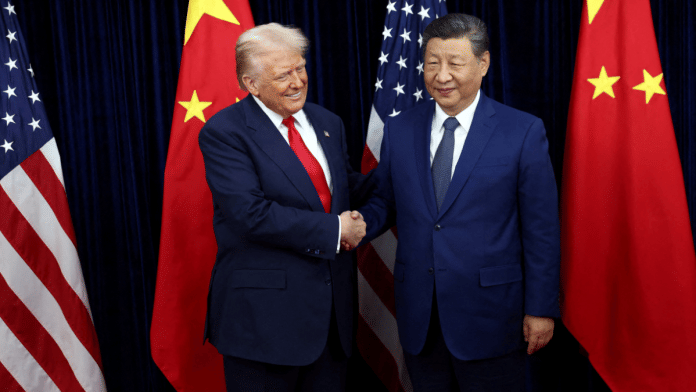


Few presidential visits to China have been as laden with expectations and uncertainty as the one Donald Trump is undertaking in Beijing on 14 and 15 May. Trump and Xi Jinping last met in October 2025 in Busan, South Korea, on the sidelines of the Asia-Pacific Economic Cooperation Summit. That meeting, which both sides presented as a success, only brought time for each of them.
For Trump, it was about trying to build an autonomous production chain for rare earth elements and other critical minerals, sectors now almost entirely controlled by China. If that chain were to be disrupted, it could paralyse entire segments of the American economy, including its military capabilities.
In return, Xi obtained something very concrete: the partial lifting of export controls on high-performance AI processors, which China needs to expand its computing capacity and avoid falling behind in the race for domination in artificial intelligence.
At the time, the two leaders reached not a strategic agreement, but a tactical one that postponed their problems without resolving them. Additionally, the most consequential issue—the future of Taiwan—was put on hold, but with some good news for China: the next APEC summit would be held in Beijing, and soon.
China’s focus remains on Taiwan
Although the upcoming Trump-Xi meeting has faced moments of uncertainty, beginning with a one-month delay announced by the US president after the US-Israel military attack on Iran, all indications show that the Chinese government is eagerly anticipating it. The Chinese have made it very clear that Taiwan will be the main topic of discussion this time.
Beijing has turned the visit into an opportunity it does not intend to waste, and for good reason. From the perspective of the Communist Party, the Chinese capital is the natural setting to address what it considers an internal, inalienable, and indisputable matter: reunification with Taiwan.
The international context also works in Beijing’s favour. Trump’s adventures—and sometimes misadventures—in other arenas, especially in Iran, have crossed enough redlines for China to note down for future use, if needed.
For now, China has opted for a calculated containment strategy based on tough rhetoric and public rejection of US hegemony, without crossing the red lines that Washington has drawn, particularly regarding arms supplies to Iran.
If anyone wonders why China hasn’t taken advantage of the US entanglement in the Strait of Hormuz to exert more pressure in the Indo-Pacific, the answer lies precisely in Taiwan. Beijing is saving its ammunition for a larger negotiation and now hopes negotiations will follow.
The signs came before Air Force One even took off for Busan. Last September, the White House rejected a $400 million military aid package for Taiwan. Three months later, Washington announced its largest arms sale to the island: an $11 billion weapons package.
While the deal was notified to Congress, its implementation remains shrouded in uncertainty as the Trump-Xi Beijing summit approaches. In February, Trump publicly acknowledged having consulted with Xi about arms sales to Taiwan, deciding to wait until after the summit to proceed. Doubts about how much of that arsenal will ultimately reach the island have multiplied since then.
Also read: Trump-Xi summit reveals a rivalry too deep to decouple, too tense to cooperate
A weakened Trump needs a win
Trump arrives in Beijing in an extraordinarily weak negotiating position for a president who has made strength his trademark. He is mired in judgements surrounding the Iran war, a conflict where he doesn’t have the support of his European allies. The US economy is suffering the repercussions of the tariffs he imposed, which were later blocked by the Supreme Court.
Trump needs a deal he can sell as a victory at home, especially before the November midterm elections. Xi, who neither faces elections nor free press, can afford to wait. And in diplomacy, waiting is power.
What’s at stake goes far beyond the press releases that will emerge from this summit. The Taiwan Strait isn’t an abstract problem: it’s the artery through which flows the most critical resource of the latest technological revolution, AI.
Taiwan Semiconductor Manufacturing Company (TSMC) produces more than 90 per cent of the world’s advanced semiconductors, those that power AI data centres, next-generation weapons systems, and the digital infrastructure of Western democracies. A crisis in the strait, or even the credible threat, would have a comparable or even greater impact on the global economy than the closure of the Strait of Hormuz. Only, instead of oil, what would cease to flow are the chips that drive the technological revolution of our time.
Trump arrives in Beijing with no cards on his side. Or, more precisely, he arrives having already played some of his best cards. What he negotiates in the coming days with Xi Jinping will determine not only the future of an island of 23 million people, but also the technological and military balance of power for decades to come.
Alicia García Herrero is Chief Economist for Asia Pacific and the Middle East at Natixis, and Senior Fellow at Bruegel. She tweets @Aligarciaherrer. Views are personal.
(Edited by Janaki Pande)