



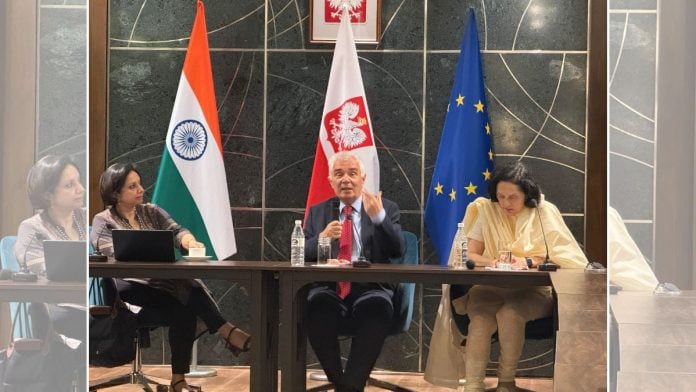
India is, in many ways, a bonus.
I retired from the Polish diplomatic service in 2022 at the age of 65, after almost four decades of diplomatic engagement. I could finally enjoy retirement without checking my calendar for the next diplomatic appointment. I could consider my career fulfilling, having served as Deputy Foreign Minister, EU and Polish Ambassador, a high-ranking official of European institutions. Then, in 2024, following the change of government, the new leadership of the Polish Ministry of Foreign Affairs offered me the opportunity to take up a new assignment in India.
I certainly did not expect it. To be perfectly honest, I did not initially understand what lay behind the offer.
India had never been part of my professional plans. I had never dreamed of being posted here, nor had I ever specifically prepared myself for a diplomatic career in the country. Yet it did not feel entirely foreign to me.
There was a rather simple reason for that.
About 50 years ago, when I met my wife, she was passionately studying Hindi. She spent six years learning the language, accumulated an impressive collection of books on India, and eventually wrote her dissertation on Indira Gandhi, the only woman to have served as the country’s prime minister. So, even though India was not part of my professional life, it was constantly present in my home. I absorbed it almost by osmosis.
I read some books about the country, partly because I wanted to understand what had captured my wife’s imagination so completely. At the time, I could hardly have imagined that this indirect acquaintance with India would eventually bring me here myself.
Now, having arrived, I can say that India has been a very pleasant surprise.
A nation that moves at remarkable speed
The India I encountered is, of course, changing rapidly. Its transformation over recent decades is extraordinary. It is a dynamic country, increasingly confident in its technological capabilities and achievements, and the physical face of everyday life has changed enormously.
You notice this transformation everywhere—in the modern airports and railway stations, shopping malls, the ease of digital services, and the scale and ambition of new infrastructure. Some of these developments would have been difficult to imagine even a few years ago.
Before coming here, I had one particular concern: the climate. I wondered how I would cope with the heat, especially during summer.
To my own surprise, I feel perfectly comfortable. I can even go jogging in Nehru Park when the temperature is around 40 degrees Celsius. I cannot say that my friends in Poland believe me when I tell them this. But there is something liberating about discovering that your body is capable of things you had previously ruled out.
The air quality in Delhi is, naturally, a challenge, particularly during winter. Improving air quality would make an already remarkable city even more attractive and would certainly contribute to the quality of life of everyone who lives and works here, including the many young diplomats who come to Delhi at the beginning of their careers. I hope that the considerable efforts being made at different levels will continue to bring results.
Also read: India cannot be summarised. After living here, I know why: Ecuadorian Ambassador
A varied food culture
One of my happiest personal discoveries in India has been the food.
In fact, India has helped me recover something I thought I had lost many years ago: my sense of taste. Indian cuisine has given it a second life. The extraordinary diversity of Indian food fascinates me. Every region seems to have its own vocabulary of flavours, spices, and traditions. You can travel a relatively short distance and suddenly discover that a familiar dish has acquired an entirely different personality.
The only problem is that Indian cuisine is so good that it creates another diplomatic challenge: controlling one’s weight.
The country is a paradise for vegetarians, and I am gradually becoming one myself. I have also developed a particular affection for paneer. Shahi paneer is among my favourites—although, as a diplomat, I should perhaps be careful about declaring favourites when there are so many regional cuisines waiting to be discovered.
The art of hospitality
Another wonderful discovery has been Indian hospitality.
Wherever I go, I am often treated with such warmth and attentiveness that I immediately find myself thinking about returning. India has developed extraordinarily high standards of hospitality and service.
I sometimes think that young people entering the hospitality industry in Europe could benefit enormously from spending time in India and observing how hospitality is practiced here. There is something sophisticated about the Indian ability to make a guest feel not merely served, but genuinely welcomed. You can’t learn this from a textbook; you have to experience it.
Indian roads and the art of staying calm
A European arriving in one of India’s major cities may initially find the driving style rather energetic. But what has impressed me most is what happens when something goes wrong.
Even when there is a minor collision or a difficult situation on the road, I am often struck by how little anger is displayed. You do not necessarily hear raised voices, dramatic complaints, or an exchange of insults. There is an extraordinary capacity to absorb the situation and simply continue.
Perhaps this is another form of Indian philosophy: accept the situation, negotiate your way through it, and move on.
Rediscovering what Poland and India have in common
On a more serious note, one of the things that surprised me most after arriving was how much Poland and India had, in a sense, disappeared from each other’s radar.
Fifty years ago, Poland was considerably more visible in India, and our economic cooperation was much more substantial than many people today realise. One of the things I discovered after arriving was the size of the knowledge gap that has emerged since then.
There are relatively few economic exchanges compared with the potential of our two countries. There are also surprisingly few people in India who speak Polish.
I find this difficult to reconcile with the cultural proximity between Poland and India.
Of course, we should be careful not to exaggerate linguistic connections: Polish and Sanskrit are not directly related in the modern sense, but both belong to the Indo-European language family, and their distant linguistic relationship produces some fascinating similarities. Poland also has a long and respected tradition of Sanskrit and Hindi studies.
The cultural connection is perhaps even more visible in literature.
Rabindranath Tagore has a particularly important place in this story. He is not only one of India’s greatest literary figures but also the first Asian Nobel laureate in Literature. His work has been translated and read in Poland, and his ideas have found admirers among Polish intellectuals and readers. The broader Indian literary tradition has also attracted Polish scholars and translators, from Sanskrit classics and Kalidasa to Kabir and other major voices of Indian poetry.
It’s beautiful that literature can create a bridge between countries long before diplomats arrive to build one.
Also read: Andes to Amazon—here’s how Indian travellers can experience Ecuador: Ecuadorian Ambassador
Cinema connection
I believe that one of the best ways to rediscover this cultural proximity is through cinema.
India is one of the world’s great movie-going countries, and cinema is deeply embedded in everyday life here. It gives us an opportunity to introduce Poland not through diplomatic language, but through stories, emotions, humour, and human experience.
To my pleasant surprise, Polish cinema is better known in India than one might expect.
The name of Andrzej Wajda certainly resonates with Indian audiences, and films such as Ashes and Diamonds (1958), The Promised Land (1975), and Man of Marble (1977) continue to demonstrate the strength of Polish cinema. Wajda’s films are now being presented to new Indian audiences through retrospectives and film festivals. We would like to show more Polish films in India and, equally importantly, encourage Indian filmmakers to look at Poland not simply as a filming location but as a potential creative and production partner.
Interestingly, Indian cinema has also discovered Poland as a filming destination. Films such as Kick (2014) and Fitoor (2016) have used Polish cities and landscapes as cinematic backdrops. Now, we are particularly looking forward to the release of King, starring Shah Rukh Khan, parts of which were filmed in Poland. The Polish locations will, I hope, give millions of Indian viewers a slightly different cinematic view of my country.
Theatre ties
Poland’s great theatre innovator Jerzy Grotowski had a profound interest in Indian traditions. His work was influenced by his encounters with Indian philosophy and performance traditions. Kathakali, along with yoga and other Asian performance practices, became part of the wider exploration that shaped his ideas about the actor’s body and training. Grotowski travelled to India several times, while his collaborator Eugenio Barba also studied Kathakali in Kerala.
This is precisely the kind of connection that I find fascinating.
It is not simply a story of one culture borrowing from another. It is a story of artists travelling, observing, learning, and transforming what they encounter into something new.
My ambition is to rediscover more of these forgotten or less visible connections between Poland and India, from literature and languages to cinema, theatre, music, and the performing arts.
Cultural proximity to economic opportunity
Poland has recently crossed a historic milestone, officially becoming a $1 trillion economy. We are now the 20th largest economy in the world, and the fifth-largest in the European Union. In fact, if you look back at economic history over the last 30 years, only one country has grown faster than Poland: China. Today, Poland is a booming global hub for advanced technologies, and our companies are successfully investing across the globe.
Despite our strong outward investment base—which currently exceeds $40 billion—Poland’s investment footprint in India remains far too limited. We are currently only the 35th largest investor in India, with a cumulative FDI of under $750 million over the last 25 years. This is simply not enough. Our mission today is to leverage the powerful momentum of the India-EU Free Trade Agreement and the recent high-level bilateral engagements between our nations to radically scale up our economic ties.
The next stage should be about moving beyond simply increasing the volume of trade and developing deeper partnerships—in technology, advanced manufacturing, infrastructure, space, energy, defence industries, and other areas where both countries have strong capabilities.
The upgrading of Poland-India relations to a Strategic Partnership in 2024 gives us a strong political framework for doing precisely that. The challenge now is to fill that framework with more business connections, investment, and people-to-people contact.
Also read: India is a civilisational continent. Can never say I’ve seen it all: Lithuanian Ambassador
Much more than an assignment
My time in India is an adventure that I feel has only just begun. There are still so many places I have not seen, journeys I have not made, people I have not met, and stories I have not discovered. I look forward to exploring more of India.
At the same time, I hope to contribute to making the relationship between Poland and India stronger, more visible, and more ambitious. There is enormous potential waiting to be explored, and I would be very happy if, by the end of my time here, I could say that we have opened some new doors and perhaps discovered a few unexpected ones along the way.
Piotr Antoni Świtalski is the Ambassador of Poland to India. Views are personal.
This article is part of a series on the life, travels, and adventures of serving diplomats in New Delhi.
(Edited by Prasanna Bachchhav)