




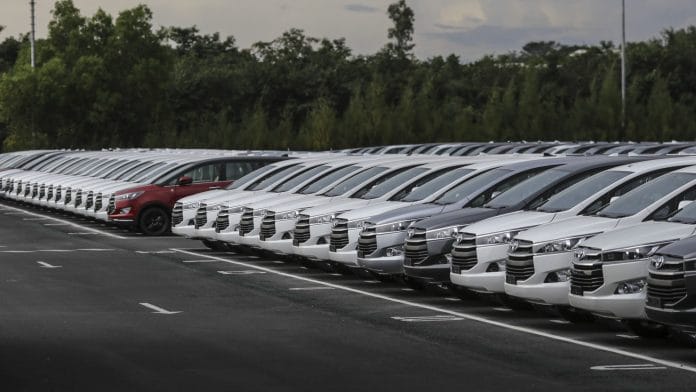

“We don’t like to experiment on customers”. This is what Maruti Suzuki’s Partho Banerjee told me at the launch of the face-lifted Baleno. Thousands of production Balenos are parked at the manufacturer’s yards and will soon be delivered once the final certification is done. “My sales head and dealers are screaming for more cars, but I don’t want to send products until all clearances are done,” said Banerjee, Senior Executive Officer (Marketing & Sales) at Maruti Suzuki India.
This was in context of the fact that Maruti Suzuki has a huge waiting period for vehicles as it heads into the festive season. While Banerjee didn’t give estimates, the manufacturer’s pending bookings are believed to have reached around 1.8 lakh. That is half the annual production of a single average automotive production line.
“Take the Brezza, we have over 60,000 bookings but production and sales are only around 15,000 units every month,” he said, mentioning that while the demand might seem great, dealers are having to turn away customers. “A problem of plenty is a problem after all. I don’t want to lose customers.”
He need not worry, the Indian automotive market is on a tear unlike any other. The post-Covid sales jump shows no sign of slowing down. The passenger vehicle sales in August were a shade under 4.5 lakh units. But Banerjee believes that number could touch over 5.5 lakh units if Maruti Suzuki and certain other manufacturers enhance their capacity. “Things should ease up for us by early 2027,” he said, pointing to the fact that the company’s Hansalpur plant in Gujarat touched an installed capacity of over a million, the first single site in India to achieve this feat.
Will the growth sustain?
It is not just Maruti Suzuki that is facing a problem of plenty. Kia India Managing Director and CEO Gwanggu Lee told me at the launch of the new Sorento that while Kia had enough capacity for now, with monthly sales crossing 30,000 units, the Korean carmaker was starting the process of adding capacity within the next few years.
Can such outstanding growth, over ten per cent year-on-year in August, carry on? Shailesh Chandra, MD and CEO of Tata Motors, which was the fastest growing carmaker in August with year-on-year growth in domestic passenger vehicle dispatches climbing an exceptional 59 per cent, did point out that the ‘base effect’ will kick in soon. “Car sales really began to shoot upwards after the GST 2.0 norms kicked in around October last year. So growth numbers will start moderating because of the base effect,” Chandra said at the annual conference of the Society of Indian Automobile Manufacturers (SIAM).
“But full-year sales will be way in excess of five million”.
Also read: New Volvo EX90 feels and looks Chinese. That’s what makes it so good
The capacity problem
And it isn’t just passenger vehicles that are booming, the big opportunity, as Union Road Transport and Highways Minister Nitin Gadkari mentioned at the SIAM conference, is in buses. Anyone who drives through the Indian urban morass knows that public transit buses are few and far between. India has less than two buses per thousand people and needs closer to eight. And not petrol and diesel buses, but electric ones, according to the minister.
But again, capacity is a problem. The country needs to produce 1,50,000 electric buses per annum but can currently make just 70,000. While Gadkari urged manufacturers to ramp up production, new manufacturers like Pune-based EKA Mobility are stepping up to the task.
Sudhir Mehta, Founder and Chairman of the EV manufacturer, told me that the company will soon be introducing 18-metre articulated electric buses in India.
“There are requirements for all sorts of electric buses over the next few years, from nine-metre last-mile connectors to these articulated buses. And also long-distance buses. But the challenges will not be around building these buses but charging them, and that is where battery and charging innovation will come,” said Mehta.
Two-wheelers and tractors are booming as well, and that does address many of the concerns around GDP growth. This is because, according to SIAM, 47 per cent of India’s manufacturing GDP comes from the automotive industry. Now capacity is being added, and with India having a penetration of just 24 cars per thousand population, even getting to 50 cars per thousand will mean continued growth for the next decade.
But as you might have seen in my video tour of Mahindra’s EV plant at Chakan near Pune, the massive increase in demand for cars, buses, and two-wheelers isn’t leading to a commensurate increase in jobs. Most automotive factories today are examples of extreme automation — with welding robots to little cat-like robots hauling equipment around. Incidentally, automation isn’t about saving money anymore, it’s also about safety, especially in construction.
Kushan Mitra is an automotive journalist based in New Delhi. He tweets @kushanmitra. Views are personal.