



Back in February 2006, then-finance minister P Chidambaram introduced a rule that was to have a seismic impact on the Indian automotive industry. This was the ‘sub-four-metre’ rule, which meant that vehicles below four metres in length and with engines below a specified capacity attracted a lower rate of excise duty.
While India has progressed from the days of excise duty to the Goods and Services Tax (GST) regime, the rules remain largely the same. Cars below four metres in length and with engine capacities below specified limits — 1,200cc for petrol/CNG vehicles and 1,500cc for diesel vehicles — attract just 18 per cent GST, compared to 40 per cent for larger vehicles. Things were far more complicated before last year’s GST reforms.
I do not want to comment on the rights and wrongs of this rule, which has now been in place for two decades. It has led to some truly unique products for India, such as the truncated compact sedan and the subcompact SUV. Many of them, such as the Dzire, Brezza and Venue, have been pretty solid performers in the market.
But there is something about the rule that has always perturbed me: the design of these vehicles. While they have improved to an extent over the past two decades as designers have got the hang of working within the restrictions, they still look wrong, as though a butcher has taken a meat cleaver to the back end of the vehicle. They lack the proportionality that, as humans, we are hardwired to recognise as a defining element of good looks.
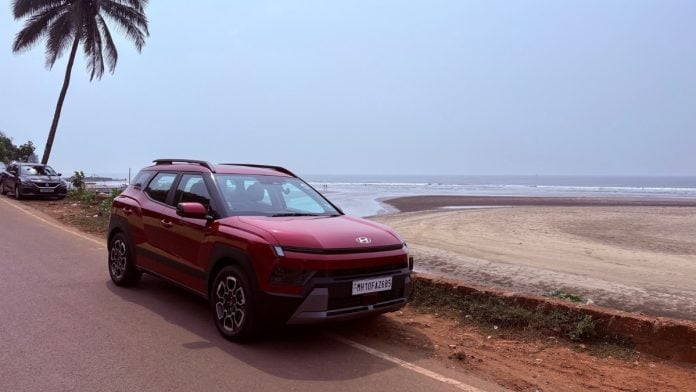
And this brings me to the new Hyundai Bayon. It isn’t a sub-four-metre vehicle. It is, in fact, 4.25 metres long. And you know what? Twenty-five centimetres isn’t much, but it makes a world of difference to the vehicle’s proportions. The Bayon just looks right. It is positively attractive. I would go as far as to call it the best-looking Hyundai SUV since the original Creta.
It has absorbed modern design elements such as LED daytime running lights and taillights, low-mounted headlights and aggressive, flared wheel arches. But they all come together well. Honestly, if Hyundai added some colour accents, as it does on its N Line vehicles, or made the wheel arches body-coloured, the Bayon could look even better.
Also read: Forget diesel, think hybrid: Renault’s new Duster makes a strong case for fuel economy
What’s beyond the looks?
But, of course, looks really don’t matter beyond a point and are rarely the primary factor driving sales. Hyundai itself should know this. The company was propelled to great heights by the original Santro, which was, to put it politely, unconventional. So, how does the Bayon drive?
First things first: it has just one engine option, Hyundai’s trusted 1.5-litre naturally aspirated petrol engine, which produces 115 PS. It is available with both a manual gearbox and what Hyundai describes as an Intelligent Variable Transmission (IVT). I drove the manual around Goa, on a mix of high-speed roads, urban streets and North Goa’s notorious rural roads, and found it pretty enjoyable.
Not fun, per se, but enjoyable, even though I was driving a manual after a gap of a few months. Push the car and it can go fast, while it feels perfectly balanced through high-speed turns. My only major issue was that the steering intervention from the Lane Keep Assist (LKA) system is quite aggressive by default. That’s useful on expressways, but less so on Goa’s new cable-stayed bridges, where tourists in rental cars drive willy-nilly.
I did not have fuel efficiency at the top of my mind, and I would need a longer-term test to assess it properly. However, I achieved around 14 km per litre over roughly 175 kms.
This engine option also helps keep the Bayon affordable, with prices ranging from Rs 10 lakh to Rs 18 lakh. The top-spec HX10 manual that I drove was priced at Rs 16.65 lakh (ex-showroom). Adding a diesel engine, particularly with the new BS7 emission norms coming into play, would significantly increase the price. Demand for turbo-petrol engines has also been limited, according to Hyundai executives, although one could arrive in a future N Line edition. Interestingly, the higher-spec versions of the Hyundai Venue, whose prices come close to those of the Bayon, do not currently offer this engine option.
Also read: The Kia Syros EV is the electric car for people who’ve been waiting to buy one
Extra 25 cm, Perplexity AI
Those extra few centimetres help the Bayon in more ways than just handling. Rear legroom and luggage space are obviously superior to what the Venue, which sits a rung below it, offers. That said, the Venue also gets diesel and turbo-petrol options under the bonnet. But this might make it seem as though the Bayon is trying to fill a very small gap. Twenty-five centimetres longer than the Venue and eight centimetres shorter than the Creta: that raises an obvious question. Why?
For one, the new Creta, which is expected in the middle of next year, will be considerably larger than the existing model, if the current Kia Seltos is any indication. This would put the Bayon almost equidistant between the two products. Hyundai is convinced, and I think rightly so, that there is a class of buyers who might not want something as large as the Creta is expected to become next year, but would like more space than the Venue offers, particularly in the rear seats. This could include young families or older buyers. Then again, I have learnt that no product really fits neatly into consumer silos.
But Hyundai has also packed in a lot of technology to appeal to younger buyers. This includes a few additional features in its Advanced Driver Assistance Systems (ADAS), which work best on high-speed expressways. But the standout feature is the integration of Perplexity AI, which Hyundai claims will allow you to have a conversation with your vehicle.
I did not try that feature, even though I subscribe to multiple AI agents, including Perplexity Pro, for a lot of day-to-day work. I have tried conversational AI in a car before. It was the Mercedes-Benz CLA. I found it quite weird to ‘converse’ with a machine. While I am sure Hyundai and other manufacturers will tie up with the likes of Google and ChatGPT, and possibly even Grok and Meta AI, in the coming years, it is not something I feel comfortable using. But just as I have become extremely used to ADAS today, perhaps I’ll bite the bullet soon enough — maybe when the panhandler at a traffic light no longer thinks I am utterly crazy.
On the whole, I like the Hyundai Bayon. It is a good-looking vehicle that ticks most boxes. Of course, there will be those who wonder why it has such limited engine options. But the average buyer isn’t looking for performance. They want a nice, normal, efficient and affordable vehicle.
Kushan Mitra is an automotive journalist based in New Delhi. He tweets @kushanmitra. Views are personal.
(Edited by Prashant Dixit)