




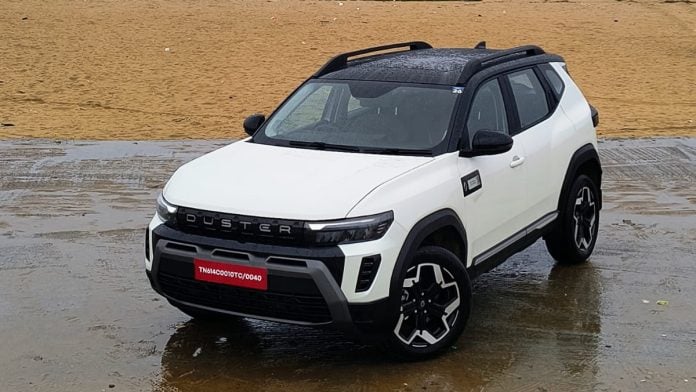

I found myself in Chennai last week for a media drive, and the messaging for this drive had a single message: “Forget Diesel, Think Hybrid”. It was everywhere, from our hotel key card covers to big, bold letters outside the halls at the ITC Grand Chola. It didn’t take a genius to guess what I was there to drive.
Which one?
Well, it was the Renault Duster E-Tech 160, as Renault calls it. We have all known it is coming ever since Renault relaunched the Duster in the same city a year ago with much fanfare. But the anticipation has not translated into sales. Almost certainly because this was announced at the launch, sales of the regular Duster have been, well, the nicest word I can use is ‘disappointing’.
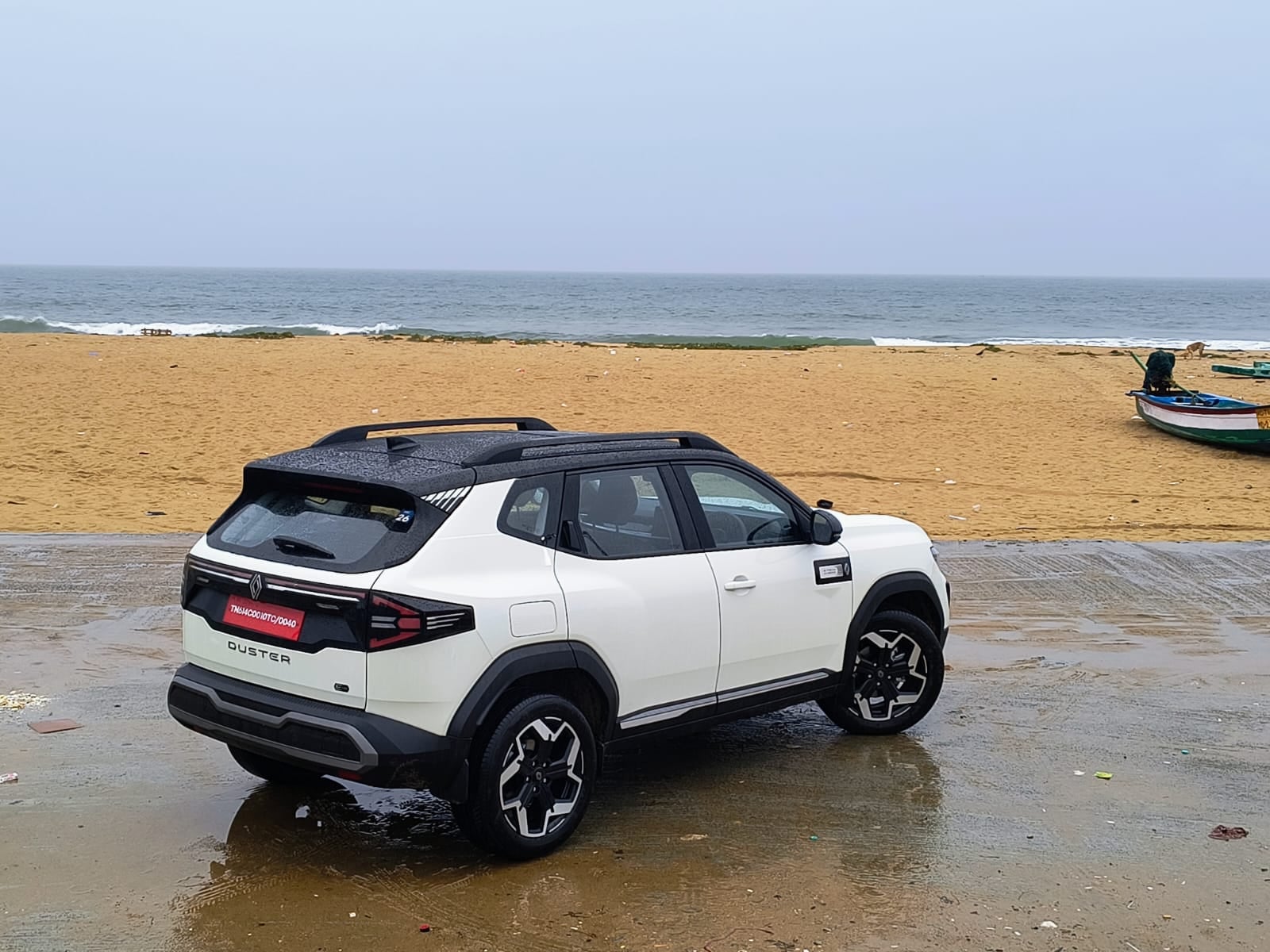
In September, Renault sold just 465 units of the Duster, an improvement on the 406 units sold in August. While the CSUV segment is certainly crowded, with 30 models vying for Indian car buyers’ wallets, the Kia Seltos offers a sense of the challenge facing Renault. It sold 12,569 units in September.
Francisco Hidalgo, Vice-President, Sales and Marketing, Renault India, admits that things haven’t gone to plan. He believes that the launch strategy was flawed, with too much emphasis on the 1.3-litre turbocharged petrol with the dual-clutch transmission. And as excellent as that vehicle is to drive, as I have written about earlier, it is not quite the variant that Indians seem to be wanting.
Having spent over a year in India now, Hidalgo has a clearer idea of the market. While there is a class of buyers who want the very top-specification, fully loaded vehicle, a larger number want fuel economy combined with ease of driving. And after Trump’s (mis)adventures in the Persian Gulf, fuel efficiency is more important than ever before. Renault’s rivals have gone down the CNG and electric route, and Hidalgo assures me that Renault will also follow that path. For now, however, he is betting on hybrids, particularly Renault’s own technology.
Sales of strong hybrids in India have been tepid. In the first half of the financial year, only 57,885 such vehicles were sold, with almost half of those being the Toyota Innova Hycross. That represented virtually no growth over the same period last year and just 2.2 per cent of overall passenger vehicle sales in that period. Electric vehicles, whose sales were more or less the same as hybrids this time last year, have seen their sales surge. They now account for more than twice the market share of hybrids, with EVs making up over six per cent of overall passenger vehicle sales in recent months.
Hidalgo believes this is because hybrids have been unexciting to drive. That, he says, is where Renault’s Dedicated Hybrid Transmission (DHT) comes in. It combines the power of the 1.8-litre naturally aspirated petrol engine and the 1.5-kilowatt-hour battery. The DHT has four speeds for the petrol engine and two for the electric motor, which can be combined to deliver eight possible operating configurations. “This is inspired by Formula 1 technology,” he tells me, adding that Renault India is taking a financial hit on the transmission. “It is expensive, but we feel that Indians should get the best hybrid experience, both power and fuel efficiency.”
So how was that experience?
The E-Tech 160 has, as the label says, 160PS of power and a certified fuel efficiency of 29 kilometres per litre. The latter makes it marginally more efficient than the Maruti-Suzuki Victoris Hybrid, giving it the highest certified fuel-efficiency figure among Indian passenger vehicles.
When you start it up, the vehicle initially moves around in EV mode, and it is very quiet.
When the engine does kick in as you set off, it does so without noticeable vibration or noise inside the cabin. With the windows down, the engine, which runs on the ‘Atkinson cycle’ — a slightly more efficient four-stroke combustion cycle — is a bit noisier than a standard petrol engine, but you barely hear it inside. In fact, like other hybrids, the Duster also has a graphic on the instrument cluster that displays how the vehicle is being powered at any point in time.
To get to the East Coast Road that heads down to Mahabalipuram, I had to travel through Chennai’s rather manic early-morning traffic. And in these start-stop, yet medium-speed conditions, where I was getting up towards 30 kilometres per hour before braking, the hybrid really shines. Because the battery is constantly recharging under braking, more often than not, you find yourself in EV mode. Also, the regenerative braking is subtle. There is no sudden slowing down when you lift off the accelerator, as happens with some other hybrids and particularly electric vehicles.
Once on the relatively open highway, the gearbox really began to shine. The power delivery feels natural and the transition between modes seamless. Put your foot down and this vehicle can definitely go fast. But if you just want to cruise at the speed limit of 90 kilometres per hour, it does that very well. With sufficient charge in the battery, it can even cruise at higher speeds in electric mode.
The single best part, though, was that Renault has achieved this without sacrificing the best aspect of the Duster: its handling. The Tamil Nadu Police had (not) helpfully placed enough barriers on the ECR, and when the Duster took the sharp left-right turn, it remained as balanced as I remembered the turbo-petrol version I drove a few months ago.
At the end of the drive, after covering over 160 kilometres in about four hours, the Duster returned an average fuel efficiency of 21.3 kilometres per litre. I do have a couple of caveats: I wasn’t driving with fuel economy as my priority, and I did drive a bit enthusiastically. If I get a chance to drive this in regular NCR driving conditions, I am sure I’ll manage at least 24-25 kilometres per litre.
And that is essentially the main selling point of the Duster E-Tech: strong fuel economy without giving up performance. The intense torque of a diesel engine might be missing, but the hybrid could offer running costs comparable to a CNG vehicle without the compromise on luggage space or performance. I certainly liked it.
That said, while the top-spec Duster Hybrid costs the same Rs 19.5 lakh ex-showroom as the turbo-petrol Dual-Clutch Transmission variant, it loses the Advanced Driver Assistance Systems (ADAS). Hidalgo did, however, say that Renault could consider offering the feature if customers demand it.
The Duster’s bigger problem
The hybrid powertrain could give the Duster a much-needed boost, but it cannot solve all the problems facing the model. Another reason the new Duster might not have been the success Renault India expected, especially given that the original was a runaway hit, is that the Duster does feel a bit cramped compared to the competition.
That matters in a market where buyers are increasingly looking for larger vehicles. The Kia Seltos and other rivals make the Duster’s space constraints harder to ignore.
With a three-row variant of the Duster coming next year, and the hybrid system expected to be available from launch, success could be a few months away.
Kushan Mitra is an automotive journalist based in New Delhi. He tweets @kushanmitra. Views are personal.
(Edited By Raunaq Lekhi)