


A few days ago, after 15 years of litigation, the Delhi High Court refused to disclose how many judgments it had delivered more than two months after ‘reserving’ them. The Court reasoned that it does not hold such data, and so cannot be made to produce it. We find it lamentable that even one of the most efficient and agile High Courts in the country cannot collate, clean and curate data-driven answers to questions about itself. In fact, the Court has little to hide. It usually delivers a reserved judgment in about a month, and delays beyond two months occur in less than 13 per cent of the final judgments it delivers. In a satirical spirit, we write this piece in the form of an RTI response.
To,
- The Central Information Commission, New Delhi.
- Shri PD Gupta who sought information on reserved and delayed judgments (and Others).
- The High Court of Delhi, New Delhi.
Sir/Madam,
Sub: Information on judgments reserved and pronounced after two months
Ref: Order of the High Court of Delhi dated 29.10.2026 in W.P.(C) 7340/2011 [PIO v. P.D. Gupta, 2026].
Please refer to the application cited. In this regard, it is informed as follows:
- In April 2009, a former judicial officer asked the Public Information Officer (PIO) of the Delhi High Court a simple question. His own writ petition had been argued in July 2007, and judgment was pronounced in May 2008. He wanted to know how many other cases heard by the same judge, sitting alone or on a Division Bench, had been delivered more than two months after arguments closed. The PIO replied that “no such data is specifically maintained and compiled.” The First Appellate Authority agreed. In May 2011 the Chief Information Commissioner reversed the decision and directed the PIO to dig out the monthly sealed-cover lists that Court Masters send the Chief Justice under the Anil Rai guidelines, limited to two years. The High Court challenged that direction, obtained a stay in October 2011, and on 29 October 2026, fifteen years later, had it set aside [PIO v. P.D. Gupta].
- The DHC’s reasoning relies on CBSE v. Aditya Bandopadhyay which clarifies that the RTI Act only applies to information that already exists; it does not oblige a public authority to “collect or collate” what it does not hold. Public interest in the timely delivery of judgments, the Court said, “arises only when the information exists.”
- The Court is mistaken. It has this information. It exists, albeit scattered, poorly maintained and unorganised. That the court is unaware speaks volumes on the poor state of the IT systems in place. This office, which holds no fiduciary capacity and no sealed covers, has therefore attempted the compilation itself.
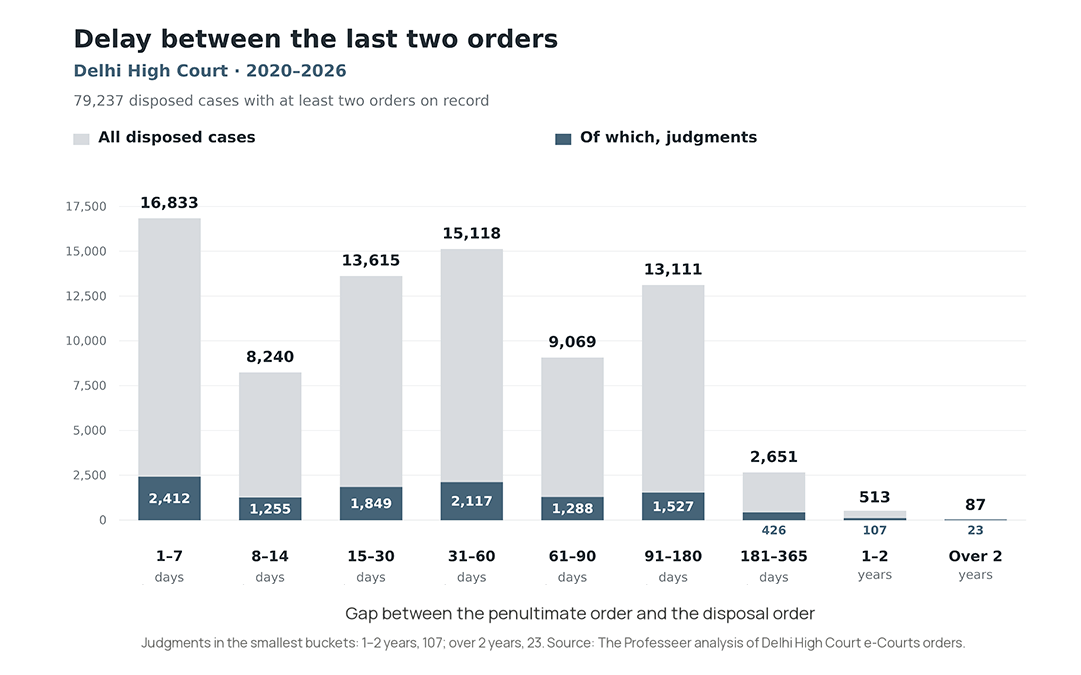
- We went through all cases of the Delhi High Court disposed of between 1 January 2020 and 30 June 2026 for which orders are available in public court records. Within these 130,000 plus cases about 10 per cent are explicitly marked as “Judgements”. Figure 1 below shows the delay between the penultimate order and the final order in these cases. About a third of disposed cases waited more than two months between their last two orders, and one in five waited more than three months. Judgments are spread across these buckets roughly in proportion.
- Not every long gap is a reserved judgment. Many are simply adjournments – a matter listed three months out, and disposed of on that date. We scouted specifically for cases where the penultimate order reads “Arguments heard. Judgment reserved” or a variant of it. This happens in about 43 per cent of the cases ending in judgements. Of these explicitly reserved judgments, 1,430 (30 per cent) were pronounced more than two months after reservation, which is largely the information Shri Gupta sought. The median wait was 34 days. See this visualisation in Figure 2.
Furthermore, disposed cases tell us how long the Court took for the cases lucky enough to get disposed of. Pending cases tell us how long litigants are still waiting. As on 30 June 2026, 182,763 cases with at least one order since January 2020 remained pending before the Delhi High Court. In 454 of them, the last available order records that “judgment is reserved”, “orders are reserved”, that “arguments stand concluded”, or some combination of these. The next order in such a case is likely to be the judgment that closes it. The time since reservation is also shown in Figure 2 below.
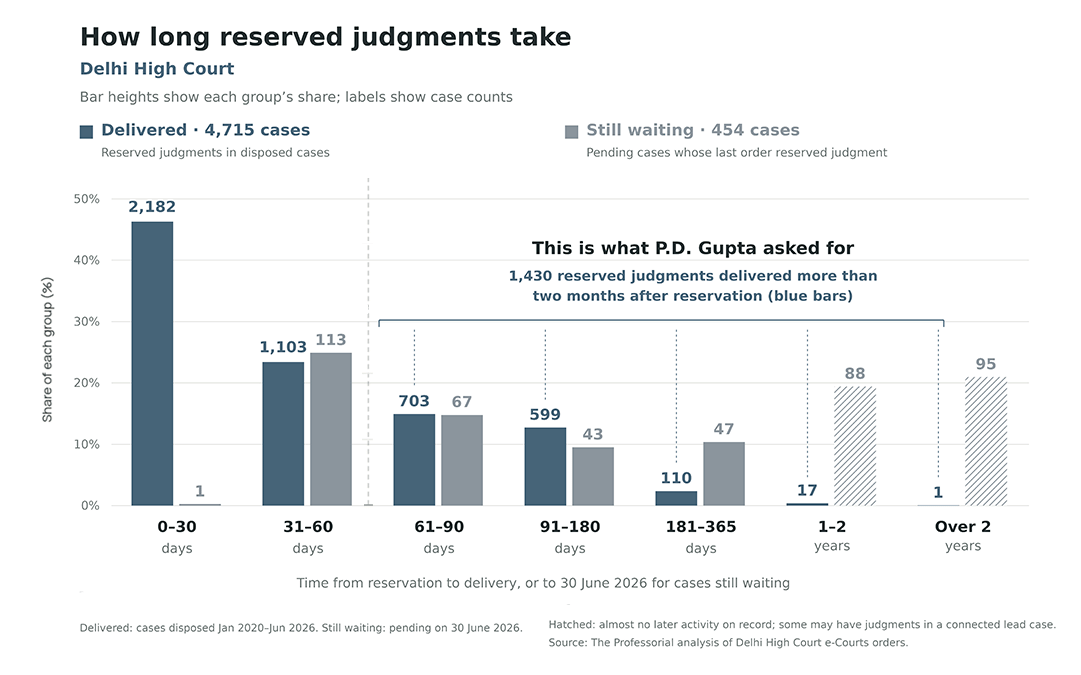
Of the 454, 340 had been waiting more than two months. Some of the cases reserved more than a year earlier might be judgments delivered in a connected lead matter and never linked back to the companion case; others may be genuinely stuck.
- These numbers are not alarmingly high. If anything, they are a minuscule component of the Court’s humongous caseload. Most reserved judgments in Delhi arrive within two months, and a court that disposes of judgments in a median of 34 days after reservation is not, prima facie, a sleeping court.
Court, know thyself?
It is not a mystery as to why the High Court does not have this information. The data systems used by the court clearly prevent its own principals from assembling a simple query that others can construct using public court data.
One can surely sympathise with the judge who passed this order. This is not the first time courts have had to take a shot in the dark for their own data.
In November 2025, while hearing Pila Pahan v. State of Jharkhand, the Supreme Court had to direct the Registrars General of every High Court to file affidavits listing the judgments reserved since January 2025, with their dates of pronouncement and upload. Those who had not complied were told to file within two weeks or appear in person. Its final judgment in May 2026 went further, requiring every High Court to show the date of reservation against each case on its website and to email its Chief Justice, every month, a list of judgments reserved and still pending.
In Periyammal v. Rajamani, the Court directed High Courts in March 2025 to gather data on execution petitions pending before their district courts. By October 2025 the Karnataka High Court had still not furnished it, and the Court had to send a fresh reminder and give its Registrar General two weeks to explain.
In Aman Kumar v. State of Bihar, when the Court asked High Courts in November 2025 whether charges were being framed on time under the BNSS, only a handful had responded. The amicus curiae confined his request to BNSS-era cases because going further back would be impossible.
Each instance tells the same story of a court system that is unable to organise, let alone grasp, the very data it produces every day. During the hearings in Pila Pahan, Justice Surya Kant had said such information “should be automated, available in public domain”. Five months after that judgment, the information continues to be “not held” by the Delhi High Court.
It is 2026. We have courts that have released official policies on artificial intelligence usage, but lack basic queryable data systems. One can only wonder in amazement how an organization as important as the High Court manages resource allocation in the absence of detailed information. It is a testament to their efforts that they have managed to navigate their considerable workload in the absence of good IT systems that enable them to analyse their own data.
Not lack of intent, just outdated software
The application of 2009 asked a question that took our courts over 15 years to answer, only to decline the information. We managed to assemble the data from TheProfesseer’s CourtsDataLab in a few hours.
It is lamentable that when the Delhi HC should be boasting about its efficiency, it will spend time fending off accusations of incompetence, or worse opacity. It is hard to explain to the average citizen that it is not lack of intent, merely outdated software that prevents our courts from being forthcoming with fairly straightforward information. We look forward to the day when a reply to an application like Shri Gupta’s needs neither a writ petition nor a column, only a link.
Yours faithfully,
Self-Appointed Public Interest Officers
Court of Public Opinion and Data Assimilation
Appeal, if any, may be preferred before the Court of Public Opinion at any time, without court fee, Form ‘D’ or sealed cover. Corrections to the data are welcome and will be furnished within considerably less than fifteen years.
For more details on the data and methodology please reach out to us at info@theprofesseer.com
Gokul Sunoj is a lawyer at TheProfesseer, Siddarth Raman is co-founder and CTO at The Professeer. Views are personal.
(Edited by Janaki Pande)