








The US attacks on Indian crew in international waters near the Gulf of Oman and the Strait of Hormuz triggered extensive discussion across Chinese state media and commentary platforms. On Weibo, the hashtag Indian oil tanker attacked by the US drew millions of views. Much of the discourse focused on India’s response, which Chinese commentators framed as a test of strategic autonomy and dependence on Washington.
A recurring theme in Chinese commentary is the contrast between the seriousness of the incident and India’s somewhat cautious response. One Weibo post noted: “The US neither apologised nor expressed regret, and Rubio remained tough, implying: break the blockade and you get beaten.”
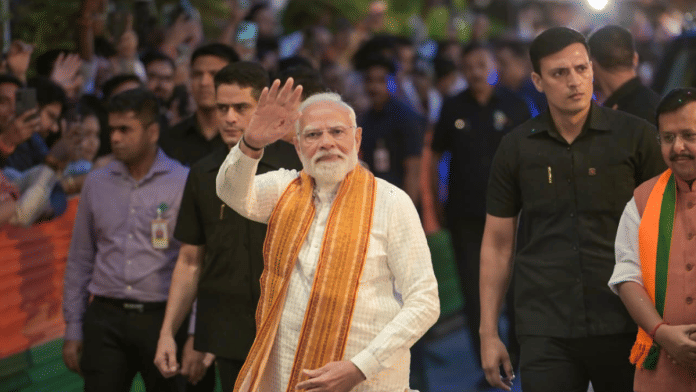
Others pointed to what they described as Indian Prime Minister Narendra Modi’s silence, highlighting the gap between his image of decisive leadership and India’s muted diplomatic reaction. One headline stated: “Before the US–India meeting, the US military bombed three ships carrying Indian crew members. Modi, known for his ‘strongman politics’, has now gone silent after Indian crew members were killed.”
The discussion extends beyond the attack and the response to it. A common argument is that India’s multi-alignment strategy, spanning the US, Iran, the Quad, BRICS, and the Shanghai Cooperation Organisation, has not translated into leverage in moments of crisis.
Chinese analysts argue that flexibility does not necessarily equal influence, and they see India as unable to meaningfully influence either Washington or Tehran. Underlying the Chinese discourse is a broader scepticism about the impact of strategic autonomy. The recent attacks were presented as exposing a gap between a nation’s foreign policy ambitions and the actual capability.
Why Chinese analysts see restraint
Chinese analysts are also able to explain India’s cautious response, citing New Delhi’s growing dependence on the US. One view suggests India seeks to project strength amid domestic pressure but remains constrained by reliance on the US for Indo-Pacific security frameworks and advanced armaments.
Ding Gang, a senior fellow at the Chongyang Institute for Financial Studies at Renmin University, argued that India is more dependent on Trump than is acknowledged. According to Gang, it spans three interconnected domains: military, economic, and geopolitical.
Militarily, he pointed to India’s growing reliance on US platforms and technologies, reinforced by two decades of deepening defence cooperation and resulting long-term dependencies in procurement, maintenance, and capability. Economically, he highlighted India’s ambition to become a global manufacturing hub and attract supply chains relocating from China, which depends heavily on access to Western markets, particularly the US.
Any serious deterioration in ties, he argued, would undermine this strategy and a key pillar of Modi’s economic agenda. The fellow also stressed the geopolitical centrality of the US in India’s strategy for balancing China, adding another layer of constraint on confronting Washington. From this perspective, a stronger response to the tanker attack would carry costs well beyond the immediate crisis, he said.
An accompanying analysis attributes India’s maritime vulnerability to three structural factors: high dependence on imported crude oil, perceived limited long-range naval support capacity, and instability in the Indian Ocean security environment. While short-term risks can be managed through diplomacy, coordination with partners, and rerouting of shipping, long-term resilience requires diversification of energy imports, expansion of strategic reserves, and strengthening of blue-water naval capabilities.
Chinese commentary broadly frames the episode as exposing a central contradiction in India’s foreign policy: the tension between its aspirations as a rising power and the constraints imposed by external strategic dependence, mainly on the US. Modi is depicted as facing a difficult choice: confront Washington and risk damaging a vital strategic relationship, or remain restrained and face domestic criticism. India is depicted as caught between stronger powers, with limited ability to shape outcomes decisively on its own terms in moments of crisis.
Also read: China’s subsidy machine has broken global trade. India shouldn’t copy it
Restraint is not weakness
It is not unsurprising that Chinese media sees the attack on Indian seafarers as a sign of New Delhi’s weakness. Beijing has the tendency to view India through the prism of US-China competition. Within this narrative, India is portrayed as a subordinate actor shaped by Washington’s strategy. It leaves little room to imagine that Modi’s administration can have its own strategic calculations.
What this reading overlooks is the deliberate nature of India’s diplomacy. New Delhi’s cautious response demonstrates a long-standing preference for managing disputes through engagement and sustained communication rather than public confrontation. The same approach has been evident in India’s dealings with China, suggesting a consistent diplomatic practice rather than a response unique to the US.
By equating assertiveness with agency and restraint with dependence, Chinese narratives overlook the possibility that caution itself can be a strategic choice. India’s response to the tanker attacks is better understood as measured statecraft, consistent with its broader foreign policy approach, than as evidence of diminished autonomy vis-à-vis Washington.
Sana Hashmi, PhD, is a fellow at the Taiwan-Asia Exchange Foundation. She tweets @sanahashmi1. Views are personal.
(Edited by Ratan Priya)