



For three decades, India has been advised on the importance of fiscal discipline, with recommendations to maintain tight deficits, rationalise subsidies and allow market-driven allocations. India has largely adhered to these guidelines, often with difficulty and under close observation. In contrast, the world’s second-largest economy has been implementing one of the largest industrial subsidy programmes in history, which international bodies have not openly addressed.
The data presented in the OECD’s newly released MAGIC database, which provides a comprehensive audit of industrial subsidies among 525 of the world’s largest manufacturers from 2005 to 2024, offers a compelling analogy. It likens industrial subsidies to doping in sports, suggesting that subsidised firms may achieve success not due to superior capabilities but because of state-provided enhancements. While the achievements are tangible, the fairness of the competition is questionable.
The subsidy distortion
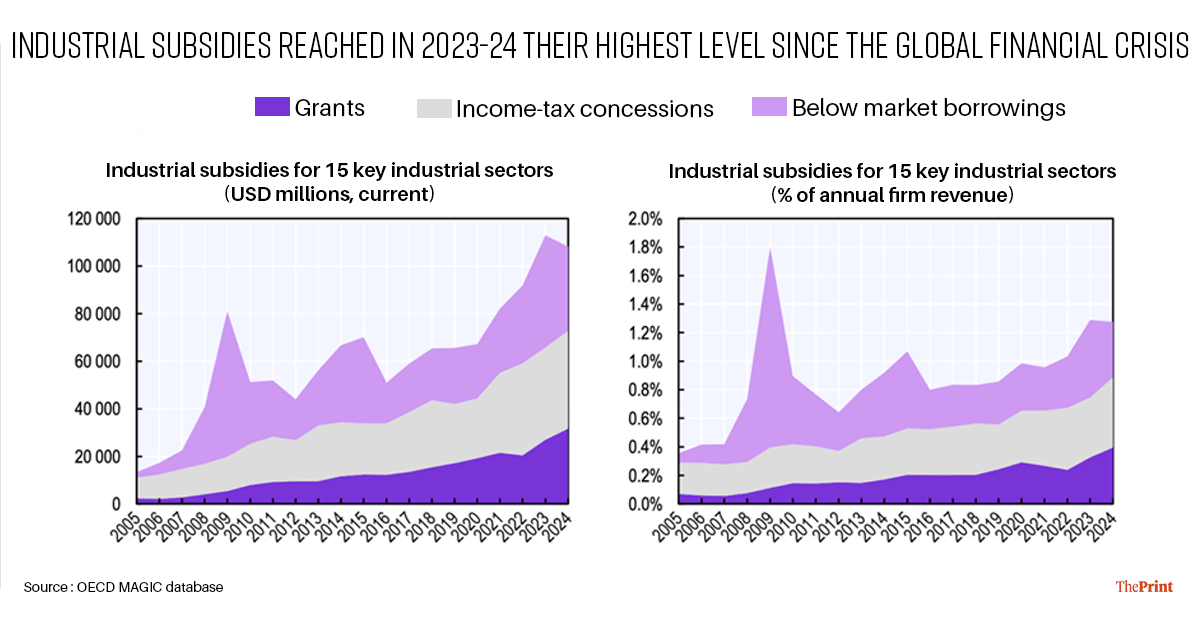
The data are unequivocal. In 2024, global industrial subsidies amounted to $108 billion, marking the second-highest level on record, exceeded only during the crisis year of 2009. Notably, the 2009 peak was a mechanical outcome, as a 15 per cent year-on-year decline in sales artificially inflated the subsidy-to-revenue ratio. In contrast, the current increase is structurally different. The ratio has risen to 1.3 per cent of firm revenues in 2024 without a corresponding decline in revenue. Governments are not providing subsidies out of panic; rather, they are implementing them as a deliberate peacetime industrial policy, framing them as a measure of competitiveness.
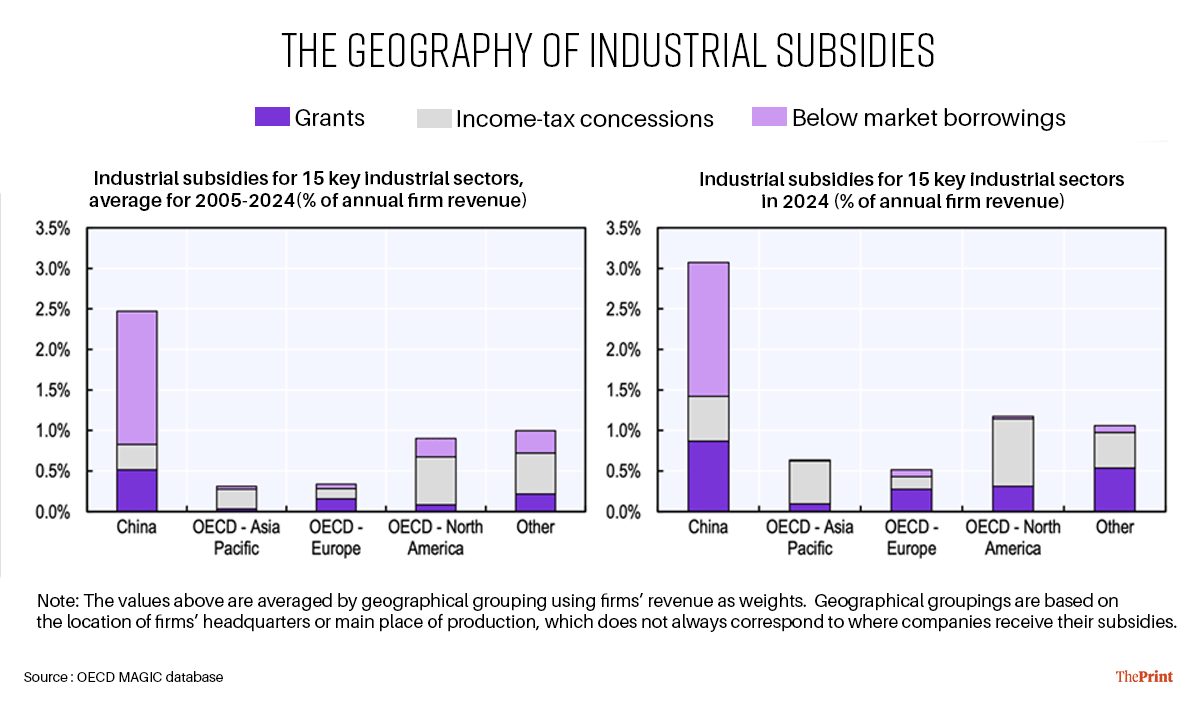
The primary finding—that Chinese firms receive three to eight times more government support than their OECD-based counterparts—has attracted expected commentary. However, what has garnered significantly less attention is the impact of this asymmetric subsidy structure on the foundations of global trade. David Ricardo’s principle of comparative advantage, which posits that countries should produce goods in which they have a relative efficiency, and that trade benefits all parties, relies on a crucial assumption: prices must reflect actual productivity. When the state covers 10% of production costs, the price charged does not indicate efficiency but access to public financial resources.
The OECD’s econometric analysis substantiates this: approximately 22 per cent of global market share gains by expanding firms between 2005 and 2023 can be attributed solely to subsidies. For Chinese firms, this figure approaches 60 per cent. Thus, three-fifths of China’s industrial rise over two decades is statistically linked not to productivity or innovation, but to government financial intervention. This narrative is not merely about trade imbalances; it highlights how subsidies have subtly distorted the price signals essential to the functioning of open markets.
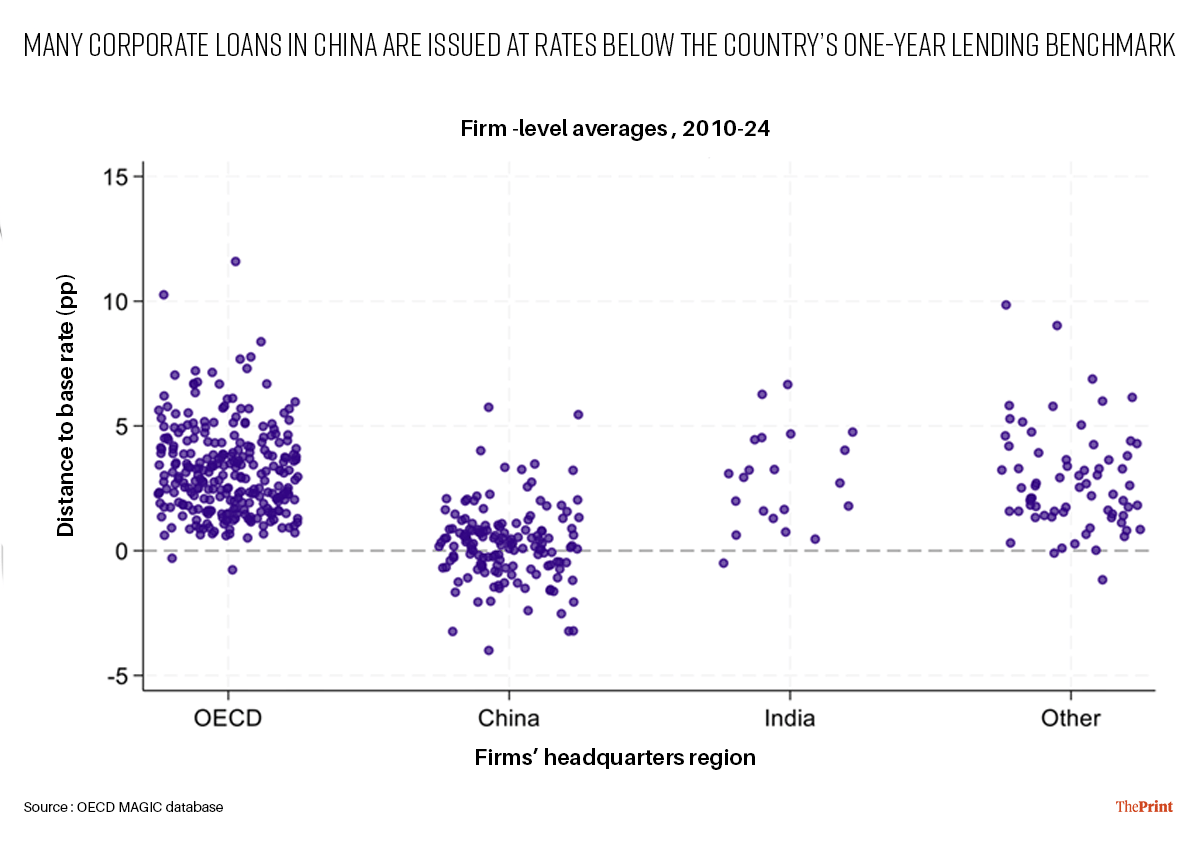
To comprehend the mechanism, it is essential to understand the concept of below-market borrowings (BMBs), as defined by the OECD. A BMB refers to a loan provided at an interest rate that does not accurately reflect the borrower’s actual credit risk. For instance, when a state bank extends credit to a loss-making steelmaker at rates similar to those of a AAA-rated sovereign, the interest rate differential constitutes a concealed transfer from the financial system to the firm. This transfer is not recorded in government budgets and seldom appears in trade notifications. However, it is unequivocally a subsidy, made particularly difficult to detect because its fiscal cost is distributed across the banking system rather than itemised in any finance ministry’s records.
China’s financial structure, in which most corporate loans are issued by state and policy banks at rates near the country’s one-year lending benchmark, renders this mechanism exceptionally potent and opaque.
Also read: Here’s how China sees Modi’s ‘Make in India’ push
When subsidies reshape industries
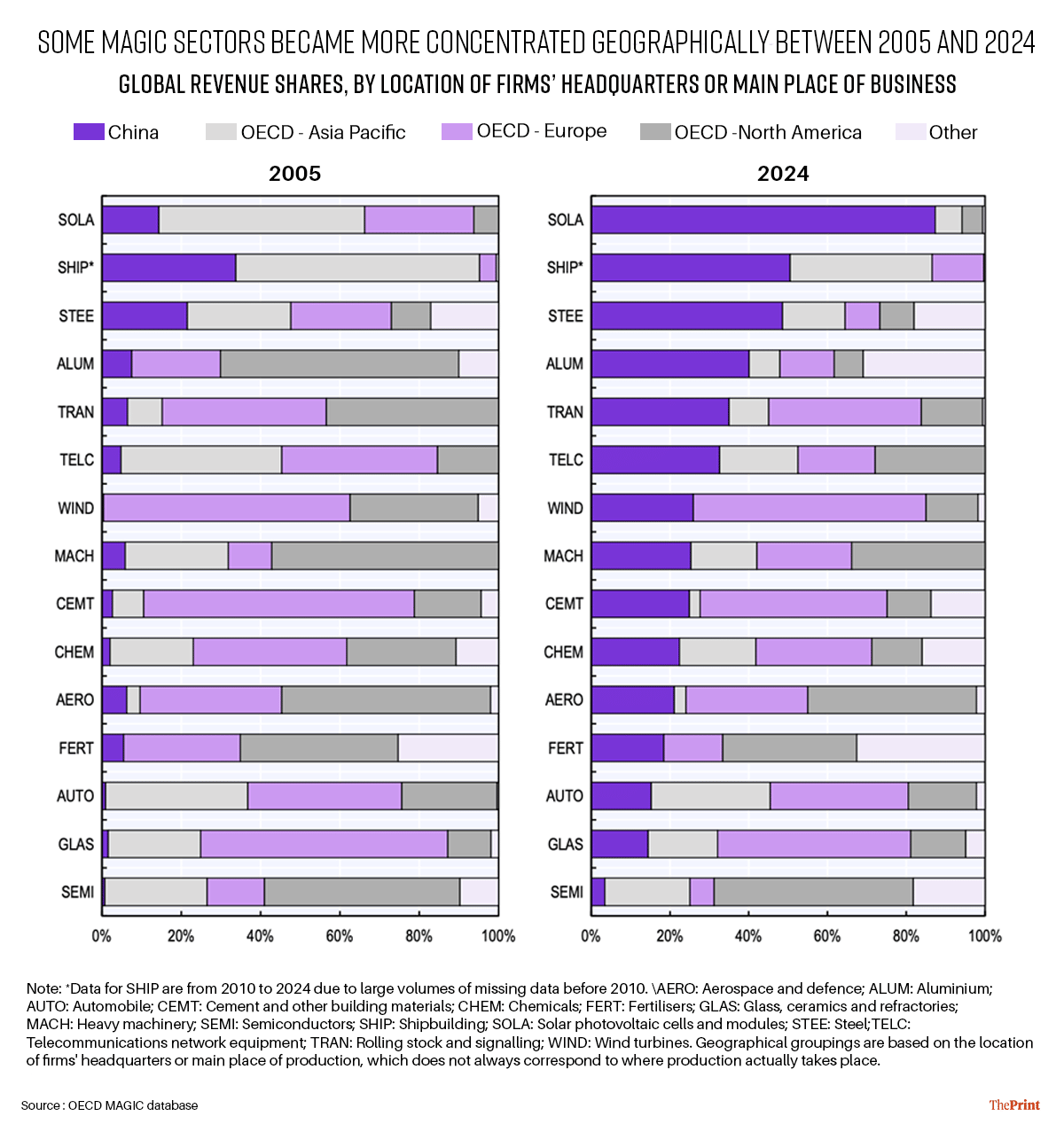
The implications are most evident in the solar panel industry. In 2005, producers based in OECD countries accounted for approximately 80 per cent of global solar module production. By 2024, Chinese manufacturers dominated over 90% of global shipments by volume, representing a near-complete reversal within two decades.
Solar panels are identified as the most subsidised sector among the 15 industries monitored in the database. As a result, by 2024, global production capacity exceeded market demand by more than double.
This situation necessitates the language of competition law: when a firm prices below cost to eliminate competitors and capture a market, it constitutes predatory pricing, which is illegal in all major jurisdictions. When the state absorbs those losses through subsidies, the effect is identical, yet there is no court with jurisdiction, no regulator with authority, and no remedy available to the displaced producers.
Module prices plummeted, competitors withdrew from the market, and the world became structurally reliant on a single region for a technology crucial to the energy transition. The scenario does not represent comparative advantage but rather manufactured dependency, with the losses subsidised by the Chinese state and the repercussions borne by others globally.
India’s instinctive policy response, which includes matching subsidies through Production Linked Incentive schemes, developing domestic solar and semiconductor capacity, and directing public sector banks toward strategic industries, is understandable and, in certain sectors, necessary. However, this approach risks mistaking the symptom for the underlying issue, potentially replicating the opacity that contributed to the current crisis.
The collapse of transparency
The OECD data reveals a deeper structural problem: a collapse in transparency rooted in information asymmetry, which is as significant as the subsidies themselves. Information asymmetry arises when one party in a competition possesses information that the other does not. In functioning markets, disclosure requirements are in place to prevent this: stock exchanges mandate financial accounts, auditors certify figures, and regulators enforce transparency to ensure that capital flows toward genuinely productive firms rather than opaque ones.
The WTO notification system was designed to achieve similar transparency in global trade; if all countries disclose their subsidies, informed decisions regarding countervailing duties and market access can be made. However, this system has effectively collapsed, with the percentage of WTO members failing to notify subsidies rising from 23 per cent in 1995 to 70 per cent in 2025. When the rules are hidden, trade negotiations, investment decisions, and countervailing duty calculations occur without adequate information, preventing markets from self-correcting.
Additionally, India must heed sector-specific warnings. The OECD data highlights fertilisers, where India has significant domestic production capacity and substantial import dependence, as heavily subsidised by Chinese and Russian state-backed firms through below-market borrowings. These artificially cheap fertiliser exports depress global prices, undermine Indian manufacturers, and create import dependence in agricultural inputs, an outcome India can least afford, with direct implications for farm-gate costs nationwide.
India has long advocated for rule-based multilateral trade from a position of relative economic weakness. This position is now strategically altered. India has the standing and self-interest to lead a genuine push for subsidy transparency, not merely as a procedural demand in Geneva, but as a stringent condition embedded in bilateral trade agreements, investment partnerships, and supply chain diversification discussions. If India is committed to being a manufacturing alternative to China, it must first ensure that the competition it enters is transparent, measurable, and governed by universally applicable rules.
The OECD has provided the evidence, the framework, and the impetus. The question is whether India will use this to help redefine the rules of industrial competition or quietly join the subsidy practices, hoping for discretion. One choice fosters a genuinely competitive economy; the other fosters dependency with Indian characteristics. The solar panel industry serves as a cautionary example, illustrating an outcome no serious industrial nation should seek to replicate.
Bidisha Bhattacharya is ThePrint Consulting Editor (Economics) and an Associate Fellow, Chintan Research Foundation. She tweets @Bidishabh. Views are personal.
(Edited by Prashant Dixit)