






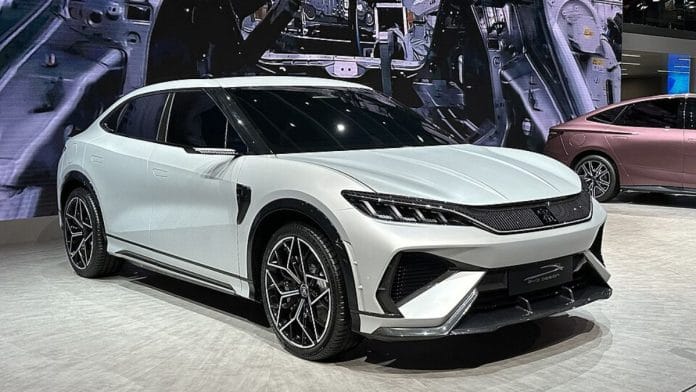

Every second car rolling off a dealership lot in China is now a new energy vehicle. One in 10 cars on the road runs on electric power. These figures alone speak to the scale and speed of China’s EV push. Official data for 2025 show record production and sales, domestic market penetration surpassing 50 per cent, and exports doubling from the previous year. In the first quarter of 2026, Chinese sources report that the country’s EV exports grew by 77 per cent year-on-year.
Chinese media have been unabashedly celebratory, amplifying each milestone as evidence of the country’s technological strength and industrial competitiveness, casting EV growth as a contribution to global green development through cooperation and technological sharing.
Behind the boom
Analysts in China project that by 2030, new energy vehicles (NEV) will account for over 90 per cent of new car sales, with pure EVs dominating that mix.
Lin Chao, Senior Economist at the Department of Information Technology and Industrial Development under the State Information Center, said that new EVs were the single largest driver of export growth in 2025, contributing 107 per cent of the increase in automobile exports. In his view, developing the EV sector is now a strategic imperative and the only way for China to move from a major automobile producer to a leading automobile power.
Wang Qing, Deputy Director of the Institute of Market Economy at the Development Research Center of the State Council, points to two structural advantages underpinning China’s rise. First, a complete industrial ecosystem that has enabled rapid technological iteration, and a vast domestic market that generates sufficient demand to sustain diverse and specialised segments. According to Wang, this is a combination few countries can replicate.
This confidence is echoed in popular discourse as well. A Weibo post noted that China’s EV industry has advanced through rapid iteration and constant self-challenge. Even relative newcomers like Xiaomi Auto are catching up fast. Models such as the SU7 Ultra and YU7 demonstrate how quickly performance benchmarks are shifting. The post observed that more Chinese brands are now stepping onto the world stage. Not only competing with established names like BMW, Mercedes-Benz, and Audi, but also influencing the standards that will define the market’s future.
China’s growing global footprint
The discourse extends well beyond domestic pride and technological innovation. Exports have become central to the narrative. One report declared Chinese EVs as a ‘global sensation,’ pointing to surging overseas figures. In Europe, Chinese NEV sales rose 179 per cent year-on-year in early 2026, with market share doubling to 8 per cent and EV penetration reaching 30.9 percent across nine countries, supported by competitive pricing from brands such as BYD.
In Southeast Asia, too, demand surged sharply. Thailand and Indonesia recorded triple-digit growth and Chinese brands captured over 86 per cent of the regional market, overtaking Japanese competitors in Thailand. Chinese EVs are also gaining ground in the Middle East, Latin America, and Oceania.
Chinese commentators are also watching trade friction closely. Discussions around Commerce Minister Wang Wentao’s visit to Brussels on 30 June framed EU tariff measures as an attempt to curb the ‘westward expansion’ of China’s NEV industry. Zhang Wei, a reporter, argued that the tariffs would hurt both sides. European consumers, he wrote, would face higher vehicle prices and slower electrification, while Chinese automakers would be forced to either raise prices and lose market share or absorb costs and take a hit on profits. A lose-lose framing that Chinese discourse uses to question the logic of protectionism.
Also read: India’s fuel story shouldn’t come at the cost of food security
The cautionary tale
India, too, features in Chinese assessments, though less as a competitor and more as a cautionary tale of EV dependency. Chinese analysts note that despite rising Indian EV sales, over 90 per cent of battery cells used in those vehicles are imported by New Delhi. China, on the other hand, is dominating key inputs across the value chain, from lithium-ion cells to cathode materials and core manufacturing technology. In this reading, India’s EV sector remains largely an assembly ecosystem, and its ambitions of becoming a global manufacturing hub are constrained by its continued reliance on Chinese supply chains. This is how the Chinese are signalling their indispensable role in global EV development.
On the broader strategic outlook, Jin Yonghua, Zhang Yu, and Zhang Zhenzhen of the Policy Research Institute at the China Industrial Internet Research Institute have flagged three risks to overseas expansion. Geopolitical tensions and protectionist policies in the United States and Europe are restricting market access; growing regulatory hurdles, including EU carbon and battery rules; and intensifying competition among Chinese firms abroad, risking price wars and reinforcing a low-cost brand image over high-value.
Despite these challenges, the broader narrative ties the EV boom directly to China’s goals of technological upgrading, energy security, and carbon reduction. The Chinese are claiming that their country is done catching up—it is now setting global automotive standards. Most striking is the pride running through this discourse: the EV sector is on its way to becoming a symbol of China’s ambition. This is how the country is changing its image as a manufacturer of cheap goods to a high-technology exporter, and as a country at the forefront of the global green energy transition.
Sana Hashmi, PhD, is a fellow at the Taiwan-Asia Exchange Foundations. She tweets @sanahashmi1. Views are personal.
(Edited by Ratan Priya)
Compared to Chinese EVs, Indian EVs are comical. Our EVs run for 1 km after 1 day of charging, get blown up, and cost a billion bucks.