





“संकट कटै मिटै सब पीरा, जो सुमिरै हनुमत बलबीरा”
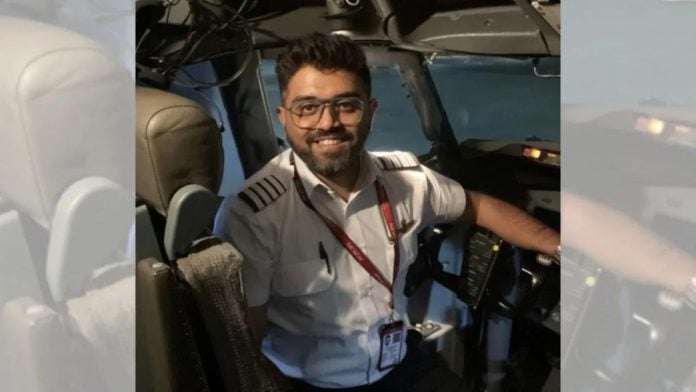
This couplet from the Hanuman Chalisa reflects the belief that in times of trouble, those who remember and call upon Lord Hanuman will find their pain and problems vanish. It was the very Hanuman Chalisa that Captain Smit Machchhar envisioned and chanted when he was attacked inside the cockpit of the Flydubai aircraft he was commanding — an attack carried out by the very person who was supposed to have his back: the co-pilot.
The story of Captain Smit Machchhar is not just the story of an Indian pilot. It is a story that has come to embody the idea of humanity.
There are moments when the world needs to pause — not merely to celebrate an individual, but to reflect what that individual’s actions teach us about ourselves. The recent incident involving Flydubai Flight FZ1073 is one such moment.
What happened inside the cockpit
The horrific and unprecedented incident took place hours after take-off, when news broke that an unidentified co-pilot had attacked Captain Machchhar with a cockpit axe, an instrument retained for the security and safety of the cockpit crew in case of emergencies. Who could have expected the threat to come from inside the cockpit itself, which raised fears of an attempt to recreate a 9/11-like scenario.
During his interaction with Prime Minister Narendra Modi, Captain Machchhar shared his ordeal. He said that after being badly injured, he lay on the cockpit floor, but his 17 years of flying experience made him aware that the aircraft was rapidly plummeting.
Even though he was grievously wounded and still under attack, he somehow summoned the strength to make “one last push” to reach and open the cockpit door. How could he let the passengers die? He knew he had to regain control of the aircraft to save the passengers and himself. He also managed to successfully send out the emergency signals.
What is particularly relevant is that he told Modi how he kept reciting the Hanuman Chalisa repeatedly, as it is his go-to mantra whenever he is in pain or trouble.
“संकट कटै मिटै सब पीरा, जो सुमिरै हनुमत बलबीरा”
The story the world saw
Within hours, news of the pilot’s exemplary courage was being flashed across social media, WhatsApp groups and television channels. Some of the headlines in Western media read: “Passengers foil bid to crash Dubai Tel Aviv flight, Israel says, after co-pilot stabs pilot”, “Pilot-on-pilot stabbing forces emergency landing of Israel-bound flight” and “Flydubai co-pilot stabbed captain, tried to crash flight to Israel after ‘racial indoctrination’, Netanyahu says”, among others.
One headline read: “Hero’ pilot, plumber and dentist among those who saved Flydubai flight to Israel.”
But there was little emphasis on the fact that an Indian captain had successfully fought off an attack and helped prevent what could have been a 9/11-like tragedy.
Now, five days after the incident, many questions remain unanswered. It is worth asking what would have happened if Captain Machchhar had failed.
“सब सुख लहै तुम्हारी सरना।
तुम रक्षक काहू को डर ना॥”
When Lord Hanuman is there, the seeker will find happiness; when Hanuman is near, there is no need to fear.
Machchhar believed that Lord Hanuman had protected his life, as well as the national pride of 1.3 billion. Had the commander not recovered enough to open the cockpit door, and had the plane crashed, the narrative would have been entirely different.
Going by some of the initial coverage, one can imagine how quickly narratives of Hindu terror or an “Indian pilot” being involved in a 9/11-like attack could have emerged.
Also Read: Flydubai scare: 3 countries are involved, who will investigate the incident?
The Indian story
For decades, Indians have quietly demonstrated their competence across almost every profession and sector imaginable. From aviation to medicine, engineering to technology, finance to academia, entrepreneurship to science, hospitality to diplomacy, Indians make significant contributions worldwide.
They fly aircraft, design infrastructure, run global corporations, perform complex surgeries, develop technologies, conduct scientific research, manage international institutions, and build businesses across continents.
Captain Machchhar’s story is another powerful reminder of this global Indian capability. His response was not accidental. It was the product of training, professional discipline, experience, composure, and an extraordinary sense of responsibility.
The backdrop of rising anti-Indian sentiment
There is a current phase of ‘Indianophobia’ reflecting anti-Indian sentiment that has been rearing its head across the world, especially in America.
In Texas recently, church members near Houston protested and turned visitors away from the 90-foot Panchaloha Abhaya Hanuman statue at the Sri Ashtalakshmi Temple, while Republican candidate Alexander Duncan criticised the statue, saying America is a Christian nation.
A report by the Washington, DC-based Center for the Study of Organized Hate (CSOH) found that monthly anti-South Asian hate posts on X jumped 240 per cent between January 2024 and June 2026, rising from 12,904 posts to 43,843 posts per month.
The report found that 45 per cent of the tracked posts were linked to themes such as immigration and jobs. Anti-Sikh hate increased by 24 per cent and anti-Hindu hate by 12 per cent, while specific slurs included “pajeet” and anti-Indian stereotypes around hygiene and food.
Data also showed that Indian professionals in the United States generally complement the labour market rather than simply “taking away American jobs”. Indian immigrants constitute around 1 per cent of the US population but have founded 8 per cent of tech startups, according to data cited in the report.
Each immigrant-founded unicorn company generates an estimated 859 jobs for the broader US economy.
So anti-India hate is misplaced and unwarranted.
Had the plane crashed, whether in Saudi Arabia or Tel Aviv, Captain Machchhar and Hindu nationalism could have become scapegoats.
Who was the co-pilot?
An official statement from the UAE Attorney General described the incident as an attempted “terrorist attack”. The statement was issued on 3 October, three days after the incident.
UAE authorities have still not officially confirmed the co-pilot’s identity, although some reports, citing sources, have identified him as Omani national Hammam al-Hammami.
His now-deleted social media accounts have reportedly been described as reflecting conservative and misogynistic views, including an interest in marrying a “niqabi woman”, while reports have also linked him to radicalisation in Syria.
Initial reports also stated that he may have been an Omani who had been radicalised. However, it is not yet clear which countries had been recently visited by the pilot and who all were a part of his network, if any.
Should the emphasis on the perpetrator’s nationality not shift to the perpetrator as a person?
Oman is generally peace-loving and has good relations with India. It is known for its neutral outlook and a foreign policy built around neutrality and non-interference.
Is the narrative an attempt to derail the good relations India has with Oman, and the strategic alliance the two nations have forged, with Oman providing India access to key ports such as Duqm and Salalah?
Of course, Israel is an interested party in the investigation, as its citizens could have lost their lives. But India, Oman, and the UAE are all stakeholders because the repercussions for all three would have been very different if Captain Machchhar had not been saved.
These are answers India needs to be actively seeking.
The narrative is straight out of a Hollywood-Bollywood drama. The mystery has only deepened.
If Oman Air had flagged and “benched” this pilot for his radical views, how did he manage to secure his employment with FlyDubai?
What are the security checks when an airline hires a pilot? What are the HR guidelines, especially post-9/11? Can an online course be enough qualification for a pilot to be hired in the aviation industry? Has the passenger manifest been analysed? Who would have benefited from an incident of this magnitude had the attacker succeeded in disabling Captain Machchhar?
Nearly five days after the incident, those concerned are still seeking answers to these questions.
The Guardian quoted Arik Arad, chair of aviation cybersecurity consultancy Cyviation and El Al’s former head of security at Ben Gurion Airport, as saying: “The co-pilot is a terrorist who tried either to hijack the plane or bring it down as a suicide. The worst scenario is he was trying to get into Israel,” Arik said.
Whether you believe in Lord Hanuman or not, it is no doubt a “miracle” that this aircraft was saved — perhaps by a plumber, a heroic commander, or a dentist.
What is likely not known is what else would have happened in the Middle East, and the rest of the world, had this plane crashed in Saudi Arabia or Tel Aviv or elsewhere. The truth behind the real perpetrators could have been buried behind a “green wall” forever.
This needs to be investigated. Given the current geopolitical scenario, this needs to happen with urgency.
When an Indian saves an Israeli passenger, an Arab passenger, an American passenger, an African passenger, or anyone else, India shares that achievement with humanity.
That is the kind of national pride the world needs. A pride that does not say: “He did this because he was Indian.” But rather: “He was an Indian, and he demonstrated the best of what a human being can be.”
That distinction matters.
Captain Smit Machchhar’s story reminds us that when humanity is tested, the labels we spend so much time arguing about — religion, nationality, race, language and politics — can suddenly become irrelevant.
What remains is character, courage and responsibility.
Therefore, Captain Machchhar should be celebrated not only as an Indian hero, but as a hero of humanity.
India has found itself inadvertently at the centre of a geopolitical melee. Perhaps that is why India must also push for a permanent seat at the UNSC. But that is a column for another day.
Meenakshi Lekhi is a BJP leader and lawyer. Her X handle is @M_Lekhi. Views are personal.
Edited by Maryam Hassan
Captain Macchhaar not only saved his own life, he saved the lives of 180 people on the craft, countless others on the ground had the place crashed – and more importantly sabotaged the plot of the incumbent israeli leader. and should the genocidal incumbent lose the forthcoming elections, all credit for his loss will go to our good captain.
Ms. Lekhi, You export Buddha to foreign capitals when you want diplomatic applause, but you rely on Hanuman in the cockpit the second real life demands a spine