






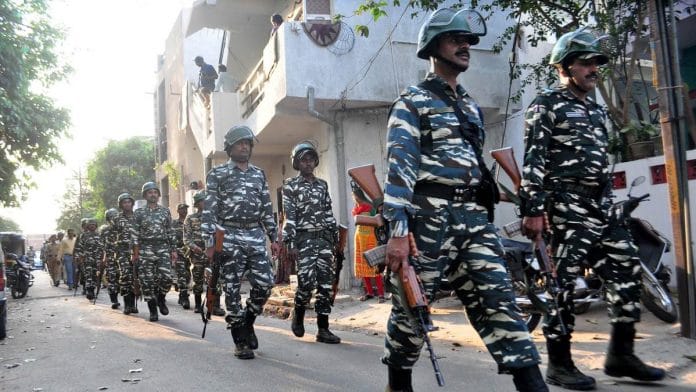


Polling in the second and final phase of the West Bengal Assembly election had not yet closed when, at 5:12 pm on Wednesday, the Director General of the CRPF, IPS GP Singh, posted on X that 500 companies of CAPF will stay in the state after the polling, until further orders.
Five hundred companies — drawn from the CRPF, BSF, CISF, ITBP, and SSB, approximately 50,000 personnel — will remain in the state for law-and-order duties through counting day, 4 May. Earlier, Union Home Minister Amit Shah had said central forces in Bengal would stay for 60 days after the polls. If we keep aside the operational logic, the constitutional question doesn’t have a firm footing.
Bengal’s warrant for caution
Bengal’s reputation for post-poll violence is not merely a reputation; it is on record. After the 2021 Assembly election, 1,979 complaints were made to the National Human Rights Commission (NHRC), involving approximately 15,000 victims across 23 districts. The CBI, directed by the Calcutta High Court, registered 52 cases of murder and unnatural death. In the 2018 panchayat elections, the TMC won approximately 34 per cent of seats uncontested, as per the State Election Commission affidavit submitted before the Supreme Court. This was a case of effective suppression of the opposition. So, 50,000 CAPF personnel on standby through 4 May is not excessive caution by any means.
The constitutional architecture
None of this settles what those 50,000 personnel are constitutionally empowered to do once the election itself is over. Law and order is the first entry on the State List under the Seventh Schedule. It belongs to the state. The CAPF acquires no territorial jurisdiction by the act of deployment. Jurisdiction must be conferred, and the authority to confer it rests with the state’s civil administration.
The central government’s basis for deployment rests on two pillars. Article 355 obliges the Union to protect every state against external aggression and internal disturbance — it’s a duty, not a power of occupation. Article 324 vests the Election Commission of India with superintendence and control over elections, under which the ECI requisitions central forces to ensure free and fair polling. But Article 324’s writ is election-specific. It does not extend, by its own force, into the post-poll period as a licence for independent CAPF law-and-order operations. Once the ballot boxes are sealed, that authority begins to fade.
What the forces can, and cannot, do
Without a Presidential Proclamation under Article 356 or a notification under the Armed Forces (Special Powers) Act — neither of which is in play in Bengal — the CAPF’s post-poll role is circumscribed by a legal architecture that is thinner than its public image suggests.
Under the CRPF Act, 1949, personnel perform duties as directed. But in a non-disturbed area, those duties run through the civil administration: the district magistrate at district level, the SSP or commissioner of police in urban areas, and the state DGP as the apex coordinating authority. The CAPF is, in law, an auxiliary to that structure. It is not a substitute for it.
The Bharatiya Nagarik Suraksha Sanhita, 2023, which replaced the Code of Criminal Procedure from 1 July 2024, preserves the same essential framework. Under Section 163 of the BNSS, the power to command dispersal of an unlawful assembly vests in an executive magistrate or officer-in-charge of a police station — not in the commanding officer of a central paramilitary unit.
Similarly, Section 164, which authorises the use of armed force to disperse such an assembly, requires the direction of a magistrate. And the protection from prosecution for acts done in official capacity, under Section 218 BNSS, applies to public servants acting under lawful orders — not to CAPF personnel acting on their own initiative outside a formally requisitioned and delegated chain of command. A CAPF jawan who opens fire on a mob without a magistrate’s written direction has no legal cover that a soldier operating under the AFSPA enjoys.
What the CAPF can do independently is conduct flag marches through sensitive areas as deterrence, deploy static pickets at vulnerable installations, and engage in escort duties where the ECI’s residual authority still runs. Independent cordoning, arrests, or use of force beyond immediate self-defence fall outside those limits.
Also read: The Bengal voter is silent. Is it fear or quiet determination?
The federal fault line
Here lies the political and constitutional pressure point. The Union’s retention of 500 companies has a defensible legal basis — the ECI order of 19 March and the CRPF Act together provide it. But legal basis and operational utility are different things. If the Mamata Banerjee government, through its DGP, declines to requisition or activate the CAPF in any meaningful capacity, New Delhi has no instrument short of Article 356 to compel otherwise. The forces would then become exactly what the TMC has always characterised them as — an uninvited presence, a political statement in uniform, constitutionally inert.
The Supreme Court’s jurisprudence, SR Bommai v. Union of India (1994) onward, has consistently treated state autonomy over law and order as close to inviolable within the federal scheme. A Centre that stations 50,000 personnel in a state against the grain of that state’s elected government — however well-founded the precaution — occupies awkward constitutional ground. The arrangement holds so long as the state chooses to work with the forces. The moment it does not, the federal tightrope becomes visible to everyone.
The IPS officer’s X post came because Bengal’s history has left him little reason to wait. That instinct is sound. But 50,000 CAPF personnel are a precaution, not a guarantee. Their presence deters only if the state’s civil administration is willing to deploy them; their powers are real only if a magistrate’s order activates them. The Constitution did not design the CAPF to function as an occupying force, and it cannot be made to function as one without fracturing the federal compact it is meant to serve. The retention is defensible. Its utility, between now and 4 May, depends entirely on a state government that has never made its hostility to central forces a secret.
KBS Sidhu is a former IAS officer who retired as Special Chief Secretary, Punjab. He tweets @kbssidhu1961. Views are personal.
(Edited by Aamaan Alam Khan)
And the police staying silent while political violence is unleashed on political rivals does loads of good to the citizenry, right ? This is not a concocted story but a reality Bengal saw in 2021. Time for you to open your eyes to reality rather than keep the head in the vacation like beach facilitated by TMC for its supporters. Bengal has failed to protect basic tenet of democracy and has ushered in an atmosphere of fear in the very foundational act of voting.
The biggest problem are the one exam wonder like this ias or IPS. Rascals are corrupt with no spine and hence all state administration are highly partisan and corrupt. And now parasite like these want to write articles on proprietary
Ambivalence and contradictions are quite glaring in this piece. How can such an order be defensible in the first place after May 4? And what about the competence and credibility of the State Police? Author is silent about this demoralising effect on them?