







New Delhi: Asylum pleas by Indians are increasingly being rejected by New Zealand and Canada, with authorities in both countries turning down a growing number of applications after finding many to be “false, fabricated, motivated, or lacking credible evidence of persecution”.
The rise in rejections comes as immigration authorities have intensified scrutiny of asylum applications from India, particularly those citing religious persecution.
Tighter screening has dealt a serious blow to a thriving network of agents and consultants charging applicants hefty sums to build claims of persecution and facilitate their migration.
Extremist networks that allegedly sent youngsters, particularly from Punjab, to these countries in the guise of securing asylum and eventual citizenship to further their agenda have also suffered a setback, with authorities increasingly refusing to entertain such applications. The trend is reflected in official immigration data perused by ThePrint.
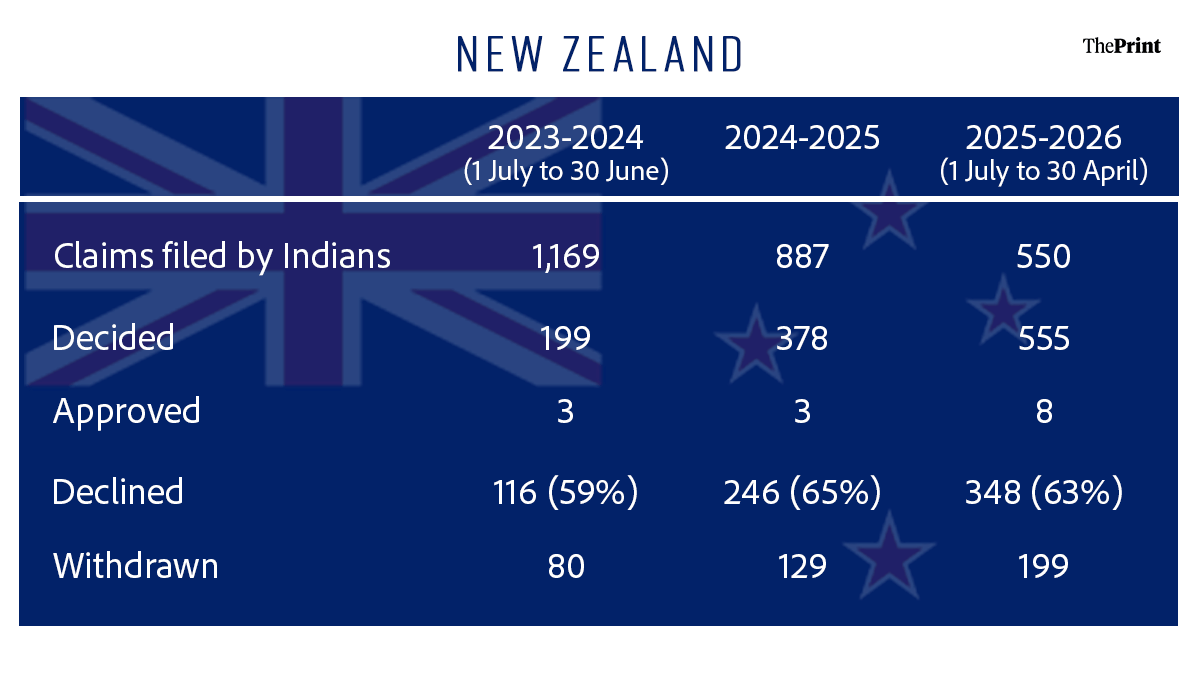
In New Zealand, in 2023-2024 (1 July to 30 June), 1,169 claims for refugee or protected person status were filed by Indian nationals. In the same period, 199 claims were decided, with only three approved, 116 declined (58 percent), and 80 withdrawn.
Similarly, in the same period in 2024-2025, 887 claims were filed by Indian nationals, of which 378 were decided, with only three approved, 246 declined (65 percent), and 129 withdrawn.
For 2025-2026 (1 July to 30 April), 550 claims were lodged. In the same period, 555 claims were decided, with only eight approved, 348 declined (63 percent) and 199 withdrawn.
In Canada too, many asylum applications by Indians are being declined after authorities found applicants had failed to establish their case.
In 2023, of the 5,024 asylum claims decided, 2,500 were accepted, while 2,051 (41 percent) were rejected, 220 were abandoned and 253 were withdrawn.
In 2024, authorities decided 5,994 claims, of which 2,175 were accepted, 1,688 rejected (28 percent), 1,377 abandoned and 754 were withdrawn.
In 2025, of 9,252 claims decided, 2,040 were accepted, 2,309 were rejected (25 percent), 3,914 were abandoned, and 989 were withdrawn.
In 2026, up to 31 March, 2,866 claims were decided, with 443 accepted, 688 rejected (24 percent), 1,406 abandoned and 329 withdrawn.
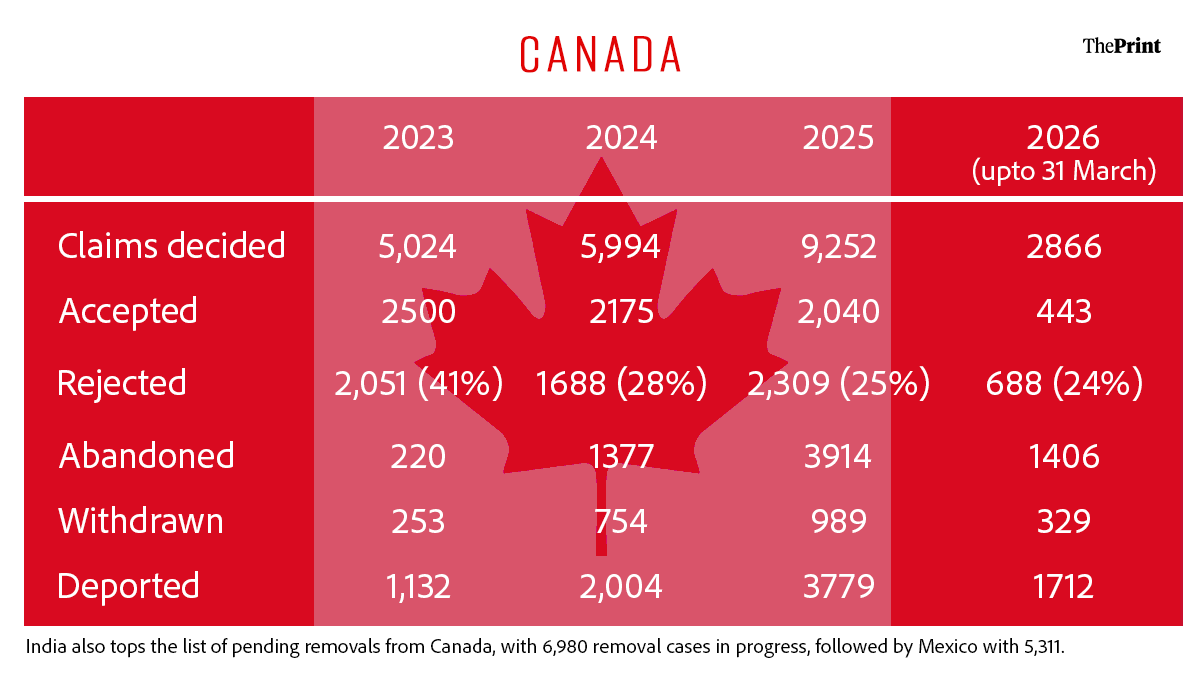
Data on deportation shows that Indian nationals have consistently been among the top nationalities deported from Canada.
As many as 1,132 Indians were removed in 2023, rising to 2,004 in 2024 and 3,779 in 2025. By March 2026, 1,712 Indian nationals had been removed from the nation. India also tops the list of pending removals from Canada, with 6,980 removal cases in progress, followed by Mexico with 5,311, the data shows.
Also Read: India’s traditional refugee policy shows why it’s unlikely to give Rohingyas sanctuary
‘Motivated, misused by extremist groups’
Responding to ThePrint’s queries, Greig Young, Head of Operations, Refugee Status Unit, New Zealand, said there is a “very low success rate for claims by Indian national’s both at the first instance and on appeal”.
“Large numbers are being found to be unfounded and may be motivated by immigration objectives rather than a genuine need to seek international protection,” Young said.
Young explained that refugee and protection claims are for the purpose of seeking protection and should not be used as a way of extending stay or accessing rights and services in New Zealand. “A declined claim can also significantly harm a person’s future immigration prospects not just in New Zealand but also in partner countries,” Young said.
Speaking to ThePrint, Kanwar Sierah, a regulated Canadian immigration consultant, said the rejection of asylum applications is on the rise as the government has realised that many of them are motivated and that the asylum system is being exploited by fringe elements, dissenters, radical groups and immigration consultants.
“Canadian authorities found that a significant number of asylum claims from India were linked to organised immigration fraud, particularly involving applicants from Punjab and Haryana. Some immigration consultants encouraged people to apply for visitor visas with the sole intention of claiming asylum later, presenting it as an easier pathway to permanent residency rather than protection from persecution,” Sierah said.
Sierah added that the issue was acknowledged by Canada’s immigration minister during a parliamentary committee meeting, where the asylum system was being used as a “pathway to permanent residency, even though it is intended to protect people facing genuine persecution”.
Sierah said authorities also found that some international students and temporary foreign workers whose permits were nearing expiry were being advised not to continue their studies or seek legal immigration options, but instead file asylum claims. Investigation later revealed that these were “packaged deals prepared by consultants”, exposing this growing “refugee scam industry”.
According to Sierah, some fringe and extremist groups also exploited the asylum system by encouraging applicants to participate in anti-India protests to strengthen claims of political persecution.
“Applicants were advised to remain at the forefront of demonstrations, raise anti-India slogans, and create evidence that could later be used in asylum proceedings,” Sierah told ThePrint.
Adding, “The issue had wider social consequences. In 2024, Canada witnessed several confrontations involving pro-Khalistan groups, including incidents outside temples and gurdwaras that were widely circulated on social media. Political leaders expressed concern that overseas political tensions were spilling onto Canadian streets.”
Sierah also said Canadian authorities have also uncovered instances where identical or near-identical narratives were used in hundreds of asylum applications. “In one case, the same story appeared in more than 250 refugee claims, a matter that was examined by the Federal Court of Canada,” he said. “As scrutiny increased, many asylum claims were rejected or declared ineligible, while others were withdrawn or abandoned.”
According to Sierah, the crackdown has resulted in a sharp increase in removals and deportations of Indian nationals from Canada.
‘Game of demand and supply’
Whether it is New Zealand or Canada, India accounts for the highest number of asylum applications, with many claims citing religious or political persecution.
While there is no official data on the applicants’ states of origin, security officials estimate that a significant proportion of these claims originate from Punjab.
Data accessed by ThePrint shows a sharp rise in refugee claims by Indian nationals in New Zealand. The number of claims stood at 89 in 2020-21, rising to 104 in 2021-22 and 172 in 2022-23, before surging to 1,169 claims in 2023-24.
Canada has witnessed a similar trend. Indian nationals have consistently accounted for the largest number of asylum claims referred for processing. The number of applications increased from 9,060 in 2023 to 32,563 in 2024. In 2025,17,835 claims were referred, while 3,299 claims were referred by 31 March, 2026.
A source in the Indian security establishment told ThePrint that the promise of a Canadian visa was allegedly used by Sikh extremist networks to recruit young Sikhs from Punjab and draw them into their activities after they reached Canada.
“It became a game of demand and supply,” the source said.
According to the source, Sikh extremist groups allegedly sponsored visas for young people from Punjab, offering opportunities for medium-skill jobs such as truck drivers, plumbers, or religious positions.
“They sponsored their visas and travel to Canada in return for their participation in pro-Khalistan activities, including anti-India protests, programmes and radical religious congregations,” the source alleged.
The source further claimed that members of Sikh extremist groups charged between Rs 1 lakh and Rs 2 lakh for issuing letters identifying applicants as party workers facing religious persecution in India.
These letters, the source alleged, were then used to support asylum applications in Canada. “Many of these youngsters, once they reached Canada, invariably became associated with pro-Khalistan groups there. This modus operandi has now been exposed, and authorities in these countries are increasingly rejecting such asylum applications.”
Back in 2023, former MP Simranjit Singh Mann—who now leads the breakaway faction Shiromani Akali Dal (Amritsar)—had faced controversy for issuing such asylum letters, which were allegedly used by separatist elements. Speaking to ThePrint then, Mann had admitted that he gave the letters to those who approached him. His office had been handing out such letters to asylum seekers, narrating the tales of torture, murders, and extrajudicial killing of the Sikhs, and what transpired post 1947 and in 1984.
“I’m very grateful to all the countries that honour this letter. Our [Sikhs’] security in India is in danger and by international law, we can seek asylum legitimately which people are doing. If the State rules by terror and doesn’t accept some, then people will flee,” Mann had told ThePrint.
(Edited by Nida Fatima Siddiqui)
Also Read: Indian vloggers & influencers in Canada have a warning for immigrants—‘the Canadian dream is dead’
Finally these countries have started using their brains. Fraud was so obvious that I genuinely questioned the intent of these countries