






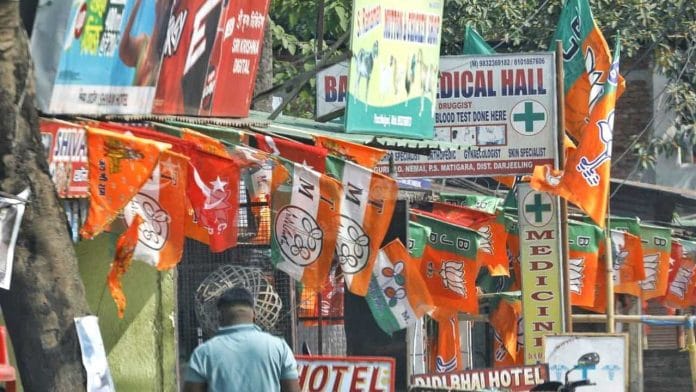


It is easy to get swayed by the size of the crowd at Prime Minister Narendra Modi’s rallies in West Bengal’s hinterlands, or be in awe of chief minister Mamata Banerjee’s spirited rebuttals to every allegation that the Opposition is levelling at her government. But the upcoming Assembly elections in West Bengal, slated for 23 and 29 April, are hard to call.
For one, the Bengal voter is almost eerily silent on their political choice this election season. And the electorate is divided on some of the big talking points—SIR, minority vote, the presence of an extraordinarily high number of security personnel on the ground to conduct free and fair polls.
Fear or silent determination?
One of the defining factors of this year’s Assembly polls has been the silence of the Bengal voter. Journalists and political analysts touring the state to get a sense of the voter’s mood are failing to do so.
Gulam Jeelani, political desk editor of LiveMint, who is currently touring Bengal, told ThePrint this is because the state has historically struggled with post-poll violence. “I found voters, especially in rural pockets, unwilling to reveal their leanings. I did not see this phenomenon in Bihar or Uttar Pradesh where the voter is rather vocal,” Jeelani said.
Senior journalist and public policy analyst Pratim Ranjan Bose blamed the voter’s silence partly on the “missing BJP candidate”. Bose told ThePrint there are many voters who are angry at the ruling Trinamool Congress government and want to vote for change but cannot really trust the BJP because the party’s local candidates are not campaigning hard enough. “I am a voter in the Jadavpur Assembly constituency and till now I have not met or even seen the local BJP candidate. If you do not get reassurance from your local candidate how would you possibly make up your mind,” Bose said.
Bose said during the 2021 post-poll violence, BJP leaders “simply ran away leaving behind their voters and workers at the mercy of the mob”.
“This time voters are being tight lipped about their choices. The Trinamool Congress voter is also choosing to stay quiet in case the BJP comes to power in the state,” Bose said.
The silence of the Bengal voter may indeed have to do with the state’s history of political violence. In 2024, the BBC put out a documentary directed by Ronny Sen titled Children of the Bombs. It claims that 565 children have been killed, injured, or maimed by crude bombs between 1996 and 2024. The bombs are mainstays of election and post-election violence in the state.
But there may be another reason behind the silence of the Bengal voter and that is their quiet determination to bring about change through the ballot box. Author and senior advocate of the Calcutta High Court Joydeep Sen told ThePrint anti-incumbency has finally caught up with the Mamata Banerjee government and the Bengal voter will vote her out without making a hue and cry.
“This won’t be a pro-BJP vote but an anti-TMC one. And before any such election, analysts have been unable to gauge the mood and there has been an uneasy quiet among voters. Be it the national polls in 2004 when the Atal Bihari Vajpayee government fell to the utter disbelief of many Delhi analysts or the 2011 polls in Bengal, which brought Mamata Banerjee to power. Many in Bengal had not been able to predict that 34 years of Left rule would come to end so decisively,” he said. For Sen, the silent Bengal voter is a determined one.
Also read: Why Bengal’s election outcome matters. The world wants to know how SIR will play out
Missing voters
Inarguably, the biggest talking point in Bengal polls 2026 is the Special Intensive Revision or the SIR, an exercise undertaken by the Election Commission of India to ensure that all eligible citizens are included in the Electoral Roll and that no ineligible voter is. A staggering 90 lakh voters were excluded by the exercise in West Bengal.
The exercise made global news with Al Jazeera reporting that since 2014, India’s Muslims have overwhelmingly voted for a political party or coalition most likely to defeat the “Right-wing BJP”. “In West Bengal, it is the TMC, which is why (Mamata) Banerjee, as the state chief minister, herself moved the Supreme Court in February, accusing the ECI of being partisan towards the BJP after the SIR was launched in October last year,” the article read.
But it was not just Bengal’s Muslim voters who have been affected by the SIR, 63 per cent of names deleted are that of Hindus with high rate of deletions in Matua-dominated border constituencies, which the BJP has been nurturing since past polls.
Times of India reported that as a result of this, BJP leaders who are opposed to the move are standing as independents. They “are threatening to cut into the vote share of the party’s official candidates,” the report read.
Sumit Datta, a Kolkata-based management consultant, told ThePrint no one knows what exact effect the deletion of names under SIR would have on the final results of the polls. “It is certainly not simple math,” Datta said.
Journalist Pratim Ranjan Bose said no political party has any clue about the impact of SIR on poll results.
Also read: Modi has ditched dhokla for jhalmuri. He’s an honorary Bengali
The Muslim vote and high security
It was expected that with the emergence of the Aam Janata Unnayan Party, established on 22 December 2025 by Humayun Kabir, an expelled Trinamool Congress MLA, minority votes in Bengal would be effectively split, benefitting the BJP. This is after Kabir announced grand plans to build a replica of the Babri Masjid in West Bengal’s Murshidabad district. He got a massive crowd to attend the foundation-laying ceremony.
Kabir’s pre-poll alliance with Asaduddin Owaisi’s AIMIM party was also expected to further dent Mamata Banerjee’s Muslim vote bank.
But a ‘sting video’ of Kabir purportedly talking about his links with senior BJP leaders has not only led to the AIMIM cancelling its alliance with the party, but has also raised doubts if Muslim vote would be significantly split at all now. Kabir has dismissed the video as AI-generated, but the Muslim voter may have already made up their mind.
Another contentious issue seems to be the presence of an extraordinarily high number of security personnel on the ground to conduct free and fair polls. With allegations of violence, voter intimidation and rigging, the presence of extra security personnel on the ground was expected to ensure free and fair polls. But the optics of such an exercise may not have intended results.
Calling the huge deployment “worrisome,” former Rajya Sabha member Jawhar Sircar, who served as the state’s chief electoral officer in the 1998-99 Lok Sabha elections, said, “this is a de facto central takeover of Bengal.”
“A deployment of this scale has the impact of overwhelming the electorate. There is a socio-psychological impact of having an unprecedented CAPF presence which may trigger responses in voters,” The Telegraph quoted Sircar as saying.
In a Facebook post, commentator Manzar Jameel asked if this was an election or a security operation? “Chiefs of all the Central forces BSF, CRPF, SSB, ITBP and CISF converge in Kolkata to “plan” a state election. In 75 years of Indian democracy, when has any single state poll witnessed such an extraordinary display of central force at the highest level?” he wrote.
Jameel said, coming as it did in the backdrop of the exclusion of lakhs of voters, this “overwhelming securitisation raises an uncomfortable question—are voters being enabled to participate, or subtly discouraged through an atmosphere of fear?”
Only Bengal’s silent voter knows the answer to this question.
Deep Halder is an author and a contributing editor at ThePrint. He tweets @deepscribble. Views are personal.
(Edited by Theres Sudeep)