



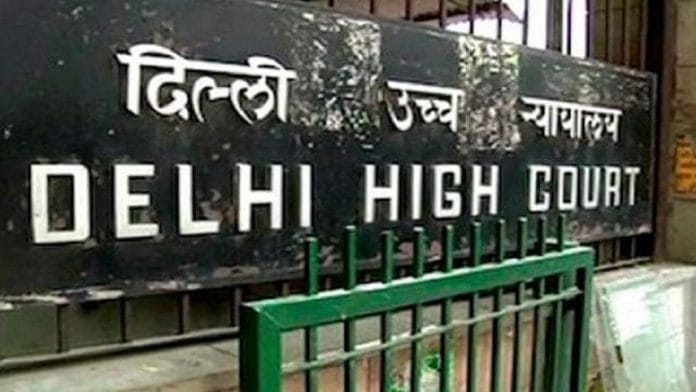
Earlier this month, the Delhi High Court dismissed a petition challenging a show-cause notice the Maharashtra Food and Drug Administration had issued to Vimal Elaichi’s brand ambassadors, Shah Rukh Khan, Ajay Devgn, and Tiger Shroff. The Court held it had no territorial jurisdiction. The challenge to a notice issued in Mumbai, to three Mumbai residents, belonged before the Bombay High Court instead.
This is not an isolated choice of forum. Mumbaikars have repeatedly found reasons to head north. Take the personality rights claims of Amitabh Bachchan (2022), Anil Kapoor (2023), Jackie Shroff (2024), and Aishwarya Rai Bachchan (2025), all famously residents of Mumbai who preferred to bring their suits to Delhi instead. These cases are only the visible end of a larger pattern. In the class of intellectual property suits, of which personality rights suits are but a part, Delhi is the preferred forum for most litigants across the country. While anecdotal reasons exist, we investigate this question with data.
We compared the two High Courts on three questions: Which court moves IP suits faster? How different is the route from filing to first hearing? And how much does Delhi’s longer institutional experience with IP litigation matter?
Quicker timelines
Using TheProfesseer’s CourtsDataLab platform, we identified that between January 2021 and July 2026, Bombay received 3,076 IP suits and Delhi, 4,263. Delhi both attracts more IP litigation (despite Bombay sitting across five benches, including Kolhapur and Goa, against Delhi’s single seat) and finishes considerably more of it.
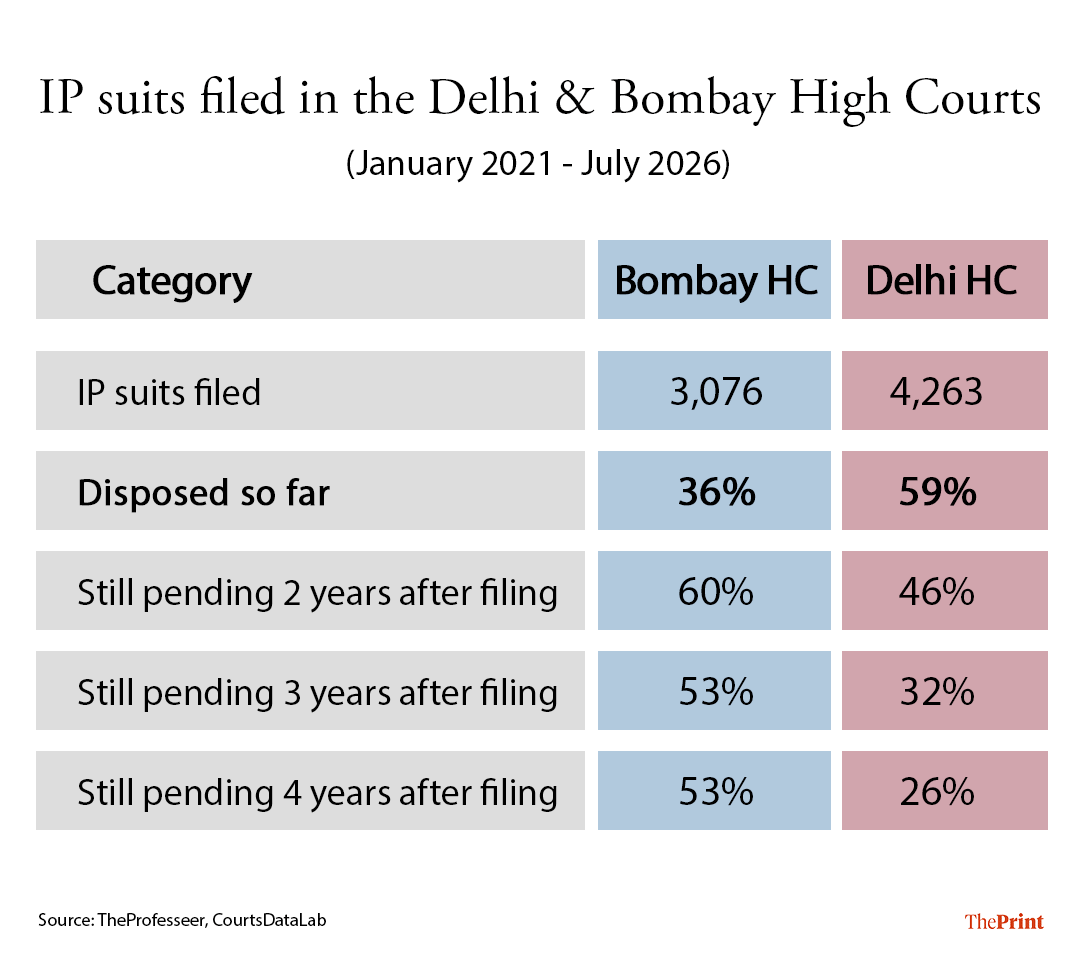
Pending cases have a way of staying pending. At the three-year mark, whether a Bombay IP suit ends is still essentially a coin flip: 53 per cent remain pending. In Delhi, only about one in three do. And among suits old enough to have crossed four years, more than half are still pending in Bombay. In contrast, it goes down to about one in four in Delhi.
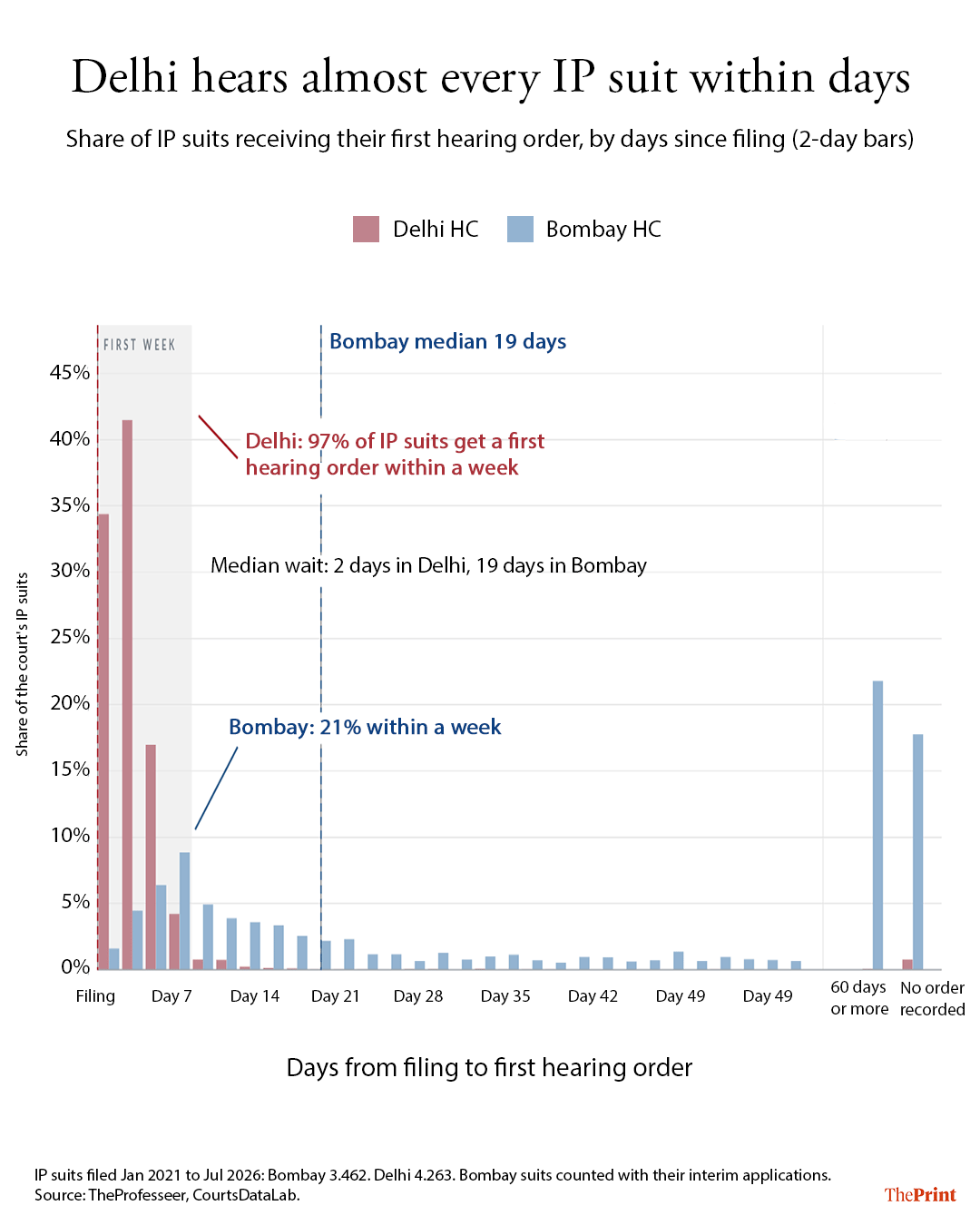
In any case, Indian litigants and practitioners would attest that in IP suits especially, the most significant hearing is not the eventual disposal, but the first hearing. That is where the interim reliefs that can make or break a case are potentially granted. An injunction, a stay, or a status quo order can determine the practical outcome of the dispute long before final judgment—especially in IP suits, where delay favours the infringer. The figure below shows how quickly that first hearing comes in each court. In Delhi, 97 per cent of IP suits receive a first hearing order within a week of filing. In Bombay, 21 per cent do, or about one in five.
What explains this consistently superior performance of the Delhi High Court? Part of the explanation is prosaic: registry design.
A prompt and efficient registry
Delhi’s process is designed to move a fresh filing quickly from registry to court. Every matter, as a rule, is e-filed. The registry promptly flags defects such as unclear pages or deficient court fees within 24 hours. If lawyers clear these before noon, the suit is listed before the judge the next day. Fresh matters are then heard on priority.
In sharp contrast, not every matter is e-filed at the Bombay High Court. Even the ones e-filed face two rounds of defects. The first is technical, where page numbers and OCR are checked, while the second more substantive, looking into aspects of court fees and pecuniary jurisdiction. Even if both stages are cleared, listing may take another couple of days. There’s no certainty on the likely date of first hearing or priority in hearing. Sometimes, lawyers find a workaround using an instrument called the ‘praecipe’, a mentioning application heard by a judge who decides whether the matter should be listed. However, speed and predictability are inconsistent in this route and depend more on a judge’s discretion rather than objective parameters.
In summary, Delhi’s registry signals promptness and efficiency better than Bombay. This expeditiousness brings lawyers and litigants back to itself (Delhi High Court?) whenever an IP dispute is in question. This lead is not accidental.
Also read: India’s Gen Z is fighting, not praying. Why its protests are bigger than politics
A head start in IP matters
The Delhi High Court established the country’s first Intellectual Property Division (IPD) in 2021, in response to the abolition of the Intellectual Property Appellate Board (IPAB) under the Tribunals Reforms Act, 2021, which transferred all pending IP cases and appellate jurisdiction directly to the High Courts and Commercial Courts. The IPD itself was the product of a deliberate, nearly six-month study of how 40 other jurisdictions across the world had structured their IP courts.
The same innovative and specialised instinct shows up in how the Delhi bench approaches the law, with judges well-versed in the doctrine, more willing to move quickly on interim relief than its peers and complete trials more quickly. Litigants respond by steering filings toward Delhi wherever the rules permit. The court was also one of the pioneers of a specialised clerk and researcher system to assist with the IPD. As a consequence, Delhi has developed a highly specialised IP bench and practice that reassures litigants and offers clarity in terms of outcomes.
That said, Delhi is now pushing back on jurisdictional hooks. In Hindustan Unilever v Kwick Living, Hindustan Unilever (HUL), registered in Mumbai, sued Kwick Living in Delhi for disparagement over an advertising campaign whose offending hoarding stood in Mumbai. Delhi had jurisdiction, HUL argued, because the campaign reached Delhi users through social media and e-commerce platforms. Troubled by this reasoning, the court referred the question to a larger bench. It asked if digital accessibility alone could carry a dispute to a distant forum, or whether territorial jurisdiction should stay anchored to physical presence, as traditionalists would argue.
How the larger bench resolves this remains to be seen. But the real question is not how wide Delhi’s door should be; it is why litigants queue at it at all. The advantages Delhi enjoys, namely speed, consistency, and reliable listing, should not be a Delhi monopoly. Every high court should read these signals as a call to reform its registry and filing systems. Swift justice should not require forum shopping. Until it does, litigants will keep gravitating northward, and courts will keep struggling to hold the line on jurisdiction.
Also read: GST’s next reform should be about making tax compliance easier for businesses
A lesson for all high courts
Development economists often describe the challenge of building good institutions as “getting to Denmark”. For India’s high courts, a close translation is getting to Delhi. Litigants across the country deserve registries that put a fresh suit before a judge within days, and they should not need roundabout jurisdictional routes to reach one.
India’s high courts share a common idea of what justice should feel like to the people who seek it. While ensuring decentralisation, courts must adopt best practices from one another. Delhi offers three practices that any high court can easily adopt on its own terms: e-filing as the default rather than the exception, a single round of defect scrutiny with a fixed 24-hour turnaround, and automatic listing and priority hearing of fresh matters on a predictable date rather than after final numbering.
Selective efficiency, in some courts but not others, privileges only the few who can afford to fight a case hundreds of kilometres away. Such a system is unfair and calls for urgent reform. The first step is, quite simply, to borrow a page from Delhi’s playbook.
Rashika Narain is an Advocate on Record at the Supreme Court of India.
Rohan Talwar is a commercial litigator from Delhi and is the Managing Partner of Talwar Law Offices.
Gokul and Srikanth are the Founding Lawyer and Founding Engineer at TheProfesseer, respectively.
Views are personal.
(Edited by Prasanna Bachchhav)