






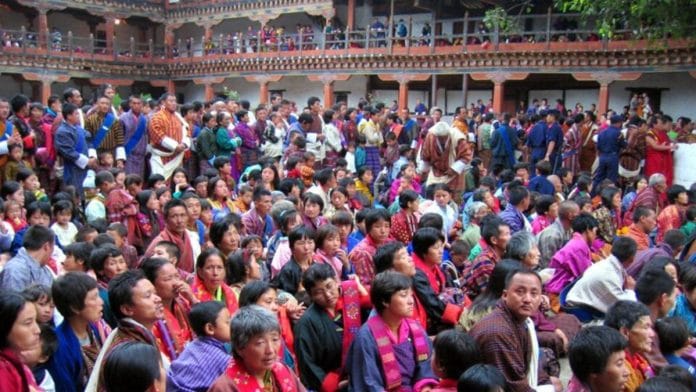

Whenever Bhutan attracts global media attention, it is often about the country’s Buddhist spirit or scenic beauty. But the media glare is also on the geostrategic front: Bhutan is a landlocked country, threatened by China from the north, especially as Beijing builds dams and engages in salami-slicing on the border territories.
However, in the last decade, Bhutan has faced a challenge of its own. Its falling birth rate and voluminous migration to countries such as Australia, Canada, and the United States pose an existential crisis.
In the first week of May 2026, Bhutanese Prime Minister Tshering Tobgay presented a mid-term review for the health ministry, emphasising the need to boost the birth rate in a country of approximately 8 lakh people.
“It is the responsibility of all of us. Even wartime countries would not suffer such a level of population decline. That is not sustainable,” he said.
Where does Bhutan stand today, and what lies ahead?
Data speaks louder
The data on Bhutan’s falling birth rate paints an alarming picture. In 2024, a mere 9,914 births were recorded in Bhutan, a 0.5 per cent drop from the previous year.
In 1952, Bhutan’s population growth rate was 2.74 per cent, and in 1979, it reached 3.44 per cent. Since 1980, the percentage has been on a downward trajectory, with the lowest dip in 1993, resulting in a growth rate of negative 4 per cent.
While multiple factors explain the population decline, globalisation and the opening up of the global economy were indeed key forces in the country’s outward migration, making the latter a direct factor. Though the year 2000 saw a major recovery in population to 2.45 per cent, the country has since seen a further decline. As of May 2026, the population growth stands at 0.69 per cent.
Meanwhile, the low birth rate remains a major concern. The situation becomes even more alarming when one looks at migration data over the last two decades.
It is estimated that over the last six decades, approximately 66,000 people have left Bhutan in search of employment, education, and other opportunities. Australia has become one of the top destinations for Bhutan’s educated youth. Among those moving to other countries, many are high-skilled, including civil servants, who migrate in search of better remuneration in other occupations.
“65% of migrants worked as professionals and technicians before migrating, and 52.6% of aspiring migrants are currently working in these occupations in Bhutan,” read a World Bank report on migration dynamics.
The report notes that a quarter of migrants worked in the education sector before leaving the country.
“Migrants are attracted by the prospects of better education opportunities, high earning potential, and a growing Bhutanese community in Australia,” said the document.
Also read: Modi can’t send workers on a long march back home again
The king’s speech
The king of Bhutan, Jigme Khesar Namgyel Wangchuck, had addressed the question of mass migration in his address during the National Day celebrations on 17 December 2023.
“I empathise with our youth who are at a crossroads. Given limited opportunities at home, they are faced with the challenging decision to move abroad for better incomes. Even our professionals–doctors, nurses, engineers, teachers, lawyers, architects and engineers, are in a similar position,” he said.
The king further stressed the gravity of the problem.
“Our challenge is that we have barely 700,000 people in our country. Unless we find the right solution, our population may dwindle to the point when we have more shops than customers, more restaurants than diners, and more houses than tenants,” he stated, adding that development is the answer.
Bhutan has therefore come up with the Gelephu Mindful City (GMC), an upcoming special administrative region in the Kingdom of Bhutan. The GMC will operate under the administrative model of ‘One Country, Two Systems’, and is mandated to “adopt and adapt best governing and business practices from around the world.” The move was announced by the king in his 2023 National Day speech.
The GMC has gained global prominence for its unique founding philosophy, which combines economic advancements with well-being, environmental sustainability, and mindful living. This approach combines global innovation and sustainability, grounded in Buddhist philosophy.
Among its key mega-infrastructure goals are the establishment of Gelephu International Airport as well as projects for hydroelectricity, green technology, finance, and digital assets. It will also focus on education, agriculture, and forestry, along with new monasteries and spiritual centres. These initiatives are aimed at slowing the number of migrants by accommodating the aspirations of the next generation. Supported by aid and investments from various countries, including India, the GMC aims to capitalise on its proximity to the Indian state of Assam.
During his visit to Bhutan in July 2025, Prime Minister Narendra Modi referred to the GMC in his address. He shared tangible support initiatives, including a decision to “connect Gelephu and Samtse to India’s extensive rail network”. Once completed, the railway connectivity would be key in providing the “Bhutanese industries and farmers with easier access to India’s large markets.” Railway connectivity with the GMC could further hold strategic potential for India as it continues to strengthen its infrastructure presence in the Himalayas.
India has also promised to establish “an immigration checkpoint near Gelephu to further facilitate visitors and investors.” This will be a major gateway to businesses and tourists.
While India continues to provide financial support to Bhutan’s Five-Year Plan, the GMC is being developed in a four-plus-one model. The city has a seed fund of its own, followed by Gelephu Investment Development Corporation’s nation-building bonds, aiming to raise $100 million. Under the third model, projects raise their own investments by bringing partners locally or overseas. The fourth funding channel will “rely on grants and loans from multilateral partners such as the World Bank and the Asian Development Bank”.
As the infrastructure projects at GMC take shape by 2045, critical questions linger: can the city remain responsive to development needs that will evolve across decades? Will opportunities at home truly rival those elsewhere, strong enough to draw Bhutanese back and stem a renewed brain drain?
For a country with limited economic opportunities to scale and a deeply rooted development philosophy, the success of the GMC may not be measured solely by speed, size, or skyline. The real test would be whether it succeeds in offering meaningful livelihoods and providing timely resolutions to pressing issues, including existential challenges such as the mass exodus.
Rishi Gupta is a commentator on global strategic affairs. Views are personal.
(Edited by Prasanna Bachchhav)
imagine a article on bhutan popualtion including hisotry and not talking about nepali genocide exodus