






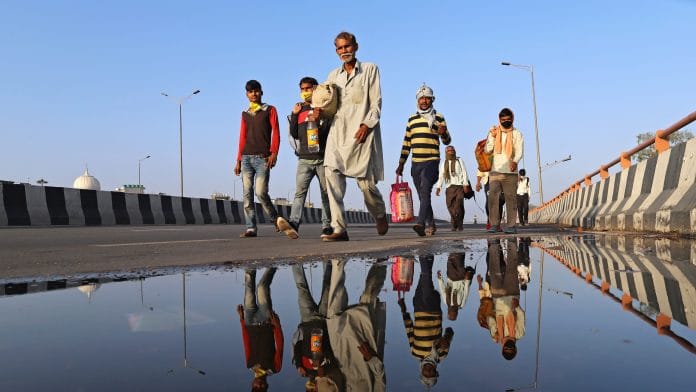


Those who labor hardest to build India are also the first to suffer in a crisis. When the first Covid lockdown was imposed in March 2020, images of migrant workers walking along deserted highways from cities back to their rural homes stunned and disturbed the country. They had to, because without the opportunity to earn a daily wage they were hungry and destitute — and, unlike in their native villages where families could help, there was no social safety net in large towns on which they could rely in an emergency.
The same thing, though on a thankfully smaller scale, is happening again. As the blockade of the Strait of Hormuz finally begins to bite, the price of fuel — and particularly liquid petroleum gas, or LPG, which is commonly used in the subcontinent for cooking — is increasing. For those lucky enough to have a formal address, the cost of a 14.2-kilogram cylinder has only increased by about 7%, to 913 rupees ($9.50) — though they still have to worry about a long wait for replacement.
But most urban migrants are outside the formal rationing system, and have to buy cooking gas on the black market. And there, the price, according to some reports, has more than quadrupled. That’s enough to make daily life unaffordable. Many low-margin street vendors have had to close shop as well, removing a source of cheap food. One construction worker told the Guardian newspaper that he hadn’t eaten properly in days.
The right response for any government in a supply shock like this one is to allow prices to rise while protecting the vulnerable — whether through direct subsidies or well-targeted rations. The problem is that, in India, entitlements are usually linked to your home address. Many migrants only stay in the cities for work part of the year, and don’t have a formal address there. And so they wind up slipping through the welfare system’s cracks.
This shouldn’t happen in a country that is rightfully proud of its innovative digital solutions, particularly in governance. Every Indian, after all, has a unique ID number, usually linked to a bank account. That should technically allow them to access their welfare entitlements anywhere.
But updating the creaking machinery of the welfare state is much harder than building a digital identity on top of it. Back in 2020, the government was shocked into motion by migrants’ obvious distress, and announced a program it called “one nation, one ration card.” It was to allow Indians access to subsidised foodgrain wherever in the country they might be. But that was never extended to other aspects of the welfare state — in particular, to the LPG or kerosene used for cooking.
The deeper problem is that the state tends to think of internal migration as something to be regretted, not enabled. It sees it as a sign of desperation, not aspiration; and so puts too little energy into making migrants’ lives better in the towns where jobs are, preferring to lavish attention on the places they leave behind.
You would think that India’s robust democracy would weaken this attitude. Sadly, it tends to strengthen it instead — because that other crucial entitlement, the vote, is particularly hard to transfer across regions and states. Cities’ elected leaders thus have little incentive to respond to the needs of migrants who will vote in faraway elections.
Fixing these gaps is overdue. It’s a moral necessity, as both the lockdown and this latest crisis prove. But it’s also an economic one. Migration to the towns is the engine of development and growth; without people coming in to work, vital sectors from construction to manufacturing would grind to a halt.
The laborer who told the Guardian that he’d been days without a proper meal was apparently working at the site where a new airport for New Delhi is coming up. The vast infrastructure projects that Modi hopes will transform the country depend upon those like him. In a real sense, the very people who are constructing a new India are the ones its government ignores.
This report is auto-generated from Bloomberg news service. ThePrint holds no responsibility for its content.
Problem statement is well defined, what is the solution?
As long as parties survive on regional / language issues, this problem will remain. Can parties be banned on this ground?? Absolutely not.
May be cooperatives need to be formed at every major city for migrant workers with a “Permanent Address” to deliver the benefits to migrant workers.
This article looks like propaganda, the title is illogical and the disclaimer said it all, “auto-generated from Bloomberg”. Why does The print publish such article?
What fake news is this? Direct Benefit Transfer is tied to Aadhar, which is not tied to address.
And what is stopping state govts, from doing DBT for state freebies, instead of subsidies? Then address won’t matter.
Lastly, Modi didn’t ask anyone to go home during corona. Hr asked people to stay puy for 21 days. Fear was spread by opposition, to make them go home.
Intentional mischief by opposition made a mess out of the situation.