



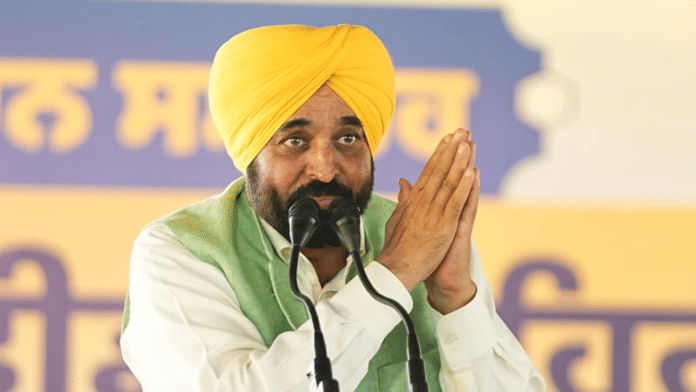

On 9 May, as Punjab Chief Minister Bhagwant Mann concluded his Shukrana Yatra — a thanksgiving pilgrimage to mark the passage of the Jaagat Jot Sri Guru Granth Sahib Satkar (Amendment) Act, 2026 — he drew a line in the sand. Responding to a 15-day ultimatum issued by Sri Akal Takht Sahib acting Jathedar Giani Kuldeep Singh Gargaj, the Chief Minister was categorical: the anti-sacrilege law will not be withdrawn, amended or taken back.
The manner of that response matters as much as its content. Sri Akal Takht Sahib Jathedar had already rechristened Mann’s Shukrana Yatra an “Ahankaar Yatra” — an expression of arrogance rather than gratitude.
This is a potential confrontation of the first order, and it has erupted even before the five Singh Sahiban (high priests) formally convene to deliberate, let alone pronounce.
The speaker episode
The episode that preceded it is instructive. The Jathedar had summoned Punjab Assembly Speaker Kultar Singh Sandhwan to the Sri Akal Takht Sahib Secretariat after the government passed the law without consulting either Sri Akal Takht Sahib or the Shiromani Gurdwara Parbandhak Committee (SGPC). The Speaker bowed his head and undertook to carry the Jathedar’s concerns back to the government.
The Jathedar’s objections were surgical, not wholesale: no unique serial number on the saroops of Sri Guru Granth Sahib Ji; no public disclosure of the identities of those holding sacred birs — a provision flagged as potentially dangerous, exposing devout Sikhs to anti-Sikh forces. The draft was prepared on the night of 11 April and passed within two days on 13 April. No copy was sent to Sri Akal Takht Sahib. No copy to the SGPC. A newspaper advertisement cannot substitute for consultation on matters that touch the internal religious affairs of the Panth.
A decade of justice denied
The new law itself is not the central issue. No practising Sikh — indeed, no person of any faith — can or should object to strict punishment for sacrilege. The SGPC itself officially welcomed the Act when it was first passed, a fact now buried under the current noise. The issue of sacrilege of Sri Guru Granth Sahib Ji has been exploited as political capital by every major party in Punjab — the Akali Dal, the Congress, the BJP, and now the AAP. Each has invoked the wounds of the Panth when in opposition and delivered precious little when in power.
The real question — the one that burns — is this: more than a decade after the egregious events that reached a flashpoint in 2015, where is justice?
In June 2015, saroops of Sri Guru Granth Sahib Ji were stolen from Gurdwara Burj Jawahar Singh Wala in Faridkot. On 12 October, torn pages were found scattered near Bargari village. The protests that followed led to police firing at Kotkapura and Behbal Kalan, where two protesters — Gurjit Singh and Krishan Bhagwan Singh — were shot dead. More than a decade later, the cases remain unresolved, now before a Sessions Court in Chandigarh under the Union Territory’s jurisdiction following a Punjab and Haryana High Court order.
The new Act applies prospectively. Article 20(1) of the Constitution bars retrospective penal legislation absolutely. As this writer analysed in The KBS Chronicle, its enhanced punishments cannot reach those whose acts predate its commencement. The perpetrators of the 2015 incidents of sacrilege will be judged under the laws of 2015. That makes the quality of prosecution in the Chandigarh courts not merely important — it is everything. This writer has formally written to the Union Home Minister urging appointment of a Special Public Prosecutor of eminence, integrity, and undivided commitment to these cases — not an overloaded routine duty officer — and a similar petition is being moved before the Punjab and Haryana High Court. This is where Panthic focus must rest, with at least as much urgency as the present institutional standoff.
Authority, legitimacy, and a structural problem
Now to the confrontation itself, and its deeper complications. The institution of Sri Akal Takht Sahib and the doctrine of Miri-Piri — established by Sri Guru Hargobind Sahib in the early 17th century — predate the colonial era and the Sikh Gurdwaras Act, 1925 by over three centuries. Sri Akal Takht Sahib’s authority is not a creature of legislation. Every Sikh across the spectrum affirms its temporal and spiritual supremacy, and when the five Singh Sahiban have spoken collectively, even the mightiest of Punjab’s political figures have bowed. That record is real.
But there is a structural problem that cannot be wished away. The SGPC has not held elections since 2011 — an entire generation of young Sikhs has never voted for their representative body. Its General House meets every November and routinely re-elects the same executive, effectively concentrating the power of nomination in the SAD president’s hands. The central government has shown no urgency in rectifying this, with no Chief Commissioner of Gurdwara Elections appointed after the previous incumbent’s tenure ended. The acting Jathedars, holding office at the SGPC Executive Committee’s pleasure, are consequently perceived — not without reason — as acting at the SAD’s behest.
Also read: Punjab’s anti-sacrilege law doesn’t guarantee justice. What more needs to be done
A political manoeuvre contested
This is the questionable political artifice that the present crisis may be calling out — one employed not infrequently by the Shiromani Akali Dal. In December 2024, the five Singh Sahiban, sitting collectively at Sri Akal Takht Sahib, issued a hukamnama declaring Sukhbir Singh Badal and other senior SAD leaders as tankhaiya — guilty of religious transgressions — for the sacrilege incidents, the Kotkapura and Behbal Kalan firings, and the pardon of Dera Sacha Sauda chief Gurmeet Ram Rahim Singh. The penance of sewa at Sri Darbar Sahib was publicly performed. The deeper requirements of that hukamnama — genuine accountability and actual delivery of justice — were not followed through. It is those same leaders who now invoke Sri Akal Takht Sahib’s authority most vocally.
The 15-day ultimatum runs until approximately 23 May. The people of Punjab — Sikhs and non-Sikhs alike — are waiting for something far more fundamental than a resolution of this institutional standoff. They are waiting for justice: for Bargari, for Burj Jawahar Singh Wala, for Gurjit Singh and Krishan Bhagwan Singh who fell at Behbal Kalan. That justice remains undelivered. Every political actor who has invoked the sanctity of Sri Guru Granth Sahib Ji must be measured, first and last, against that single, non-negotiable standard.
Only time will tell whether wisdom prevails. On the evidence of the last decade, which remains, painfully, an open question.
Disclaimer: The author holds the temporal and spiritual authority of Sri Akal Takht Sahib in the highest reverence and regards its edicts as binding, to be obeyed without reservation. As a practising turbaned Sikh, he has never — directly or indirectly — conveyed or intended to convey anything to the contrary, nor would he ever do so. The analysis above is offered entirely in that spirit.
KBS Sidhu is a former IAS officer who retired as Special Chief Secretary, Punjab. He tweets @kbssidhu1961. Views are personal.
(Edited by Aamaan Alam Khan)
Total waste of resources & energy.
If god needs protection then its no god.🤫🤫🤫