








This summer, reportedly, over a million Indians await their fate in the US at the hands of the ever-evolving immigration laws. In this anxious moment, it is easy to overlook how fraught it has always been for Indians to move and begin anew in the US.
The first of many naturalisation laws of the US was passed in 1790, and included “free white persons” in the eligibility criteria. In 1870, after the Civil War, the criteria were expanded to include people of African descent. Chinese and Asians were specifically excluded through the passing of the Chinese Exclusion Act of 1882 and the Immigration Act of 1917.
The second Trump Administration has sought to make immigration to the US an abject process filled with procedural hoops that are almost too difficult to navigate. In this moment, it is useful to remember the story of a Sikh man of humble origins who managed to become a US citizen under extremely trying circumstances.
From Taragarh, a small village near Amritsar, brothers Dr. Bhagat Singh Thind and Mr. Jagat Singh Thind, while trying to emigrate, witnessed the incredible racism of the early 1900s in the Western hemisphere.
The pioneer
Dr. Bhagat Singh Thind, dogged and determined in his time, would perhaps not be surprised that, a century after his death, the US presidential race in 2024 had three contenders of Indian-origin contenders. Nor would he be surprised by the long list of high achievers whose families made the arduous journey from India to the US over the decades.
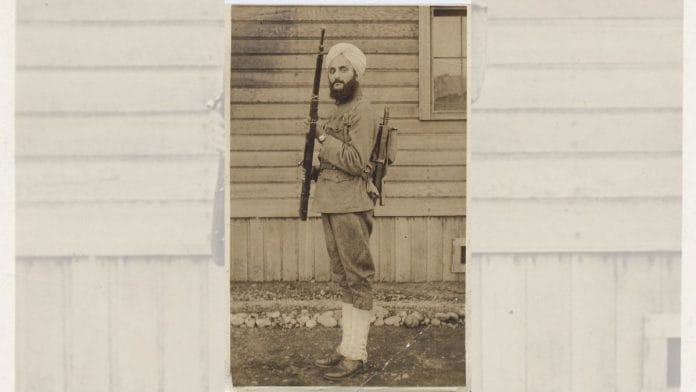
The story of the first, the pioneer, is always the one to behold. For Dr. Bhagat Singh Thind, the world outside his small village should have been a shadow. Instead, he enlisted in the US Army right before the end of World War I. He was honorably discharged from the rank of an Acting Sergeant in December, 1918. His motivation to leave India was to avoid getting arrested by the British, as he was involved in the Indian Independence movement against the colonial rulers. He applied for US citizenship in Seattle, Washington, and, received the same in December 1918.
Four days later, his citizenship was revoked by the then federal agency dealing with immigration, the Immigration and Naturalisation Service. Undeterred, Thind applied for citizenship from the neighbouring state of Oregon in May 1919 and successfully received the citizenship for the second time in November 1920. (Immigration of foreign nationals into the US was not regulated at the federal level until the late 19th century.)
This wasn’t the end of things, though. Dr Thind continued to fight for citizenship.
The case was sent to the US Supreme Court by the Ninth Circuit Court of Appeals to decide whether a Hindu born in Amritsar, Punjab, India, can be considered a “white person”. (Hindu and Sikh was used interchangeably by the US courts in those days.)
The Naturalization Act of 1906 in the US was expanded to include “aliens of African nativity and persons of African descent.” However, the highly restrictive Immigration Act of 1917 created the “Asiatic Barred Zone” to curtail immigration from countries such as India. With each subsequent legislation, the US codified whiteness as a foremost parameter of citizenship. (Parsi migrants from India such as Bhicaji Balsara argued for a racial determination of the term “whiteness” as opposed to place of origin.)
The white of it
Prof Erika Lee, an eminent historian and scholar of Asian-American immigration to the US, has written about America as a “Nation of Immigrants and a Gatekeeping Nation”. Lee traced the discriminatory attitude in the US toward immigrants to factors such as the rise of Know-Nothings party in 1850. The American Party (known as the Native American Party before 1855 and, colloquially, as the Know Nothing Party) was an alternative to the Democratic Party and based its ideology on the fear of immigration of Irish and German Catholics to the US. While the utility of immigrant labour was clear to the young nation, the Know-Nothings planted the seed of xenophobia. It helped realise the racialisation of immigration. The nativistic xenophobia continued and expressed itself during the First World War when Ghadar Party members and Germans in the US were accused of conspiring to overthrow the British government in India. Dr Thind and others like him found themselves in the US with these burdens of history, struggling for a corner in the new world.
Dr. Thind argued for his naturalisation by claiming that Hindus were white within the purview of the Naturalisation Act, since Hindus too had descended from Aryan ancestors. At a superficial reading, this case is an example of legal chicanery, where crafty lawyers throw everything and the kitchen sink to prove a point. At a deeper level, this is a tale of the scrappiness of the outliers in society and the way rules develop in society. These events and questions about the nature of loyalty played out in the backdrop of revolutionary activities by the Indian freedom fighters (belonging to the Ghadar Party) in various parts of the world, including North America.
It was not just an Indian national who had tried to attain citizenship through claims of being white. The Japanese tried it as well (Ozawa v. United States). (The US Supreme Court ruled that Takao Ozawa did not qualify for naturalised citizenship as he was not Caucasian) As much as the Thind case is a story of racism in the US, it is also a tale of the fate of freedom fighters from the colonies such as India who needed to move out of their homeland to save their lives. The promise of a new world, so alluring; yet drenched in the same institutionalised racism. Dr Bhagat Singh Thind could be eligible to become a naturalised citizen of the US – only if considered to be white. Unsurprisingly, his plea for citizenship was denied.
The jurisprudence in the cases related to US naturalisation evolved to build categories based on the distinction between a white and a Caucasian person. (Caucasian being inferred to mean white, based on the classification of races as mentioned by the Anthropologist Johann Friedrich Blumenbach’s classification of races in The Natural Varieties of Mankind)
Also read: What makes India so fascinating is that no one can prepare for it: German Ambassador
The aftermath
The judgment in the Thind case was followed by incredible hardship in the South Asian community in the US as the government-initiated denaturalisation proceedings. This led to loss of property and citizenship. One of the most tragic cases of this period was that of an Indian Vaishno Das Bagai, a staunch opponent of British rule in India. He was involved with the Ghadar Party.
After the Thind judgment, Bagai became a stateless being. He died by suicide. His Cri de Coeur, published posthumously in the San Francisco Examiner, stated, “I do not choose to live the life of an interned person: yes, I am in a free country and can move about where and when I wish inside the country. Is life worth living in a gilded cage? Obstacles this way, blockades that way, and the bridges burnt behind.”
Sangeeta Chakravorty is a Mumbai–based writer and lawyer. She is a recent graduate of the School of Advanced International Studies at Johns Hopkins University, Washington DC. Views are personal.
(Edited by Ratan Priya)