





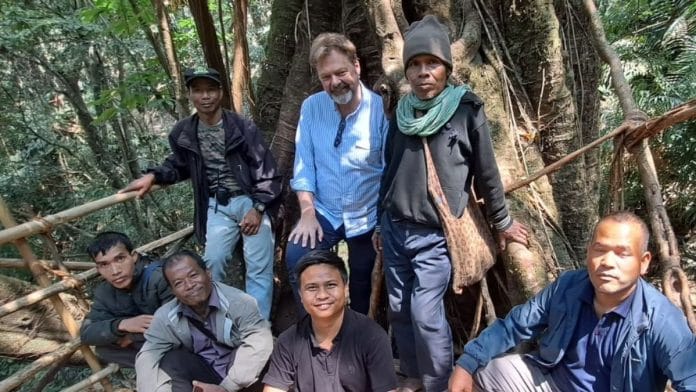


My time as the German Ambassador to India began in 2022, but some of you might know that this was not my first posting on the subcontinent. Between 2007 and 2010, I served as Head of the Political Section at the German Embassy in Delhi. So in some ways, I had an idea of what was expected of me. But can one really prepare for India? I don’t think so — and that, I suspect, is exactly what makes this country so fascinating.
India has so many facets, and is so large, so dense, and so intense that discovering it is a never-ending story. The surprises simply keep coming. And that may explain a trait that I encounter here often and admire a great deal: Indians have an unshakable optimism, and a firm sense of their own agency in the face of obstacles. I think that is why Indians do so well abroad, including in Germany. In India, you cannot plan things out as meticulously as many Germans would like, so you learn to be resourceful, flexible, and inventive. But make no mistake — the improvisational talent of many Indians usually goes hand in hand with a masterplan, a strategy for the long run.
In 2022, I came back to India after almost 12 years. During these years, the country changed considerably. The infrastructure has improved, which has made discovering the different corners of India far easier. The progress in digital infrastructure is equally impressive — an area where Germany could genuinely learn a thing or two from India. The relationship between India and Germany has also undergone fundamental change. Defence and military cooperation are much deeper now. With the Inter-Governmental Consultations (IGC), which began in 2011, we have a comprehensive coordination mechanism that creates a great many connections between ministries, and closer personal ties between the political and administrative leadership of our countries.

Perhaps the most palpable change in everyday life is the degree to which our societies have grown together. The Indian diaspora in Germany has grown to over three lakhs, and we currently host more than 60,000 Indian students. Beyond the numbers, this has genuinely changed how India and Indians are perceived in Germany. They are present in our best academic and scientific institutions, in management and IT, and in the traditional crafts as well. On the streets of Berlin, you now hear more and more Hindi and other Indian languages, added to the already remarkable mix that makes up the city’s soundscape. I recently visited the impressive Sri Ganesha Hindu Temple there, which has one of Europe’s tallest Gopurams. The moment I stepped inside, I felt the same bustling familiarity — and having that bit of Indian culture and warmth in Berlin is something that enriches our country.
A lively literary ecosystem
What makes living in Delhi so rewarding — professionally, but also personally — is India’s extraordinarily rich cultural and intellectual life. What first brought me to India back in 2007 was, in fact, a book. On one of those hot summer days in New York, where I was posted at the time, I found myself in one of the city’s many bookstores, drifting along the shelves. I picked a rather heavy tome off the shelf at random and read the first sentence: “You too will marry a boy I will choose.” Within a few pages, I was completely engrossed in this great romance set in post-independence India. I took it home and did not put it down until I had worked through all 1,300-odd pages.
The book describes Indian society in such vivid detail that I simply had to experience the country first-hand. I am, of course, talking about Vikram Seth’s A Suitable Boy. Nearly two decades later, I have had the privilege not only of spending seven years in India, but also of counting Vikram Seth as a friend. In a way, reading brought me to India, and reading has been one of my preferred ways of unravelling facet after facet of Indian society, culture, and history.
Indians have a remarkable talent for narrative and expression. You find it in films, in music, even in food, scents, and textiles. India has always struck me as a country of open doors and open arms, and this applies to its books and their authors as well. A number of younger Indian writers have produced some extraordinary fiction and non-fiction; you will never run out of things worth reading here. Authors here are remarkably accessible, and a conversation with a writer tells you more about a book than any review. I see this lively literary ecosystem as proof that India remains a space of many voices, of open argument, and of competing perspectives.
The author is the German Ambassador to India. He tweets @AmbAckermann. Views are personal.
This article is part of a series on the life, travels, and adventures of serving diplomats in New Delhi.
(Edited by Aamaan Alam Khan)