



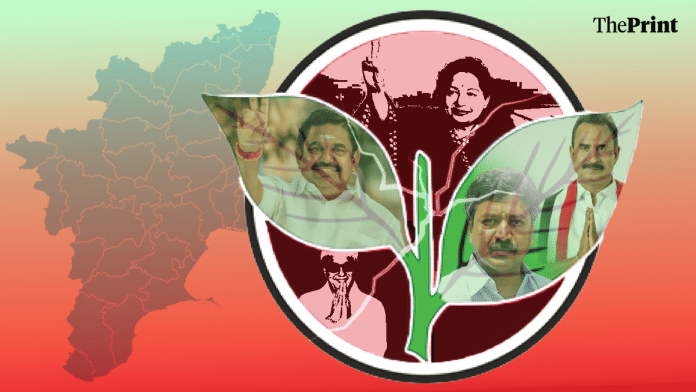
Two seats but one script that threatens to foreshadow a party’s slow march into political irrelevance. There are many takeaways from the results of the Tamil Nadu Assembly by-elections in Madurantakam and Dharapuram, but the one looming largest relates to the very future of the AIADMK.
It may be comforting to highlight, as some analysts have, that the AIADMK, which secured a little over 25 per cent of the popular vote in both constituencies, has been far from annihilated. But while a quarter of the vote in a three-cornered race may pass as a respectable loss, this holds good only as an abstraction. A granular examination of the AIADMK’s performance reflects some unflattering truths.
Madurantakam and Dharapuram were among the 47 constituencies won by the AIADMK in the April 2026 Tamil Nadu Assembly election. Both seats came up for bypolls last week because their sitting MLAs defected to the ruling TVK.
In the April election, the AIADMK won Dharapuram with a huge margin (16,727 votes), securing a vote share of 40.56 per cent. In terms of victories, this ranked just outside the top quartile of its 47 wins. The victory margin in Madurantakam was much smaller (7,194 votes), though its vote share stood at a handsome 35 per cent, higher than nearly half of the party’s other winning seats.
In short, the AIADMK should have fared far better in these constituencies. That it was pushed to third place in both and registered a net swing of about 15.5 percentage points in Dharapuram and 9.3 pp in Madurantakam does not bode well for the party.
It is a mistake to attribute too much weight to the PMK’s decision to remain neutral in the bypolls while explaining the AIADMK’s poor showing. There is no doubt that the PMK core community, the Vanniyars, are a dominant voting bloc in Madurantakam. But the swing against the AIADMK was far greater in Dharapuram, which suggests that the PMK’s neutrality fails to explain the overall slide.
Even worse, the results suggest that swing in favour of the TVK (about 13.8 pp in Dharapuram and 8.6 pp in Madurantakam) were gained almost entirely at the expense of the AIADMK. This only compounds the problem for a party that has already witnessed a spate of crossovers by legislators and local functionaries to the TVK.
Duopoly or disintegration?
Whether the October bypoll results will be a catalyst for further defections and intensify the challenge to Edappadi Palaniswami’s leadership will be worth watching. By themselves, the two by-elections point to neither duopoly nor disintegration, but it is perhaps no surprise that people are already asking whether this is the beginning of a process leading to both.
The TVK, which has not fought shy of assimilating the AIADMK, would of course like to hasten the process. The next round of by-elections will see five seats (Perundurai, Ambasamudram, Viralimalai, Karur, and Tiruchirappalli East) going to the polls.Four of these were originally held by AIADMK MLAs who switched camps to the TVK, while the last—Tiruchirappalli East—was vacated by Chief Minister Vijay, who chose to retain his Perambur seat after winning both constituencies in April.
Victories for the TVK will nudge it even closer to the majority mark and reduce its dependence on its allies. But what the by-elections showed is that it cannot take the electorate for granted. Madurantakam may have been something of a cakewalk, but Dharapuram was a fairly close call, with the TVK’s margin of victory much smaller than that of the AIADMK in the April election. Dharapuram also gave the TVK some flutters with the AIADMK leading in the early rounds before fading away and slipping to third place. The unusually heavy campaign the TVK ran in these by-elections reflected the importance it attached to them. Losing even one of the seats would have threatened the party’s political narrative and damaged Vijay’s image.
Meanwhile, the DMK attempted to make some lemonade out of lemons by claiming victory in defeat. There is no taking away from the fact that its vote share remained more or less intact. The marginal fall can be easily explained away by the absence of its various allies, who either lined up behind the TVK or contested as a separate bloc (the CPM, CPI and CPI-ML).
While the party can justifiably claim that it continues to enjoy a steady voter base, it will have to do better than hold its ground if it wants a shift in the electoral winds.
If the election results need to be condensed into a line, a hard-fought victory for the TVK, a middling performance for the DMK, and a defeat for the AIADMK could spell more troubles ahead.
Mukund Padmanabhan is a Professor of Philosophy at Krea University and the former Editor of The Hindu. He is the author of The Great Flap of 1942, a narrative history of India and World War II. He tweets @muk22. Views are personal.
(Edited by Prashant Dixit)
I am surprised it lasted so long after the passing of Ms Jayalalithaa.