





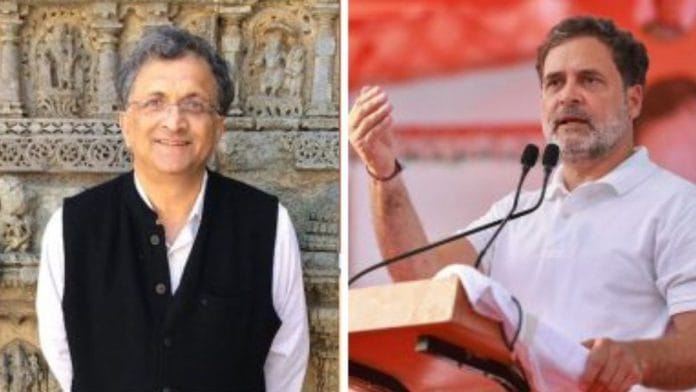


For several years, an argument has been making repeated rounds in political circles — especially in Hindu nationalist ones, though even those not particularly sympathetic to Hindu nationalism have sometimes expressed the same view, if less often and less emphatically. The argument is that, for all practical purposes, members of the “Gandhi Dynasty” — Sonia, Rahul and Priyanka — have become unwitting promoters of Narendra Modi’s ascending political fortunes.
This argument is made especially with reference to Rahul Gandhi. Two principal criticisms are levelled against him. The first is that he comes from a dynasty, which no longer enjoys popular support given that Indian politics has become broadly anti-dynastic and has, of late, empowered those rising from modest backgrounds — Narendra Modi being the most prominent example.
The second criticism is that Rahul Gandhi suffers from political ineptitude. It is argued that the Congress party is unable to see these defects, and even if some members do, the party as a whole is unable to jettison him (as well as Sonia and Priyanka) from a position of privilege and leadership. Willy-nilly, Modi is the biggest beneficiary. Modi is undoubtedly a popular hero for many citizens, but there are many others who support him because there is no plausible alternative in national politics. It is suggested that the latter set of voters can be snatched away through a more imaginative and skillful political management.
This political view recently received a huge intellectual boost from a well-known and unwavering Modi critic, Ramachandra Guha. He is one of India’s leading public intellectuals and a highly respected historian. In a column in The Telegraph, Guha called the Gandhi dynasty “Modi’s Enablers.” The historian’s ire is especially directed at Rahul Gandhi, though he concedes that the Congress leader is “a decent human being.”
Guha on Rahul Gandhi
What are Guha’s criticisms? Rahul Gandhi “lacks discipline, gravitas and a curriculum vitae.” He showed discipline “only during the few months of the Bharat Jodo Yatra.” His capacity for hard work is episodic, not relentless. In contrast, his BJP adversaries work untiringly all the time. The energy Rahul Gandhi spends on X should instead be invested in “renewing his own party at the grassroots.”
How do we assess Guha’s criticisms? In the social sciences, a distinction is often drawn between opinions and arguments. Guha says his is an argument, not an opinion. His column is driven by “empirical evidence,” not by his normative opinions against the Gandhi dynasty or dynasties in general.
So let us examine Guha’s argument. What political outcome is Guha trying to explain? And what are the factors that, according to him, explain that outcome? Rahul Gandhi’s inability to defeat Modi is the outcome Guha seeks to account for, and the explanatory factors are a mix. He is politically incompetent; he does not work hard enough; and he is an “entitled dynast.”
Here is the greatest problem with this mode of explanation. It is institution-free. In political analysis since the Second World War, the explanation of large political outcomes — for example, persistent election defeats or changes in regimes — is normally a combination of elite behaviour and institutional or structural changes. For large political outcomes, in other words, the analytic space is multi-variate, containing several variables. Leadership is just one of them.
Guha does talk of how “the Modi government has eviscerated public institutions, cowed the press and the judiciary, undermined democratic processes” etc. But these play no role in his interpretation of the Congress party’s election defeats. Institutions are spoken about, but they are not part of his explanatory impulse.
Guha recognises that the Bharat Jodo Yatra enhanced Rahul Gandhi’s political stature and under his leadership of the 2024 parliamentary campaign, the Congress nearly doubled its seats, relative to 2019. But these gains were “frittered away” by Rahul Gandhi’s ineptitude. That is why Modi is back at his most powerful.
Also read: The Modi paradox in 2026. Complete political domination alongside worsening economic slide
ECI, ED and the Judiciary
Such a staggering focus on personalities comes as a surprise. Let us concentrate on the impact of two institutions: the Election Commission of India (ECI) and the judiciary. So much has been written about them. And much has also been said about how India’s elections, the principal source of political power in a democracy, are ceasing to be free and fair.
A large body of literature on democratic backsliding, a process at work in several parts of the world, including the United States, is relevant here. It focuses on how the backsliders seek to alter institutions — for example, restructure the electoral playing field in such a manner that their hold over power does not decline. They also try to ensure that the judiciary, which can neutralise such moves, ceases to be a neutral referee.
Do these arguments not have implications for India? Could it be that after the shock of the 2024 election results, the Modi government thought of restructuring the electoral space in such a manner that 2024 is not repeated? In Haryana and Maharashtra, serious claims were made about the manipulation of electoral rolls. And an even more systematic initiative emerged after that. Under the SIR scheme and ‘gerrymandering’, franchise came to be redesigned in such a way that those whose votes were unlikely to go to the BJP either could not vote in adequate numbers, or were concentrated in constituencies in such a manner that their votes were rendered ineffective.
It is quite common for such institutional moves from the backsliding playbook to be challenged in courts. That is why the backsliders try to control the courts, so they cease to be “neutral referees”. This larger argument has an Indian version, too. In some circles, it has been argued that whenever political executives have been strong in the past, including during Congress rule, India’s judiciary has not been neutral. The judiciary acted even-handedly, playing its constitutional role, only when governments were weak. In support of this argument, the Supreme Court’s 1976 verdict, which called the Emergency constitutional, is the example often cited.
This argument is awfully incomplete. After 1971, Indira Gandhi’s election triumph and her subsequent victory in the Pakistan war had generated unrivalled power for her. The Economist called her the “elected queen” of India. Yet a judge in Allahabad overturned her election.
Also, who could have equalled Nehru’s power in the early 1950s? Yet the courts, treating the right to property as a fundamental right, rejected the legality of land reforms, which was the core of Nehru’s agricultural policy. (It was through a constitutional amendment that the legality of land reforms was re-established.) Thus, courts can act independently, even when executives are strong. But in India, of late, they have not.
More can be said about the Modi government’s institutional capture, especially how the law has been weaponised against opposition politicians through agencies such as the Enforcement Directorate (ED). Almost everywhere in the world, threats of prosecution and imprisonment can seriously deter the opposition from mounting a serious challenge to the incumbents, making it much harder for them to win elections.
To sum up, to make his campaign more effective, Rahul Gandhi may wish to restructure his leadership style, taking some of Guha’s criticisms in his stride. But to explain Modi’s continuance in power with an overwhelming focus on Rahul Gandhi’s leadership flaws is to ignore the mighty role BJP’s institutional capture has played in shaping India’s electoral arena in recent years.
Ashutosh Varshney is Sol Goldman Professor of International Studies and the Social Sciences and Professor of Political Science at Brown University. Views are personal.
(Edited by Prashant Dixit)
Writer is among the coterie of intellectuals who keep on propping up Rahul Gandhi. It may be far fetched but it seems BJP us paying these arm chair analysts and opinion makers to prop up Rahul and hide his incapacity so that BJP gets the opponent of their choice. These guys never talk about 2014 when all the agencies and systems were in hands of Rahul yet he faced worst defeat of his life.
I am not a big fan of Priyanka but she seems fat better option than Rahul and she also seems more mature and sincere than her 56 year old teenage brother.
I am giving one more conspiracy theory today for which I have no proof. There is a reason why Sonia is not letting Priyanka to take the driver seat as she knows the day Rahul leave that seat for his sister, his utility for BJP will end and all the cases like National Herald will be fast tracked and he alongwith Sonia will be sent to jail. This may have been communicated by BJP directly to Sonia.
So here BJP has double advantage in the ring, on one side they are very strong and on other side they have the freedom to choose the opponent of their choice.