





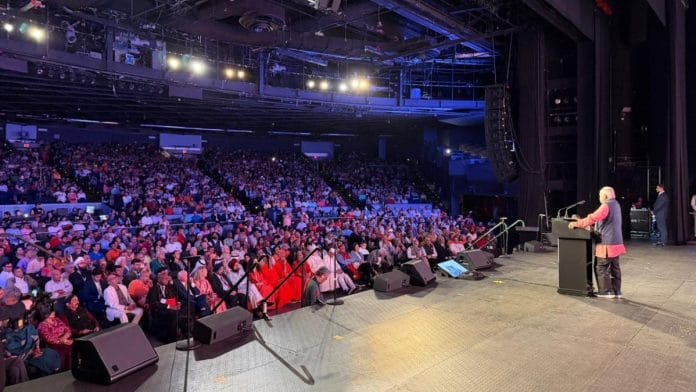

If any Hindu thinks that there should be no Muslims in India, he will not remain Hindu”, thus spoke Mohan Bhagwat, the RSS chief, at New York’s Madison Square Garden on 29 August.
This widely noted remark triggered two sets of responses. One claimed that Hindutva was either not originally anti-Muslim, or that it had moved decisively towards ideological moderation under Bhagwat’s tutelage. The former position would imply that those who claimed that Hindutva was anti-Muslim were either guilty of conceptual misidentification, or worse, were deliberately committing an act of political mischief. But the latter position would not deny the RSS’ anti-Muslim origins; it would only emphasise its contemporary movement toward moderation under Bhagwat’s leadership.
The second set of responses was unremittingly critical. It accused Bhagwat of “tere munh per teri si, mere munh per meri si” (“one face at home, another abroad”). In India, the RSS targets Muslims. Overseas, it projects magnanimity and a preference for religious harmony. Indeed, this claim of double-facedness, or duplicity, led to 90-odd US political leaders, including lawmakers such as Ro Khanna and Pramila Jayapal, signing a pledge that they would not accept financial donations from organisations or individuals linked to the RSS. Earlier, the hugely popular mayor of New York, Zohran Mamdani, had said that he would have banned Bhagwat’s event at the Madison Square Garden, but he did not have the legal authority to do so.
Since politicians and political parties are always looking to raise money, such fund-denying positions acquire a certain edge in US politics. Diasporas tend to be quite involved with their lands of origin. Indian Americans are very wealthy by now. They do contribute funds to influence politics.
So how do we judge? Which of the two groups is right?
Also read: Hindu nationalism has taken first steps toward establishing a Jim Crow system
Hindu supremacy, Muslim subordination
Clearly, the most pertinent issue is whether Hindutva has become moderate under Bhagwat’s leadership. To be more specific, the question is this: Does Hindutva accept Muslims as fellow Indians today, rather than seek their expulsion or extermination?
Let me draw a distinction between two alternative conceptions: building a Hindu nation through Muslim expulsion/extermination, or building it through Muslim subordination. My argument is that Hindu nationalism as an ideology seeks Hindu supremacy via Muslim subordination, not via Muslim expulsion or extermination. The latter is how Jews were treated in Germany under Hitler.
It is true that some of the Hindu nationalist cadres, or even mid-level leaders, have deployed words, slogans and themes that reek of violent fantasies and express a desire for Muslim expulsion. Let me recall some instances from my childhood and teenage years. My father was a UP government officer, and we were transferred every third year or so. In some towns, it was possible to hear vicious anti-Muslim slogans. I remember one slogan from Aligarh quite vividly: “Musalman bade beimaan, unke kato dono kaan, unko bhejo Pakistan” (“Muslims are hugely dishonest, cut off their ears, and send them to Pakistan”). In other towns, such as Lucknow or Allahabad, I would hear such slogans rarely, if ever.
Some leaders have also not shied away from venting such fantasies. During research for my Hindu-Muslim book, Ethnic Conflict and Civic Life: Hindus and Muslims in India (Yale and Oxford, 2003), I met an important functionary of the VHP in Gujarat. After receiving a promise of anonymity, which I am keeping here as well, he had no hesitation in saying that if the Muslims had been fewer in number, then “Arab Mahasagar mein phenkna” (“throwing them into the Arabian sea”) would have been an ideal solution for India. “Desh ke gaddaron ko, goli maro saalon ko” (“shoot the disloyal scoundrels”), a slogan loudly heard during the Delhi riots of 2020, has the same violent fantasy built into its political imagination.
Also read: Legal autocrats are on the rise. They use constitution and democracy to destroy both
Two-pronged objective of Hindu nationalism
If we go through the formulations of VD Savarkar, the ideological father of Hindu nationalism, we will find that the idea of Hindu supremacy, conjoined with Muslim subordination, is the basic thrust of Hindu nationalist ideology, not the idea of Muslim extermination.
The most systematic account of this distinction has appeared in a recent book by Luna Sabastian, Fascism in India: Race, Caste and Hindutva (Harvard University Press, 2025). She makes three important claims.
First, the centuries-long background of Muslim rule in India gravely bothered Savarkar, despite more than a century and a half of British rule. In the 1910s and 1920s, he believed that Muslim rule might return after the British left. “What was at stake for Savarkar was the erasure of the Muslim as a potential site of sovereignty”. Erasure, in other words, of the possibility of Muslim sovereignty returning, not a physical erasure of Muslims.
Second, Savarkar proposed that Hindus become a miscegenous race. “The template of Nazi racism applied by many scholars to Hindu nationalism is seductive but misleading.” Nazis wanted German purity and Jewish expulsion/elimination. Savarkar argued that just as Muslim men had married Hindu women in the past and converted them to Islam, Hindu men should marry Muslim women and convert them to Hinduism through shuddhikaran (purification). “This reproductive conquest mirrored, reversed and avenged Islam’s historical conquest of India.”
Third, strength through sanghathana (organisation) would have to be added to this project. Why? “Muslim men were capable of sovereignty. This needed to be crushed out of them; they needed to be defeated, to be absorbed.”
But Muslim women were quite distinct. “For Savarkar, women differ from men in their boundless capacity for re-inscription…; free for male inscription (by the father at conception) and re-inscription (by the husband..) through conversion and marriage.” Shuddhi and sanghathana, put together, are thus the pathways to restoring Hindu power.
What does Sabastian’s Savarkar have to do with Bhagwat’s claim about Hindus and Muslims? Bhagwat may not recommend that, in order to avenge what happened in the past, Hindu men should marry Muslim women. But Hindu nationalism under him continues to have a two-pronged objective: Hindu supremacy and Muslim subordination. Notably, this vision is not one of Hindu-Muslim equality, which is a fundamental premise of India’s Constitution.
Ashutosh Varshney is Sol Goldman Professor of International Studies and the Social Sciences and Professor of Political Science at Brown University. Views are personal.
(Edited by Prashant Dixit)