






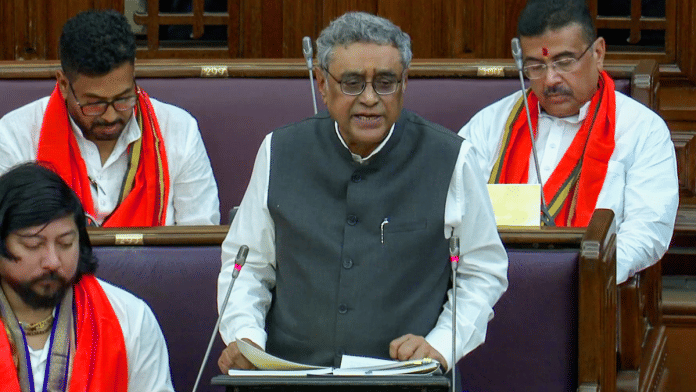


Culture. Tradition. Development. Employment. Dearness Allowance. These are the keywords for the West Bengal budget for 2026-2027. State finance minister Swapan Dasgupta’s maiden budget on 22 June has given an emphatic nod to cultural nationalism, religious tourism, development and job creation. It also breaks away from the previous administration’s focus on minority affairs and fights with the Centre.
By promising to utilise central government funds and flagship schemes to the tune of Rs 40,000 crore, Dasgupta has tried to close the gap between Kolkata and New Delhi. He is opting for cooperation, not confrontation.
Keeping Bengal first
As a newly elected MLA on 4 May, Swapan Dasgupta was talking about how West Bengal needs a new narrative. One that detaches itself from the immediate past and puts the state back on the highway to growth, development, job creation and cultural revival.
Exactly one month and 18 days later, as the Finance Minister of West Bengal, Dasgupta has presented the budget for the first-ever BJP government in the state, with a net allocation of Rs 4,38,775.29 crore. It has taken into consideration all the points he had touched upon on the evening of his victory.
Addressing a post-budget press conference in Kolkata, Chief Minister Suvendu Adhikari said the budget is “an attempt to bring back the lost culture and dignity of West Bengal.”
The state announced a 20 per cent hike in the Dearness Allowance (DA) for government employees. With the total DA of 38 per cent, the government is now acting on the persistent complaint of state employees who worked under the previous Trinamool Congress government. This will come into effect from 1 October.
In one of its pre-poll promises, the BJP had said it would give DA in line with the Centre’s rate. CM Adhikari asked for time to deliver the promise. “Give our government some time. We are committed to filling the 22 per cent DA gap. This time, we are providing 20 per cent DA,” Adhikari said.
The new government had also promised extensive job creation. On Monday, the government announced a massive recruitment drive to fill 1,00,000 vacant government jobs across various departments, including 20,000 positions in the police force and 50,000 teaching and non-teaching posts in schools. Dasgupta said 33 per cent of the jobs would be reserved for women, wherever applicable.
The government has also announced the Bharosa Karmosuchi scheme—to be launched in October—for monthly financial support to graduate job-seekers up to Rs 3,000 per month. Other unemployed young individuals will get Rs 2,000 per month. Additionally, the state has come up with a competitive exam support scheme—free coaching centres in every district and a Rs 30,000 one-time financial grant for students preparing for competitive examinations.
The budget outlined a massive Rs 40,000 crore infrastructure development push with plans to acquire 1,000 to 1,500 acres of land in Kalyani. The plan is to build Kolkata’s second major commercial airport, an elevated corridor connecting Chingrighata and New Town in Kolkata, a deep-sea port at Dadanpatrabar and a four-lane bridge over the Mayurakshi river in Birbhum. It also proposed studies for metro rail projects in Durgapur, Asansol and Siliguri.
Also read: Mamata Banerjee’s Osman Hadi killing speech has put India in a geopolitical mess
Back to roots, closer to Delhi
The most striking feature of this budget is the end to Bengal’s animosity with the Centre. Dasgupta talks of double-engine sarkar and “build Viksit Bangla as a part of Viksit Bharat”. The budget has unlocked around Rs 40,000 crore in development funds by adopting and utilising central government schemes.
Additionally, Rs 14,000 crore have been allocated to the VB-GRAMG scheme for rural employment. It is likely to kick in from July 2026.
Open market economics banks on cooperation and competition, not confrontation. And now West Bengal has a double-engine government.
“West Bengal’s precarious finances offered little scope for conflict. The double-engine government removed its possibility. Dasgupta will bank heavily on meeting his aim to increase state expenditure, ensure adequate capital expenditure to trigger growth and reduce fiscal deficit and revenue gap,” senior journalist and public policy analyst Pratim Ranjan Bose told ThePrint.
He added that reducing the debt-GDP ratio would be Dasgupta’s most ambitious dream and there is not much clue yet to the source of finance in the budget statement. “Probably, Dasgupta is resting his case on growth and central assistance,” he said.
Of all the new pledges and promises, the most noteworthy change is the over 50 per cent reduction in the budgets of the Minority Affairs and Madrasa Education departments. The TMC government was allocating Rs 5,713 crore—the BJP government has it has cut it down to Rs 2,165 crore. “We strongly oppose the steep cut in minority sector allocation,” Leader of Opposition Ritabrata Banerjee told the press.
This marks a clear shift in West Bengal’s expenditure priorities. “While education is generally an investment in human capital, large allocations to madrasa education over the years have not translated into commensurate gains in employability, productivity or economic growth,” Abhishek Malhotra, Assistant Professor, Department of Economics, Sri Venkateswara College, Delhi, and Visiting Fellow, India Foundation, told ThePrint.
Malhotra hailed the redirection of resources toward cultural heritage, religious tourism and associated infrastructure. He said it is likely to generate a much higher economic multiplier through increased tourist inflows, local employment, entrepreneurship and private investment.
To promote religious tourism, the budget has announced the development of the Bengal Shaktipeeth Circuit and the Chaitanya Mahaprabhu Pilgrimage Circuit to preserve and modernise Bengal’s age-old Shakti temples under a newly formed heritage commission. Specific funds will also be used to build heritage parks and libraries across West Bengal.
Bharatiya Jana Sangh founder Syama Prasad Mookerjee’s birth anniversary on 6 July will be declared a state holiday, the state finance minister announced. The government will also install a 125-foot statue of Mookerjee and allocate Rs 200 crore for a library and research facility dedicated to preserving his legacy.
“The budget also proposed setting up a modern museum-cum-cultural centre to mark the 150th anniversary of “Vande Mataram”, the national song written by Bankim Chandra Chattopadhyay. In another cultural initiative, the government announced plans to establish a Tagore Cultural Centre,” a report said.
The West Bengal budget 2026 formally ends the state’s fight with New Delhi and gives an emphatic nod to cultural nationalism. The slashing of minority funds will likely remain a sticking point.
Deep Halder is an author and a contributing editor at ThePrint. He tweets @deepscribble. Views are personal.
(Edited by Ratan Priya)