



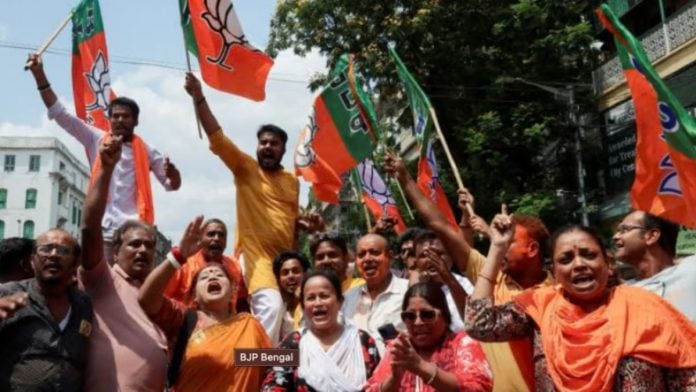
Bhoy out, bhorsha in”, roughly translated as “fear out, faith in”, is a political campaign slogan by the BJP earlier this year. It had caught the imagination of an electorate besieged by lawlessness for the past 15 years in West Bengal under the TMC rule.
Be it former chief minister Mamata Banerjee’s callous remarks on rapes, the 2021 post-poll violence where BJP workers and supporters were targeted across the state, or the more recent RG Kar rape and murder case that got people out on the streets demanding the resignation of Banerjee, West Bengal was crying out for change.
The BJP defeated Banerjee’s TMC and came to power in May this year with the promise of ‘sushasan’ or good governance. But with egg therapy, strip parades and encounter killings in the last few months, the new government has turned the idea of justice itself into a joke. Something Bengal’s voters looking for change did not sign up for.
Justice, khap style
On 28 October, two men, one accused of a BJP worker’s murder and another of a minor girl’s rape and murder, were shot dead in separate encounters within 24 hours in West Bengal. According to the police statement, in both incidents, the script remained more or less the same—accused were taken for crime scene reconstruction; they snatched firearms from the police teams and were killed in retaliatory firing.
The report said this is the second incident in which a rape-murder accused has been killed in West Bengal in an encounter with police since July. On 8 July, Prabhas Mondol, the accused in the rape and murder of a 13-year-old girl at Baruipur in South 24 Parganas district, was shot dead in an encounter.
At that time, the police version was that the accused had snatched a policeman’s weapon when he was taken for crime scene reconstruction and fired at the police party. He was killed in retaliatory firing.
The issue of rape had dominated public and political discourse under the Mamata Banerjee government. Two years ago, the rape and murder of a trainee doctor in Kolkata’s RG Kar Medical College and Hospital and the protests that followed had rocked the nation, sparking intense international scrutiny from global media houses.
On 15 August 2024, the BBC reported tens of thousands of women in West Bengal marched through the streets in protest against the rape and murder. The Reclaim the Night march was the culmination of nearly a week of frenzied protests after the killing of the 31-year-old.
In the following weeks and months, junior doctors and medical students went on an indefinite strike and cease-work protest across state-run hospitals in West Bengal, as all opposition political parties and their student wings in the state, including the BJP, Congress, and the Left parties, organised separate protest marches against the state government and concerned officials for alleged evidence tampering in the case.
One of the reasons the then Opposition politicians and people in general doubted the administration’s willingness to conduct an impartial probe in the RG Kar case was Banerjee’s cavalier comments on rape in the past.
From suggesting that girls should not be allowed to go out at night, to questioning whether an incident of rape was in fact a case of “love affair/pregnancy”, to calling a rape survivor’s testimony a concocted story, the state’s first and only woman chief minister till date had ended up trivialising a heinous crime.
Now, West Bengal’s new Chief Minister Suvendu Adhikari has said police would take “whatever step it deems necessary” if anyone dared to raise a hand against women, while the state’s urban development and municipal affairs minister Agnimitra Paul has posted a poem, titled “Encounter” on Facebook.
“While she (Agnimitra Paul) did not explicitly refer to police action, the timing of her post suggested that it was in response to the Tuesday incidents (twin encounters). In the opening lines of her poem, written in Bangla, Paul called for an end to crime and said people should be able to live in peace,” states a report.
While the ruling BJP may find no issues with encounter killings of rape accused even before the courts have had the chance to examine the cases, the Opposition and human rights organisations are not amused.
Both the TMC and the CPI (M) came down heavily on the government on the issue. MLA of the Mamata Banerjee faction of the TMC, Shobhandeb Chattopadhyay, has said an encounter might generate publicity but stressed the need to follow the country’s legal system. He pointed out that the Banerjee government had initiated amendments to the law to ensure speedy punishment in rape cases.
CPI(M) leader Sujan Chakraborty questioned how the accused could have possibly managed to snatch firearms from the police. Meanwhile, human rights organisation Association for Protection of Democratic Rights questioned the circumstances under which the accused were taken for a crime-scene reconstruction at midnight.
Also read: The real reason BJP is quibbling over the size of INDIA bloc’s rally
‘Police response raised uncomfortable questions’
Encounters are not only the khap-style instant justice delivery method that the new government in West Bengal seems to be adopting. In the last week of October, after three men were allegedly forced to walk naked in public, Kolkata Police paraded the accused through the same neighbourhood in “shorts, barefoot and with ropes tied around their waists, during a reconstruction of the alleged crime”.
“The original offence was disturbing enough. Then the police response raised uncomfortable questions about whether an alleged violation of human dignity had been followed by another, this time at the hands of the agency tasked with upholding the law,” The Telegraph wrote, pointing out that in recent months the police have paraded accused persons in shorts through crowded public areas during purported crime reconstructions.
The report quoted human rights activist Sujato Bhadra as saying that the law enforcement agency is violating basic human rights and is behaving like mobs.
“This sets a precedent, and if the police behave this way, the people will take the cue. This is a total collapse of the rule of law within five months of the new BJP government assuming power. If the police have started to deliver justice, the judiciary should be disbanded,” Bhadra told The Telegraph.
Yet another disturbing trend since the BJP has come to power in West Bengal has been the trend of mobs throwing rotten eggs at those who are linked to the TMC.
“In this peculiar ritual of cutting down public officials to size, numerous elected and outgoing MLAs, MPs, councillors, municipal and panchayat chiefs, grassroots activists, and even family members of leaders from the opposing TMC camp have been attacked with rotten eggs,” The Wire wrote, adding that this has played out in the middle of busy streets, during transportation of undertrials between police stations and courts, and even inside the homes of those accused.
Even the most prominent faces in the TMC, like MPs Abhishek Banerjee and Mahua Moitra, were not spared from this “egg therapy”. Moitra had shared a live video of a mob throwing eggs at her even as the police stood as silent bystanders, according to her.
Bengal has had a shameful history of political violence. After the BJP lost in the 2021 assembly polls and the TMC came back to power, hundreds of BJP workers and their family members reportedly fled the state and took shelter in Assam.
Then a senior minister in the Assam government, Himanta Biswa Sarma, had claimed around 300-400 BJP karyakartas and family members crossed over to Dhubri in Assam to escape post-poll violence. Sarma had claimed the Assam government was providing food and shelter to the party workers who had fled West Bengal.
Such lawlessness became one of the big factors why Banerjee lost the support of the very electorate that had once turned to her to rid the state of the Left government and bring in Poriborton (change). People have now turned to the BJP to bring back the rule of law. Normalising extra-judicial punishment in full public view would be a betrayal of voters’ trust yet again.
Deep Halder is an author and a contributing editor at ThePrint. He tweets @deepscribble. Views are personal.
(Edited by Saptak Datta)