





Revolutions not only devour their own children, as the old saying goes; they often drag to the ground all that was once held sacred and inviolable. The 2024 July-August uprising in Bangladesh, led mostly by students agitating against the excesses of the Sheikh Hasina regime, not only brought down the government of the day but also pulled down and desecrated the statues and memorials of the founding father of Bangladesh, Sheikh Mujibur Rahman.
The uprising and the period after did not just stop at that. It has examined, and continues to do so, the very ideals on which the country was born and the towering figures from history from whom those ideas came.
One of the most important of such figures, the man whose song became Bangladesh’s national anthem, Amar Sonar Bangla (My Golden Bengal), is now being reimagined as a closeted Zionist, a cruel zamindar of disreputable backstory, and a Muslim hater, not just by the country’s Gen Z, but also by some of its prominent politicians, influencers and writers.
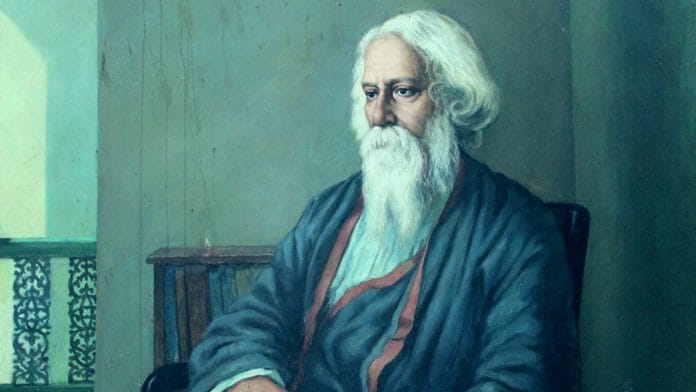
The billion Bangladeshi Taka question is: Will Rabindranath Tagore, so far revered by Bengalis both in West Bengal and Bangladesh, be able to pass the Gen Z test?
Rabindranath Tagore, who?
Through national and cultural multi-day events on his birth and death anniversaries, essay competitions, and seminars in educational institutions, books and films commemorating his life and times, Tagore has been celebrated in Bangladesh. Yet, with the socio-political churn brought about by the July uprising, Bangladeshis are now scrutinising Tagore’s politics and his worldviews through his writings. This has led them to ask: how does a country that does not recognise Israel and has no formal diplomatic or trade relations with it look at someone who was at the very least sympathetic to the idea of Israel?
On TV and in campus debates, and in lengthy posts on social media, Tagore’s acceptance of the Zionist state is being critiqued. Tagore passed away on 7 August 1941, and the modern state of Israel was only established seven years later on 14 May 1948.
But a now-viral post on popular Bangladeshi digital media and news page, Friday Post, on October 11 has argued that during the debates surrounding the establishment of the Jewish state, Tagore occupied a notable place in discussions about the relationship between East and West, cultural identity, and the revival of Eastern civilisation. The post says Jewish intellectuals frequently referred to his work during this period.
Quoting Shimon Lev of the Hebrew University of Jerusalem, the post reads: “Tagore was India’s most prominent representative in the Jewish and Zionist world of his days. Through the reception of Tagore’s writings, India constituted an additional component in the construction of an Asian identity in Jewish Palestine, emphasising the revival of the East and connecting it to its historical roots.”
The post also quotes Rabbi Benyamin, one of the most prominent representatives of Pan-Semitic Asian Zionism, as saying: “Clearer are the paths of India than paths of renowned countries in Europe and America. All this was achieved by the power of Tagore’s poems and Gandhi’s endurance.”
The Bangladeshi news outlet has also quoted Tagore’s 1930 interview with The Jewish Standard to show his support for the idea of Israel. According to the news outlet, Tagore was asked whether he supported Zionism.
“He replied, ‘I respect the Zionist ideal and admire the selflessness of those who work for it. I have followed as closely as I can the steady and continuous progress of the transformation of your ideal into reality. You have made extraordinary headway’,” states the Friday Post.
How do the youth of a country, an overwhelming majority of whom support the Free Palestine movement, react to such readings on Tagore?
On the same day as the post, The Daily Star reported that ANM Ayas, president of Rashtra Sanglap Forum, a nationalist group that emerged after the July 2024 uprising, and three others were arrested for allegedly attempting to deface a Tagore’s graffiti at Bangladesh Shilpakala Academy in Dhaka’s Segunbagicha.
Is it only Tagore’s views on a Jewish state that have fuelled anger against him? There is more. Bangladeshi politician and advocate Asaduzzaman Fuad, popularly known as Barrister Fuad, has mounted a spirited campaign against not just Tagore but the class of Bengali Hindus he belonged to. On TV debates and public addresses, Fuad has been putting forth the view that the Permanent Settlement, or the landmark revenue system introduced in 1793 by the British East India Company that changed land ownership and tax collection in colonial Bengal in favour of zamindars, helped those like Tagore.
“The Bengali Muslim faced two-tier discrimination, from the white masters and the Hindu zamindars. Tagore belonged to the upper caste Hindu landowning class that marginalised the Bengali Muslim,” Fuad said, adding that during Partition, Hindus were only 30 per cent of the population in Dhaka but they owned 70 per cent of the land, which goes on to show how marginalised the Bengali Muslim population was by those like Tagore.
Also read: Tarique Rahman’s real test after a grand Durga Puja – Hasina’s return, Hindu votes, Islamist diktats
‘Biggest ambassador of Hindu-Muslim unity’
Academic and author of the book ‘A Global Sociology of Caste and Power’ Satanik Pal told ThePrint the irony of today’s Bangladesh rejecting Tagore is that the polymath’s family had long been shunned by the Hindu society of that time for being what was known as Pirali Brahmins.
“Pirali Brahmins were a group of Brahmins deemed polluted on account of being in business with or maintaining social relations with Muslims in the medieval and early modern periods,” Pal said.
Pal added that Tagore was against extremists of all religions and such selective reading of him, as some Bangladeshis seem to be doing today, is indeed tragic.
Many young Bangladeshis deriding Tagore today quote extensively from Major General (Retd) MA Matin’s book ‘Amader Swadhinata Sangramer Dharabahikata Ebang Prasangik Kichhu Katha’ (Chronology of our freedom struggle and some associated discussions). The retired army officer has reimagined Tagore as an orthodox Hindu, a Muslim hater who opposed the partition of Bengal and was also against the setting up of Dacca (now Dhaka) University.
In an opinion piece in Daily Waadaa titled ‘Poet or Patriarch?’, M Ahmedullah writes that Tagore’s towering international reputation and extensive collection of poetry, music, and philosophical prose have often been used for ambitious social engineering projects.
“Critics argue this political deployment has often served to pressure the Muslim majority of Bangladesh into marginalising or erasing parallel dimensions of their indigenous heritage, historical memory, and distinct cultural expressions,” Ahmedullah writes.
Academic and oral historian Avishek Biswas told ThePrint that while re-reading any literary great with new perspectives is a welcome move, what has to be remembered is that during 1905, Tagore became the biggest ambassador of Hindu-Muslim unity.
“Bangladesh’s Gen Z should not read Tagore through the narrow lens of religion. He imagined a world where one walked with the head held high,” Biswas said.
Interestingly, some have even blamed former Bangladesh Prime Minister Sheikh Hasina for anti-Tagore sentiment in Bangladesh today, arguing that during her tenure, the polymath was elevated to the status of a secular deity.
“To admire him was a mandatory political credential; to question the state-curated version of him was to be branded a barbarian, a communalist, or a latent Islamist seditionist. In the regime’s binary world, you were either a refined, Tagore-quoting citizen or a crude, suspicious insurgent,” former Minister (Press) of the Bangladesh High Commission in New Delhi Faisal Mahmud writes.
As post-Hasina Bangladesh rewrites itself, it may be some time before Tagore finds his feet again.
Deep Halder is an author and a contributing editor at ThePrint. He tweets @deepscribble. Views are personal.
(Edited by Saptak Datta)