






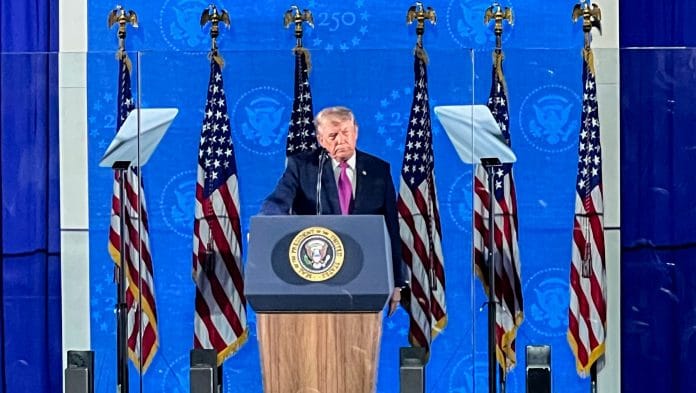


As the United States marks 250 years of independence, it stands at an inflection point, both in how it sees itself and its ties with the rest of the world. Debates over immigration, nationalism, and foreign policy have unsettled the long-held idea of America as both an ongoing nation-building project and the principal architect of the post-war liberal order. Yet, despite recurring predictions of American decline, no other state has shaped the contours of modern geopolitics and international relations as profoundly, both through the accumulation and projection of power. As allies, rivals, and partners recalibrate their strategies in response to the foreign policy impulses of the Trump administration, it is an opportune moment to reflect on America’s journey to become the most consequential great power of the modern era, exercising an unmistakable influence over the course of world affairs.
Despite decades of obituaries predicting its decline, the United States remains the world’s pre-eminent military and economic power, even as technology reshapes global competition. But 250 years of self-proclaimed American exceptionalism underscore an enduring reality: Greater power brings greater responsibilities and even more difficult strategic choices. For every rising power in the twenty-first century, the United States will remain a principal benchmark, competitor, partner, and sometimes adversary, ensuring that America’s trajectory continues to shape the future of the international order.
The American reload
America’s rise has been a story of constant adaptation. Successive waves of migration continually replenished its talent pool while reshaping the politics of national identity and the meaning of being “American”—debates that today animate the “America First” and “Make America Great Again” narratives. It is equally a story of geographic adaptation: From thirteen colonies on the Atlantic seaboard to a continental power expanding westward and southward, forging the territorial contours of today’s fifty states. This expansion endowed the United States with strategic depth, vast natural resources, access to both the Atlantic and Pacific Oceans, and a commanding position across North America while establishing it as a Pacific power. After emerging from the Civil War, rapid industrialisation transformed these geographic advantages into economic might. Railroads, steel, manufacturing, finance, and technological innovation powered an economy capable of projecting influence far beyond its shores.
Economic power soon translated into geopolitical ambition. By the late nineteenth century, the Spanish–American War and the rise of American sea power reflected the growing belief that US security and prosperity depended on developments far beyond its shores. While the Monroe Doctrine of 1823 was initially more aspirational than enforceable, the Roosevelt Corollary in 1904 transformed it into an assertive doctrine of hemispheric leadership, signalling that the United States was no longer content merely to defend itself, but intended to shape its strategic neighbourhood.
The Second World War transformed American ambition into global leadership. Washington emerged not merely as the war’s victor but as the principal architect of a new international order, building an unparalleled alliance network and an economic architecture that underpinned its own primacy while enabling the relative prosperity of others as well. The United Nations, the Bretton Woods institutions, NATO, the Marshall Plan, and the dollar-centred financial system formed the pillars of a post-war American project that relied as much on institutions as military power to sustain global stability, later dubbed the liberal international order.
Also read: How India can fill the human rights deficit in Trump era
Great powers’ Catch 22
Leadership, however, comes with an inseparable sibling: Burden. As American power grew, so did expectations that it would secure trade routes, defend allies, stabilise markets, respond to crises, deter adversaries, and uphold the rules-based order. Great-power status increasingly meant becoming the world’s first responder, while managing partnerships and commitments that are more complex.
The Cold War revealed both the extent and limits of American leadership. Nuclear deterrence prevented direct conflict with the Soviet Union but shifted competition to ideology, technology, space, and proxy wars. Korea and Vietnam exposed the limits of military superiority, demonstrating that winning battles was often easier than securing lasting political outcomes. The Soviet Union’s collapse briefly ushered in a unipolar moment, with liberal democracy ascendant, globalisation accelerating, and American primacy appearing unrivalled. Yet history has a habit of humbling claims of permanence.
The attacks of September 11 redirected American strategy toward counterterrorism and prolonged military interventions. The wars in Afghanistan and Iraq displayed America’s unrivalled ability to project military power but also exposed the immense costs and limits of nation building. Military superiority could topple regimes but not necessarily build stable political orders. The ongoing crisis in West Asia further underscores that overwhelming military power does not automatically translate into regime change either. The 2008 global financial crisis revealed another vulnerability: The highly interconnected order that American leadership had helped build could also transmit instability with remarkable speed, raising fundamental questions about economic resilience and the durability of the liberal international order. Even as these crises strained the foundations of American power, a more consequential structural shift was underway—the gradual transition and diffusion of power plus the emergence of a more contested international order.
Also read: Trump’s hard-power world has exposed India’s economic dependencies
Great powers don’t like peers
China’s rise has fundamentally reshaped the global balance of power. But unlike the Cold War, today’s rivalry is defined as much by interdependence as by competition. The United States and China contest leadership in critical technologies, supply chains, and global infrastructure, while remaining deeply connected through trade and finance. At 250, America faces perhaps its most difficult strategic dilemma: China’s comprehensive national power cannot be contained without inflicting economic costs on itself, its allies, and the wider world. The defining logic of twenty-first-century geopolitics is not outright containment, but a complex mix of deterrence, resilience, selective decoupling, and continued engagement.
The currency of power has changed. Aircraft carriers and nuclear weapons remain indispensable, but twenty-first century influence increasingly rests on technological leadership, industrial capacity, advanced manufacturing, digital infrastructure, and resilient supply chains, making economic competitiveness inseparable from national security. The United States still possesses an unparalleled alliance network across Europe and the Indo-Pacific, but those relationships are evolving. Allies increasingly seek partnership over patronage, while major stakeholders of global and regional orders seek to pursue greater strategic autonomy. Developing countries expect investment, technology, infrastructure, and climate finance alongside security guarantees. Leadership is therefore measured not only by the ability to project power, but also by the capacity to provide global public goods. Nowhere is this shift clearer than in the Indo-Pacific, where overlapping minilateral frameworks such as the Quad and AUKUS complement traditional alliances, recasting the United States less as a solitary guarantor and more as the orchestrator of coalitions.
Equally important is what happens within America itself. Its global influence has always rested on far more than military power, drawing strength from economic dynamism, innovation, immigration, higher education, resilient institutions, and democratic governance. These foundations have been an inevitable part of not only America’s domestic vitality but have also had long-term geopolitical impact.
The United States is still likely to remain one of the world’s pre-eminent powers. The challenge, however, is adapting to an international order where power is more diffused, technology outpaces institutions, alliances demand consultation rather than deference, and transnational challenges cannot be managed unilaterally. America’s greatest advantage has never been military or economic power alone, but its remarkable capacity for reinvention and renovation in the face of transition. At 250, it confronts the timeless paradox of great powers: The greater the power, the greater the responsibilities and the more difficult the strategic dilemmas.
Monish Tourangbam is a Fellow at the Chintan Research Foundation (CRF), New Delhi. Views are personal.
(Edited by Theres Sudeep)