






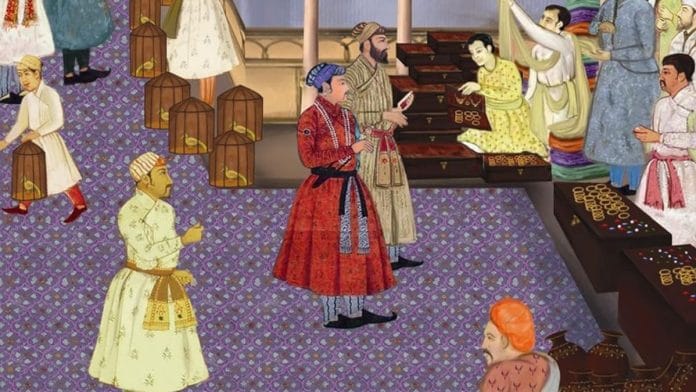


Imagine a text that is the first autobiography by an Indian in an Indian language, provides a rare glimpse into the life of a commoner during Mughal times and is a primary source for understanding the Adhyatma movement within Jainism. Sounds like fiction, but Ardhakathanaka by Banarasidas ticks all the boxes.
Banarasidas was a merchant whose life spanned the rule of three Mughal emperors, Akbar, Jahangir and Shah Jahan.
At a time when Indian literary traditions usually consisted of grand chronicles of monarchs or hagiographies of saints, Banarasidas shifted the focus toward the self. He chose to document his life not as a flawless hero but as a fallible individual navigating the complexities of the Mughal era. His account reveals aspects of the time rarely found elsewhere.
Banarasidas was a Shrimal Jain merchant who completed this account in 1641 when he was 55 years old. Since Jain tradition holds 110 years to be the ideal human lifespan, with wry humour, he named his account Ardhakathanaka or Half a Tale. Unfortunately, he would pass away just two years after completing the book. He wrote the text in versified colloquial Brajbhasha and clearly meant it to be read, recited and enjoyed by friends and associates. He was born in Jaunpur and spent his early life there, but later lived, for varying periods of time, in Agra, Varanasi and Khairabad. Patna and Itawah formed the eastern and western boundaries of his world.
Also read: What Mughal and British rule did to India’s forests
Mercantile life
Ardhakathanaka provides fascinating insights into the values, practices and experiences of a medieval mercantile community. Banarasidas’s family belonged to the middle-ranks and dealt in jewellery, textiles and other goods. As a boy, he was trained in bookkeeping, cost accounting, drafting commercial documents and detecting counterfeit coins. Fluent in Sanskrit, Prakrit and Brajbhasha, he had adequate knowledge of Persian as well. In fact, he helped a Mughal noble to read Jain texts in Sanskrit.
Travel was an integral part of a trader’s life; Banarasidas too constantly journeyed between Agra, Jaunpur, Varanasi and Patna. These involved considerable risk — he and his fellow travellers once lost their way and were forced to spend the night in a bandit-infested forest. Another time, the group was mistaken for thugs by the local authorities, and they almost ended up in jail.
The text contains invaluable information on the business ethics and commercial practices of the time. It describes a robust system of credit where promissory notes (hundis) ensured smooth transactions and cashless movement of resources across territories. Strict rules were enforced for forming and dissolving partnerships. A respectable merchant was expected to be honest, thrifty and enterprising. Business ethics had to be upheld irrespective of family or caste solidarity.
The Ardhakathanaka also provides a striking depiction of the clash of cultural values in the author’s family. His family expected Banarasi to follow his father’s footsteps into the world of commerce. But his heart lay in the study and writing of religious and literary works. Elders in the family admonished him—
Too much learning behoves a Brahman or a bhat (bard);
A merchant’s son has to sit in the bazar.
He compromised for the sake of livelihood and family peace but did not give up on his dreams. Later in life, not only did he author several works of poetry, philosophy and lexicography, he was one of the leading proponents of the Adhyatma movement, which was a precursor of the Terapanthi sect of Digambar Jainism.
Also read: To understand Mughal history, look at the wives and daughters. Not just male rulers
Interaction with the Mughal State
The ‘big’ political events of the time—the conquests, rebellions and court rivalries are hardly mentioned by him. The only time they appear in the text is when they intrude directly into his world. One such instance is the rebellion by Prince Salim (the future Jahangir). The prince was moving through the forests near Jaunpur. The governor of Jaunpur received orders from Emperor Akbar to prevent Salim’s progress, as the emperor suspected rebellion. Banarasi described the immediate impact—
All roads leading to and from Jaunpur were blocked,
All bridges and gateways into the city were closed.
The city was turned into a veritable fortress with the cavalry deployed and artillery and armed guards stationed on the ramparts. Food, water and arms were stockpiled as Jaunpur prepared for a siege. The townsfolk fled the city, fearing loot and devastation. Caught between the emperor’s orders and Salim’s anger, the governor prepared for death. Fortunately, notes Banarasidas, he was able to secure the prince’s pardon and peace returned to Jaunpur.
Another instance in the account shows how far the common people, in this case, traders, were often at the mercy of nobles and local chiefs. At this time, Banarasidas was a young boy. The governor of Jaunpur arrested all the jewellers and demanded a sum from them which was beyond their means. He then ordered them to be lined up and flogged. However, he then released them. The next morning, the jewellers conferred among themselves and decided to leave the city, taking as much of the wealth with them as they could. They could only return after some months, when the governor had left Jaunpur for Agra.
Banarasidas’ description of people’s reactions to the news of Akbar’s death provides a sharp contrast to the above—
The news of his death reached Jaunpur.
The people, bereft of their emperor, felt orphaned and helpless.
For Banarasi himself, the news was like ‘a blow upon the heart’. He fainted in shock, cutting his head open on the stone floor of the courtyard, which ‘turned red with his blood’. Given that the governor who had caused so much grief to the people was a noble in Akbar’s administration, it is unusual to find this reaction. Nor can Banarasi be accused of flattering Akbar since the latter died thirty-six years before this account was written. Moreover, he mentioned the passing of Jahangir in a matter-of-fact manner, without emotion.
In the meantime, as the news of the emperor’s demise spread, the city was in turmoil. As during any major political transition, riots had broken out, shops were closed, and people barricaded themselves inside their houses. The wealthy, hastily buried their jewellery, valuables and account books in separate hiding places. Both men and women cast off their finery and dressed in ‘rough blankets’. The poor and the rich now looked the same. After ten days of terror, a letter arrived from Delhi, which proclaimed that Salim was now on the throne as Emperor Jahangir. The news spread quickly through the city, ‘giving relief to the people’. These descriptions demonstrate how vulnerable the urban commercial milieu was to transformations at the imperial level in the pre-modern world.
Also read: How pragmatic calculations shaped Mughal rule in medieval West Bengal and Tamil Nadu
An ‘ordinary’ life
All that I have heard, and seen with my own eyes,
Let me tell of those matters in my own words
He penned his story to share his life experiences with future generations. This endeavour, in itself, was exceptional for the time. It is an unfiltered and deeply personal account which owed nothing to royal patronage. There exist plenty of chronicles and official histories for the period which detail the factional politics at court, the administrative policies and the grand military conquests. But this account is completely different as it held up to the light the lived reality of a middle-class merchant. Banarasi did not explicitly refer to political or administrative matters, but his values, beliefs and experiences clearly reflected the socio-cultural norms and trends of the period. He offered an insider’s view of the myriad textures of urban life in a medieval Indian city, something as riveting as it is rare.
It is this that makes Banarasidas’ Ardhakathanaka so unique.
Dr. Krishnokoli Hazra teaches history at the undergraduate level in Kolkata. Views are personal.
(Edited by Theres Sudeep)