



Listening to the speeches delivered in the run-up to the Students’ Union elections at Aligarh Muslim University, one could almost hear Shakespeare whisper sardonically “The fault, dear Muslims, is not in India’s Constitution, democracy, and secularism, but in yourselves, that you are fanatics.”
Every speech resembled every other in its religious rhetoric, rabble-rousing, pompous invocations of past glory, and thinly veiled threats of what might happen should the community not be kept in good humour.
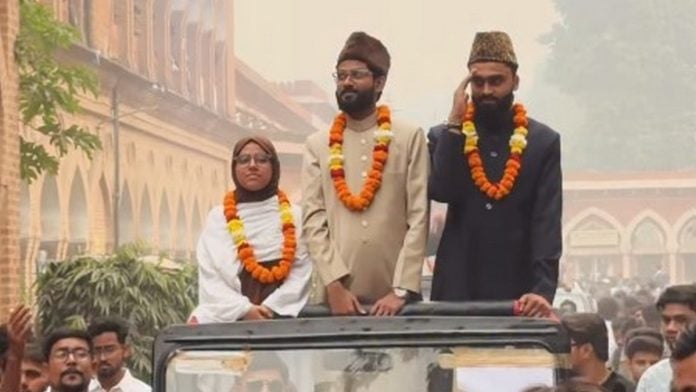
The victorious presidential candidate Noman Ashraf electrified the atmosphere with his pan-Islamist bluster as he waxed eloquent about his heart aching and throbbing for the Muslims of Palestine, Iran, and Sudan. He prophesied that these people would finally be victorious with divine intervention in the form of swarms of Abābīl—the mythical avian army that dropped clay pebbles on the forces threatening the Ka’bah in pre-Islamic Arabia. The uproarious cheer with which it was welcomed made it clear that the implied intent of this allegory wasn’t lost on anyone. The meaning was further clarified when he rhetorically asked that if the grievances of Muslims couldn’t be discussed at AMU, would they be deliberated at the RSS headquarters in Nagpur?
Nashra Naim, a candidate for the post of vice president, came draped in a Palestinian keffiyeh to insinuate that Muslims in India share the same lot as the Palestinians in Gaza. Her message was stark. She began her speech with a verse of the Quran that pertains to jihad—Ayat 7 of Surah Muhammad. It reads: “O you who believe, if you help (the religion prescribed by) Allah, He will help you, and will make your footholds firm”. Neither the semiotics of her dress nor the semantics of her scriptural reference went unnoticed. She won the election and became the first woman elected to one of the Union’s three top positions. Needless to say, she wore a hijab, and so did all the other women candidates. As an aside, one can safely remark that Islamic feminism is more Islamic than feminist.
Mohammad Hamdan, who won the post of honorary secretary, repeatedly raised the Islamic war cry of Nara-e Takbeer, and the premises reverberated with the response: Allahu Akbar.
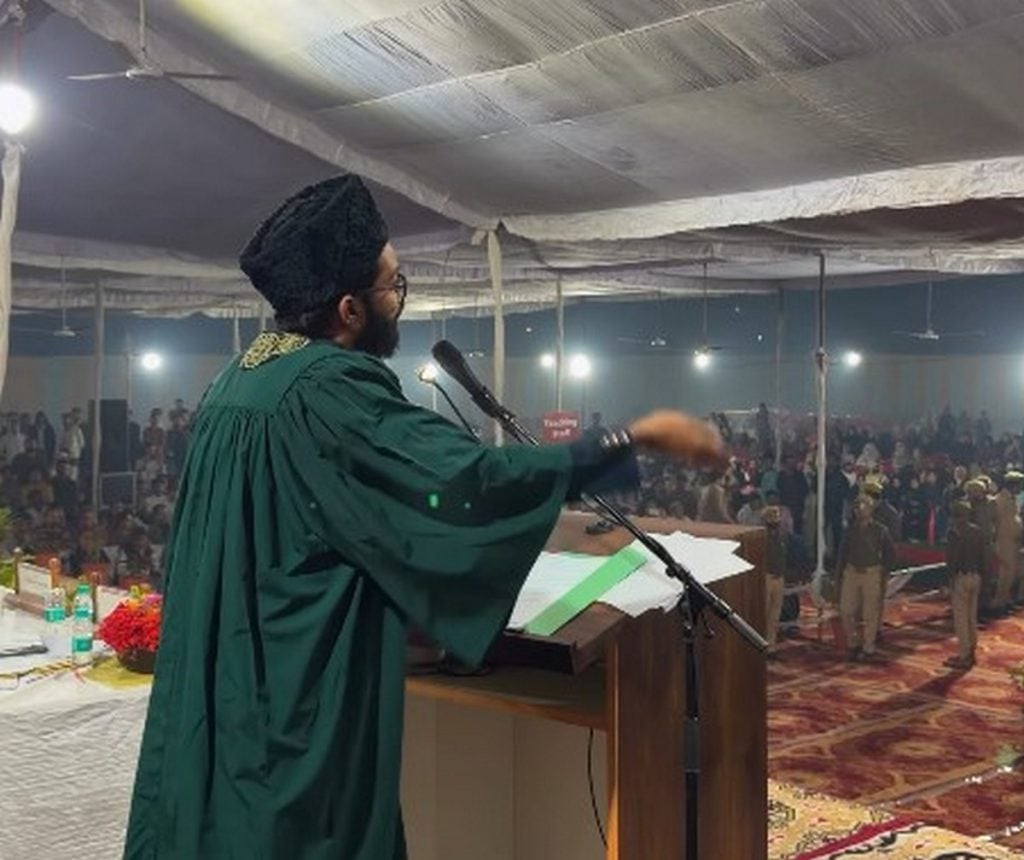
The entire discourse is so marinated in Islamic idiom that it is impossible for a non-Muslim to be a part of the process—for neither can he speak this language, nor is any other language spoken, heard, or understood at AMU.
Therefore, it’s no surprise that not a single non-Muslim was elected to any of the 28 seats contested across the AMU Students’ Union, Women’s College Students’ Union, and AMU Court, even though Hindus comprise no less than 20 per cent of AMU’s student body, a proportion far higher than that of Muslims in India.
Strangely, not even a Dalit was elected, even though Muslim politics professes love for Dalits—using them as a cover for its own belligerence, drawing much of its vocabulary from Dalit discourse, and dreaming of the Dalit-Muslim alliance as a democratic masterstroke against rampaging “fascism”. Dalits are Hindus, after all—regardless of the guileful vehemence with which the Muslim political narrative insists that they are not. The fact that the Scheduled Castes and Scheduled Tribes are denied their constitutionally mandated quota at AMU offers a better perspective on the reality behind the narrative of Muslim-Dalit hyphenation.
Also Read: Sharjeel Imam’s Islamist manifesto will be forgotten. The silence of liberals will not
Why a Hindu can never win at AMU
Contrast the elections at AMU with those at other universities. At JNU, Muslims are regularly elected to office. The Allahabad University Students’ Union elected Adeel Hamza Sahil as vice president in 2016. Fahad Ahmad was elected as the general secretary of the Tata Institute of Social Sciences (TISS) Students’ Union for the 2017-2018 term. In many other universities and their affiliated colleges across the country, where Muslims are in negligible numbers, they regularly contest and win elections to unions and other elected bodies.
This is possible because, unlike at AMU, public discourse on these campuses is generally liberal and secular, not religious and communal. Candidates are judged on their ability, programme and ideology, not on religion and identity. If any identity is invoked at all on such campuses, it is to indulge Muslims—and in a place like JNU, it always works in their favour.
On the contrary, a Hindu candidate at AMU has to efface his identity. He must not only wear a sherwani, but also the Jinnah cap (yes, the Jinnah cap!), and go about canvassing with the Muslim greeting, Salam Alaikum. If he were to wear his Hindu identity in dress, manners and speech, and recite the Vedas from the terrace of the Union Hall, the way Muslim candidates recite the Quran, one can’t even imagine the hell that would break loose.
Even though it is obvious that, on a Muslim-majority campus, a Hindu candidate can never win, the bogey of a Hindu takeover is routinely raised to force consensus behind a single Muslim candidate and keep any Hindu out.
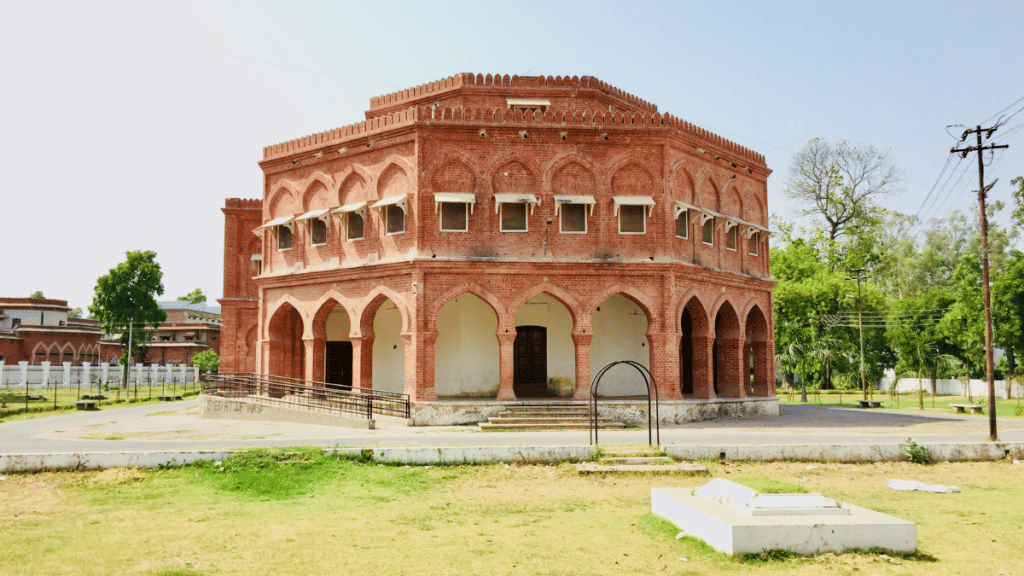
An anecdote may illustrate this well. On the eve of polling for the 1990-91 Union elections, a massive scare was drummed up that a Hindu might win the presidency. The kingmakers gathered all the Muslim candidates in a huddle at the university’s Jama Masjid, with the purpose of forging a united Islamic front to block the Hindu inroads. They decided to choose a consensus candidate by drawing lots (qur’a, in Urdu). Everyone was made to swear on the Holy Quran to agree on the name yielded by the lots. A chit was picked, a name was announced, and the remaining chits were made to disappear. The SIMI-supported candidate cried foul, alleging that every chit had the same name. The official Islamists accused the unofficial Islamists of rigging the process.
Who eventually won is beside the point. What is significant is that the entire charade was orchestrated with the express purpose of preventing a Hindu from winning. It wasn’t a one-off incident; it was part of a pattern that has only been reinforced by the new wave of radical Islam. How ironic that nowadays they never tire of complaining about the consolidation of the 80 against the 20.
Hindu communalism is a reality, but with a difference. Muslim communalism is organic; it stems from the deep theological core of Islam that is hostile to every other religion—particularly idol-worshipping Hinduism. Hindu communalism is a tentative protest against this hostile behaviour. It is shallow and superficial—there being no theological rationale and ideological basis to it. Hinduism has no antipathy towards other religions.
AMUSU as a simulation of a Muslim state
To better contextualise this narration, it should be remembered that Muslims don’t spend a single paisa on AMU, which is a government institution and receives one of the largest grants from the central government.
As I have argued before, the first prime minister, Jawaharlal Nehru, brought the central universities under the University Grants Commission (UGC) with the primary purpose of financing the post-Partition, fund-starved AMU. A couple of other universities, viz. BHU and DU, were perhaps retained in this category as a cover.
AMU is a university in form and shape. In essence and character, it is the seat of Muslim political ideology. Since its inception—from its days as Muhammadan Anglo-Oriental College —its purpose has been to create a cadre of leaders capable of leading Muslims in political contests against Hindus. The AMU Students’ Union is a simulation of Muslim politics, a role-play of an Islamic state.
In the run-up to the elections, which concluded this month, the idea was commonly bandied about that the Union elections were necessary to keep the supply chain of Muslim leadership running. It is no secret what kind of leadership has been emerging from AMU. Suffice it to say that these leaders can own up to neither their past deeds nor their present desires.
US can have a Mamdani, AMU can’t have a Ramesh
Around the same time, another election took place—the US midterms, which produced the first-ever Muslim senator, Abdul El-Sayed, alongside many other Muslims elected to representative bodies across the country. This came close on the heels of Zohran Mamdani’s election as Mayor of New York. There have been others across Europe, including Sadiq Khan, Mayor of London, and Humza Yousaf, First Minister of Scotland (2023-2024).
In India, too, almost every elected body—from Parliament to panchayats—includes a notable number of Muslims. While these figures fluctuate, the current Lok Sabha has 24 Muslim members, even though only 14 constituencies have a population in which at least half are Muslims. This means that at least 10 Muslim MPs were elected by non-Muslim-majority electorates. In the 7th Lok Sabha (1980-1984), that number reached 49. This pattern of Muslim candidates winning in constituencies with non-Muslim majorities holds true across state assemblies and local bodies as well.
Conversely, Muslim-majority constituencies almost invariably return Muslim candidates. A Hindu winning from such a seat is an exception rather than the rule—and even then, usually only on the ticket of a party practising appeasement politics, such as the TMC in West Bengal.
So, why is it that in the USA, where the Muslim population is less than 2 per cent, and in the UK, where it stands at just about 6 per cent, there are Zohran Mamdanis, Abdul El-Sayeds, Sadiq Khans, and Humza Yousafs galore, while there is hardly any non-Muslim in a similar position in any Muslim country? In Pakistan, if a Hindu is allowed into the legislature at all, it is almost always through nomination or a reserved seat. And in Bangladesh, only four candidates from minority communities, two Hindus and two Buddhists, were elected this year to the 350-member parliament.
If Muslims can represent Christians in the US and the UK, why can’t Hindus represent Muslims in India? Why all this hullabaloo about the falling representation of Muslims in Parliament? If only a Muslim can represent Muslims, who will represent Hindus in Muslim-majority constituencies—and who represents them in the AMU Students’ Union?
A Muslim candidate in a Hindu-majority country can advertise his identity—his difference—and still win. He can win without identifying with the majority. It’s no mean feat. And the same holds true in America and England as well. Almost all of them flaunt their Muslimness, their speeches punctuated with Insha Allah and Alhamdulillah, and yet they are not rejected for their religion. New York elects Zohran Mamdani despite 9/11, and London elects Sadiq Khan despite 7/7. If people see merit in them, they elect them for their competence and ability to deliver on their promises. Can the same ever happen in a Muslim-majority society?
When Mamdani won, a popular Muslim YouTuber mocked India’s “anti-Muslim” democracy, and went looking for the Indian Zohrans by frenetically calling out, “Zohran tum kahan ho?” The right thing for her to do would be to go to AMU or JMI, and look for a Ramesh or a Suresh in their elected bodies—or to look for a Rishi Sunak as the Chief Minister of J&K.
Also Read: From Shah Bano to Waqf—how Muslim politics has produced just intermediaries, not intellectuals
Double standards on democracy
One has to ask what exactly Muslims celebrate when they hail the triumphs of the Mamdanis and El-Sayeds. Do they celebrate their contribution to the secularisation of the West and the deepening of its democracy that enables voters to go beyond considerations of origin, ethnicity, and even religion while electing their representatives? Or do they actually gloat at the way they have used democracy and secularism to infiltrate the Western system with a view to eventually subverting it? One only has to look at their triumphalism on social media to get the answer.
Democracy and secularism thrive in symbiosis. An un-secular society cannot nurture democracy. Muslim thought-leaders have a problem with both. From the days of Sir Syed Ahmad Khan, they have been opposed to democracy on the grounds that, because Hindus are more numerous than Muslims, a Muslim would stand no chance of being voted in, assuming Hindus wouldn’t vote for a non-Hindu. The fact, however, is that Hindus have regularly voted for Muslims. We have had not only Muslim Presidents and Vice Presidents, but also Chief Ministers in states like Assam, Bihar, Kerala, Maharashtra, and Rajasthan.
So, why do Muslims have the unfounded fear that Hindus wouldn’t ever vote for them? Because they themselves wouldn’t vote for Hindus. It is a theological and emotional impossibility for them to vote for anyone outside their religion.
When they are in the majority, their best blueprint for a minority is that of a “protected” (dhimmi) community without any political rights. Where they are a minority, the majority is always viewed as an oppressor.
Ibn Khaldun Bharati is a student of Islam, and looks at Islamic history from an Indian perspective. He tweets @IbnKhaldunIndic. He can be reached by email at ibn.khaldun.bharati@gmail.com. Views are personal.
Editor’s note: We know the writer well and only allow pseudonyms when we do so.
(Edited by Asavari Singh)