



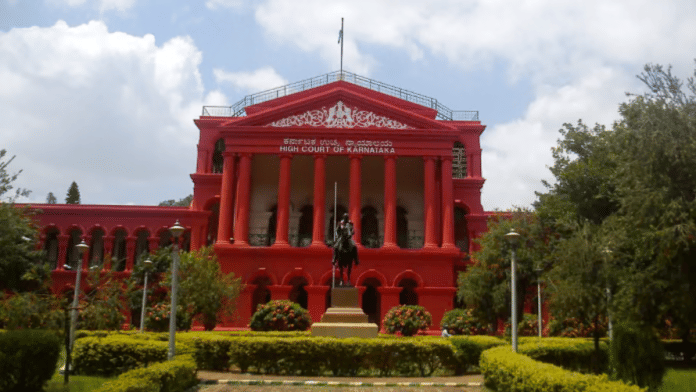
New Delhi: The Karnataka High Court has quashed an FIR against 13 people over posters expressing dissent against a Supreme Court 2019 judgment, holding that such criticism did not amount to promoting enmity or outraging religious feelings under Sections 153A and 295A of the Indian Penal Code.
In an order on 15 October, Justice HP Sandesh said merely expressing dissatisfaction with a Supreme Court judgment with terms like “denial of justice”, and calling on people to “raise the voice for justice”, could not be treated as an attempt to create disharmony.
The court observed that it fell within the scope of the freedoms protected under Articles 19 and 21 of the Constitution.
The petitioners faced allegations of promoting enmity between different groups, outraging religious feelings and criminal conspiracy under Sections 153A, 295A and 120B of the IPC, respectively. They were also booked under the Karnataka law dealing with disfigurement of open places.
Also read: Legislative privilege vs free speech: A 20-yr battle & why 7-judge SC bench may defer resolution
What prompted the FIR
The case dates back to 2019 after posters appeared on walls alongside a road in Mangaluru following the delivery of a judgment by the Supreme Court.
According to the police complaint, the writing described the judgment as a “denial of justice”, called for people to “raise the voice for justice”, and contained a reference to the Popular Front of India which was subsequently banned by the Centre in 2022 under the Unlawful Activities (Prevention) Act.
Based on the slogans, the police booked the 13 people under Sections 153A, 295A and 120B of the IPC for promoting enmity, outraging religious feelings and criminal conspiracy along with the Karnataka law on disfigurement of open places.
The 13 subsequently approached the Karnataka High Court in 2021, seeking to have the FIR quashed.
Their central argument was straightforward: criticising a judgment or describing it as unjust did not satisfy the ingredients of the criminal offences invoked against them.
The freedom of speech protection
The petitioners argued that the very registration of the criminal case was erroneous because the allegations were not enough to make out an offence under Sections 153A and 295A IPC. It was further contended that there was no conspiracy that could justify invocation of Section 120B IPC.
They relied on the constitutional guarantee of freedom of speech under Article 19. Their counsel argued that the presence of the slogan on roadside walls after delivery of the judgment could not, on that ground alone, justify the offences invoked by the police. The High Court was therefore urged to quash the proceedings.
The petitioners also relied on the Supreme Court’s decision in the Javed Ahmad Hajam (2024) case arguing that lawful criticism or dissent is protected by the right to freedom of speech under Article 19(1)(a) of the Constitution.
They pointed out that the Supreme Court had stressed that while this freedom is subject to reasonable restrictions, criticism of government decisions made in a lawful manner forms part of a democracy.
What state argued
Opposing the petition, the State of Karnataka argued that the petitioners had reacted immediately after the pronouncement of the Supreme Court’s judgment and had put up posters in a public place.
The state contended that such conduct could lead to the creation of disharmony in the country and therefore attracted Sections 153A and 295A IPC. On that basis, it argued that the High Court should not interfere with the proceedings.
‘Dissent about the judgment’
The High Court, however, was not persuaded. Examining the contents of the complaint, the court observed that the “expression” at the centre of the prosecution essentially stated that justice had been denied and called upon people to raise their voice for justice.
The court held that such words did not satisfy the ingredients of Sections 153A and 295A. It drew upon the principles discussed by the Supreme Court in earlier judgments while examining the requirements for invoking Section 153A.
The High Court observed that the slogans reflected dissatisfaction with the Supreme Court judgment but did not amount to an expression aimed at creating disharmony.
An important part of the High Court’s reasoning was concerned with the standard to be applied while determining whether expression attracts Section 153A.
Referring to Javed Ahmad Hajam (2024) the Court noted that the test concerns “the general impact of the words or expressions on a significant number of reasonable people.” It added that the mere possibility that a few individuals might develop hatred or ill-will, would not, by itself, be sufficient to attract Section 153A.
The Court consequently characterised the impugned expression as “dissent about the judgment”, rather than speech creating disharmony. It said that the statements that justice had been denied and that a voice should be raised fell within the scope of Articles 19 and 21 of the Constitution. The High Court, thus, quashed the FIR.
(Edited by Ajeet Tiwari)
Also read: Karnataka High Court strikes down state law hiking SC/ST quotas to a 24% total, reaffirms 50% cap