



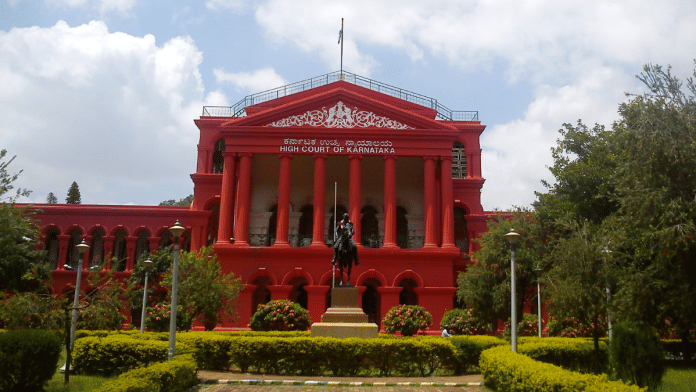
New Delhi: Striking down a state law that had increased reservations for Scheduled Castes (SCs) and Scheduled Tribes (STs) beyond the permissible constitutional cap, the Karnataka High Court has reiterated that breaching the 50 percent quota cap without proving extraordinary and exceptional circumstances undermines the fundamental constitutional guarantees of equality and equal opportunity under Articles 14, 15, and 16 of the Constitution of India.
Sections 3 and 4 of the Karnataka Scheduled Castes and Scheduled Tribes (Reservation of Seats in Educational Institutions and of Appointments or Posts in the Services under the State) Act, 2022 were declared unconstitutional in its 170-page judgement delivered by a bench of Chief Justice Vibhu Bakhru and Justice K.S. Hemalekha on Monday.
The legal battle centered on the Act which replaced a 2022 ordinance enhancing state-level reservations in educational admissions and public service appointments for Scheduled Castes from 15 to 17 percent and for Scheduled Tribes from 3 to 7 percent.
Because Karnataka’s existing reservation framework already allocates 32 percent to Other Backward Classes (classified under Categories I, II-A, II-B, III-A, and III-B), the statutory increase pushed the state’s aggregate affirmative action quota from 50 to 56 per cent. Consequently, the unreserved pool available for general merit candidates was reduced from 50 to 44 percent.
The challenges were brought before the high court through multiple writ petitions, led by a public interest litigation filed by Mahendra Kumar Mitra on behalf of the Dr Ambedkar Scheduled Castes Federation and a petition filed by civil engineering graduates. The petitioners specifically impugned Sections 3 and 4 of the Act, alongside subsequent Karnataka Public Service Commission (KPSC) recruitment notifications – such as a selection drive for 92 Assistant Engineer posts in the Bruhat Bengaluru Mahanagara Palike (BBMP) that reserved over 55 per cent of total seats.
Also Read: UNESCO flags cracks in India’s reservation system as legal challenges mount; cites 30% vacant posts
What arguments were made
Petitioners challenging the legislation leveled a multi-pronged attack against the statutory quota hike – contending that expanding total reservations to 56 per cent directly violated Articles 14, 15, and 16 – constitutional equality, in essence. Relying on landmark Supreme Court Constitution Bench decisions – including M.R. Balaji v. State of Mysore, Indra Sawhney v. Union of India, M. Nagaraj v. Union of India, and Dr. Jaishri Laxmanrao Patil v. Chief Minister – they maintained that the 50 per cent ceiling is a binding constitutional rule rather than a flexible guideline.
It was argued that the state failed to demonstrate any rare, geographically isolated, or extraordinary conditions that could legally justify exceeding the 50 per cent ceiling.
The petitioners assailed the Justice H.N. Nagamohan Das Commission Report (2020) and the Justice Subhash B. Adi Committee Report, arguing they failed to apply judicially settled parameters for assessing representation. Furthermore, official figures published by the Directorate of Economics and Statistics in 2024 revealed that actual SC and ST representation in state civil services stood at 18.65 per cent and 5.05 per cent respectively, already surpassing their baseline quotas of 15 per cent and 3 per cent, disproving claims of inadequate representation.
Additionally, the petitioners pointed out that the State Government enacted the legislation without consulting the National Commission for Scheduled Castes (NCSC) and National Commission for Scheduled Tribes (NCST), violating mandatory requirements under Articles 338(9) and 338A(9) of the Constitution.
Defending the Act, the Karnataka government raised several legal and demographic justifications, contending that the traditional 50 per cent ceiling stood obliterated following the Constitution (103rd Amendment) Act, 2019, which introduced up to 10 per cent reservation for Economically Weaker Sections (EWS) under Articles 15(6) and 16(6). The state argued that excluding SCs, STs, and OBCs from EWS benefits reduced their open competition eligibility pool to 90 per cent, thereby rendering earlier judicial caps obsolete.
It asserted that the Nagamohan Das Commission, the Adi Committee, and the Ratnaprabha Committee provided comprehensive quantifiable data. Demographic figures showed that the SC population had grown to 17.15 per cent and the ST population to 6.95 per cent (2011 Census), totalling 24.10 per cent of the state population, while reserved quotas had remained frozen at 18 per cent for decades.
The state argued that Article 338(9) consultation applies to executive decisions rather than legislative enactments under Articles 245 and 246. It maintained that reservation policy falls within the legislative domain and carries a presumption of constitutionality outside the scope of judicial review on merits.
Reasoning behind the judgment
Reaffirming the nine-judge Bench ruling in the Indra Sawhney case, the court held that the 50 per cent ceiling is not an elastic guideline or rule of prudence, but a firm constitutional boundary required to balance individual equality of opportunity under Articles 15(1) and 16(1) against affirmative action under Articles 15(4) and 16(4).
The judgment noted that breaching this “Goldilocks solution” leads to reverse discrimination and transforms equal protection into caste-based quotas.
Rejecting the state’s defence, the court cited Janhit Abhiyan v. Union of India to hold that EWS reservation is a distinct provision for general merit categories. The 103rd Amendment does not alter or enlarge the 50 per cent quantitative limitation governing SC, ST, and OBC reservations under Articles 15(4) and 16(4).
Clarifying the Supreme Court’s rulings in M. Nagaraj and Dr. Jaishri Laxmanrao Patil, the bench emphasised that collecting quantifiable data on backwardness and inadequate representation is a condition precedent to provide reservation within the 50 per cent ceiling, not a legal license to exceed it.
The court held that Article 16(4) mandates “adequate representation”, not “proportionate representation” based on census figures. The court said that Nagamohan Das Commission committed a fundamental error by treating population proportion as the sole test for adequacy, which contradicts established constitutional law.
The exception allowing a departure from the 50 per cent rule is strictly confined to far-flung, remote, or isolated populations completely cut off from national mainstream life. The court ruled that general population growth, routine administrative shortfalls, or a state’s subjective desire to match quotas to population shares do not constitute extraordinary circumstances.
The he court affirmed that consulting national commissions under Articles 338(9) and 338A(9) on major policy decisions affecting SCs and STs is mandatory. Sending letters to the commissions three years after passing the Act and during ongoing litigation failed to satisfy this mandatory constitutional prerequisite.
(Edited by Nardeep Singh Dahiya)