





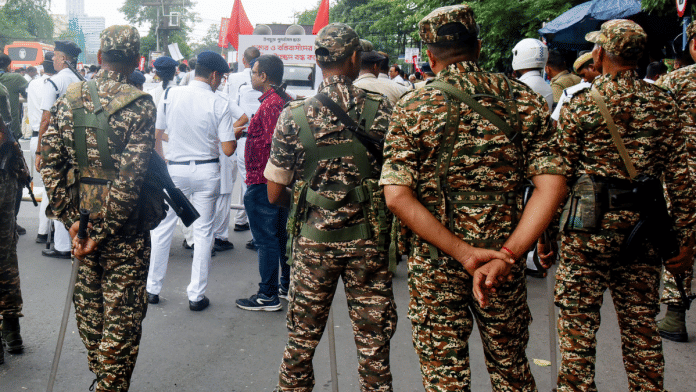


New Delhi: The Delhi High Court recently dismissed petitions of two CRPF inspectors who were denied promotion, and held them medically unfit due to tattoos on their right forearm, the saluting arm. The order brings into sharp focus the disciplinary regime governing tattoos in paramilitary forces.
The two officers were already serving in the Central Reserve Police Force and got their tattoos surgically removed after they were declared unfit for promotion in 2024. But the HC declined them relief now, saying the rules didn’t permit tattoos where it was etched on their arms, and getting them removed after the medical test did not cure their ineligibility.
A bench of justices Anil Kshetarpal and Amit Mahajan clarified that the medical guidelines do not impose a blanket ban on tattoos, rather, they regulate them by specifying permissible location, content and size. Tattoos are allowed if they meet those criteria, but a tattoo on the right forearm (saluting arm) falls outside the permitted scope.
It emphasised that serving personnel cannot plead ignorance about existing rules and seek relief.
Unlike direct recruitments to higher posts, where candidates were sometimes allowed to remove tattoos before review medicals and given time for scars to heal, the court applied a stricter standard in the present case because the inspectors seeking their promotion were in service.
It clarified that eligibility must be assessed at the stage of application and medical examination and once unfitness is recorded, later removal of tattoos offers no relief.
Indian courts have consistently held that a tattoo on the right forearm is treated as a ground for disqualification because they interfere with the solemnity of the salute and break uniformity.
Also Read: Village fair tattoo may cost man his CRPF future; MHA says can’t bend rules, HC to decide
No blanket bar on tattoo
In 2024, the two CRPF inspectors applied for promotion to the Assistant Commandant (General Duty) post, and cleared the written and physical tests. But, they were declared unfit during the medical examination, solely because of tattoos on their saluting arm.
The petitioners challenged this decision before the Delhi High Court, arguing that the advertisement for the Assistant Commandant’s post did not explicitly bar tattoos. They further contended that they had already undergone surgery to remove the tattoos and therefore should not be penalised for a defect that was curable.
Interestingly, the two had tattoos when they joined the service as a constable in 2010 and 2012, respectively and later got promoted in 2022 and 2023 to the inspector’s post.
However, when they applied in 2024 for a further promotion to the post of Assistant Commandant, the tattoos became a stumbling block.
The recruitment guidelines, the court was told, mention various skin diseases that may lead to rejection of a candidate on medical grounds. As serving inspectors, the tattoos never posed any challenge or setback, the petitioners argued.
According to the rules governing paramilitary forces, tattoos are allowed on traditional parts of the body like the inner forearm (non-saluting arm) and on the back of the hand (dorsum). Tattoos on the right forearm (saluting arm) are prohibited. The size of the tattoo must be less than one-fourth of the part (elbow or hand) where it is placed.
The Court noted, “The rules do not per se stipulate an embargo on having a tattoo. They only provide the permissible location, content and size of the tattoo.”
It emphasised that eligibility must be assessed at the stage of application and medical examination. Subsequent removal of tattoos does not alter or cure ineligibility, it said.
The court said, “Even if the petitioners have now had the tattoos removed, they can reap no benefit for the same in the present proceedings and they may apply for the next examination.” Importantly, the court stressed that members of disciplinary forces cannot plead ignorance of recruitment rules, especially when seeking higher posts.
Legal position
Over the years, courts across India have dealt with a steady stream of cases involving tattoo‑related disqualification in recruitment and a clear judicial pattern has emerged.
They have repeatedly emphasised that visible tattoos undermine the decorum of the forces, where uniformity and discipline is central.
According to the guidelines, tattoos must be small, innocuous and not prejudicial to military discipline. Religious symbols or names are acceptable. Tattoos that are indecent, sexist, racist, lewd or located on any other part of the body than specified are categorised as non‑permissible.
Candidates with such tattoos are deemed ineligible for enrolment and may be rejected at any stage.
Traditional tattoos (names, religious symbols on the left forearm in consideration with size) are tolerated, but modern decorative tattoos influenced by western culture are seen as inconsistent with Indian military ethos, according to the guidelines.
The Delhi High Court has considered a series of cases that highlight how tattoo‑related disqualification is treated differently for direct recruits and serving personnel seeking promotion.
Direct recruits may be allowed to remove tattoos before review medicals, with time given for scars to heal, while serving staff seeking promotion are bound by stricter standards, eligibility is assessed at the stage of application and medical examination, and later removal of tattoos cannot reopen eligibility.
In the Shubham Sharma and Vineet Meena case (2022), the Delhi High Court was dealing with direct recruitment cases in Central Armed Police Forces (CAPF). Here, the court granted liberty to the candidate to surgically remove tattoos on the right arm and undergo a fresh medical examination.
By contrast, in the present case, the petitioners were already serving Inspectors in CRPF seeking promotion to Assistant Commandant (GD).
In a 2024 case involving direct recruitment to the CAPF, the court held that once a tattoo is removed, no tattoo exists and therefore the candidate, Akshay Choudhary, could not be treated as permanently ineligible.
It directed that the petitioner be given an opportunity to undergo a fresh medical examination after the removal of the tattoo.
The Tattoo Clause under the applicable guidelines does not stipulate that scars from surgical removal automatically disqualify a candidate. The Medical Board was justified in examining the scar to ensure if the saluting arm appeared clear, but it had erred in reviewing the petitioner only days after surgery, the courts have ruled.
The court directed a fresh medical re‑examination to assess proper healing before deciding fitness for appointment.
In Gedela Chandra Sekhara Rao (2024) vs Union of Indian, the Delhi High Court dismissed a petition by a serving CAPF personnel who was declared medically unfit due to tattoos on his left forearm and chest.
The Bench made its reasoning clear in these short lines: tattoos on prohibited sites are impermissible under the revised medical guidelines; serving members of the force are presumed to know the rules and cannot plead ignorance.
This approach is strikingly similar to the present case. In both matters, the petitioners were already serving officers seeking promotion.
Although the Supreme Court has not issued a tattoo‑specific ruling, its broader jurisprudence on recruitment standards has shaped how high courts approach these cases.
(Edited by Ajeet Tiwari)
Also Read: AK-47s, Quran verses, lovers’ names —the tattoos Kashmiris are rushing to remove