





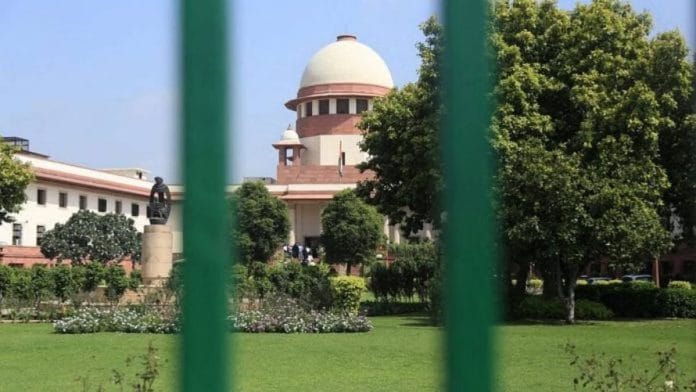


New Delhi: The Supreme Court has released a man detained in June last year for digging and construction activities near Mathura’s Shree Krishna Janmabhoomi and Shri Dwarkadhish Temple because the Uttar Pradesh government delayed deciding his representation.
A two-judge bench of Justices M.M. Sundresh and N. Kotiswar Singh set aside an order passed on 2 February by a two-judge bench of the Allahabad High Court, which upheld the Mathura District Magistrate’s detention order against Sunil Kumar Gupta under the National Security Act (NSA), 1980 on 2 July last year.
The high court had held the detention order was valid because Gupta disrupted public order. The Supreme Court ruling of 27 April is an important development on the issue of procedural safeguards that govern preventive detention under the NSA.
A First Information Report was registered against Gupta in June last year for digging and construction work near the temple despite objections raised by residents of the area. The unauthorised activity led to the collapse of five houses, claiming three lives and sparking protests and road blockades.
The chaos, panic and resultant traffic congestion led to the government calling in the National Disaster Response Force and State Disaster Response Force. Protestors had spilled into the streets, demanding compensation for the families of those who died because of Gupta’s actions. The protests had affected the inflow of tourists into the temple as the roads leading to it were blocked by agitators.
Gupta was arrested under Section 105 of the Bharatiya Nyaya Sanhita, 2023, on the charge of culpable homicide not amounting to murder, an offence that can result in life imprisonment or up to 10 years in jail. Two days after he applied for bail, the District Magistrate invoked Section 3 of the NSA to issue a preventive detention order.
Also Read: ‘Failed’ law, ‘misused to stifle dissent’: Ex-SC judges speak out against UAPA, sedition, NSA
How detention orders work
Under Section 3 of the National Security Act (NSA), the Centre or state governments are empowered to pass orders for detaining persons if they are satisfied that it is necessary to prevent a person from acting in ways prejudicial to the defence of India, or to its relations with foreign powers, or its security, among other reasons.
In line with this, district magistrates and authorised police commissioners are allowed to detain individuals to prevent actions “prejudicial to India’s defence, foreign relations, security, public order, or essential supplies”.
Gupta had moved the Allahabad High Court, challenging the detention order, but failed to get any relief. Gupta’s argument in the high court was based on what he said was the lack of valid grounds on invoking the NSA against him since he was already behind bars. He argued there was inordinate delay on the part of the authorities in deciding his representation.
According to the timeline submitted by Gupta to the high court, he had sent a representation on 7 July last year, questioning the detention order passed by the district magistrate on 2 July. It was submitted to the Superintendent of Jail, Mathura, who forwarded it to the district magistrate, who in turn sent it to both the state’s Advisory Board — a statutory body under the NSA— and Centre along with his comments.
On 12 July, the Uttar Pradesh government approved the detention order against Gupta, but took more than a fortnight to act on his representation. Subsequently, the Uttar Pradesh government’s Home Department rejected Gupta’s representation on 23 July. Five days later, Gupta’s representation was rejected by the central government as well.
The high court found no merit in Gupta’s argument on inordinate delay in deciding his representation. It favoured the detention order, saying that if the government is satisfied that keeping someone in detention would prevent him from acting in a manner prejudicial to India’s defence or security or its relations with foreign powers, then it can very well do so. Even if the detaining authority has a “reasonable apprehension” under the Act that someone likely to be released can indulge in acts prejudicial to public order, the authority can detain them, the Allahabad High Court’s two-judge bench ruled.
The final word
The apex court took serious note of the 16-day delay shown by the authorities in considering Gupta’s representation. It was a violation of their duty to consider the representation at the earliest, the court observed.
“A duty is imposed on the concerned government to consider the representation of the detenu at the earliest point of time. In the present case, the detaining authority did not forward the representation to the state government immediately, though it had actually been sent to the detaining authority by the prison authority at the earliest point of time,” the court ruled.
“Unfortunately, the action of considering the representation was not forthcoming at the earliest point of time. This would vitiate both the detention order and its subsequent approval,” the Supreme Court held.
(Edited by Nardeep Singh Dahiya)
Also Read: Centre revokes Sonam Wangchuk’s NSA detention, says step aimed at peace & dialogue in Ladakh