



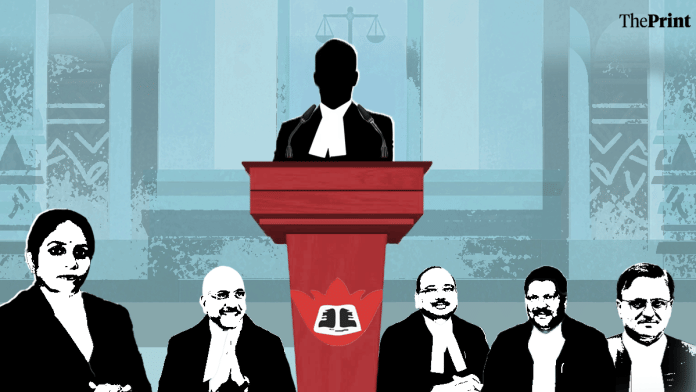

New Delhi: When Aam Aadmi Party (AAP) convener Arvind Kejriwal filed an application seeking the recusal of Delhi High Court Justice Swarana Kanta Sharma on the ground that she had attended events organised by the Akhil Bharatiya Adhivakta Parishad, the move trained spotlight on an RSS-linked lawyers’ body that has, for years, hosted some of the country’s senior-most judges.
The ABAP was founded in 1992 by RSS activist Dattopant Thengadi, with the declared aim of “resurrecting Bharatiya values” within the legal profession. Its claimed goals are social justice and legal access through an “indo-centric” system.
Registered as a society, ABAP has grown into one of India’s largest lawyer networks–claiming to have an average of 200 lawyers in every district court–and operating through a system of district, state and national conferences that routinely bring together sitting and former judges, Union ministers, lawyers and experts.
The conference trail makes the depth of judicial engagement clear.
In December 2025, Supreme Court Justice Vijay Bishnoi delivered the keynote address at ABAP’s 17th National Conference in Balotra, Rajasthan, speaking on “social harmony”. Union Law Minister Arjun Ram Meghwal, Solicitor General Tushar Mehta and Rajasthan High Court Justice Pushpendra Singh Bhati were among those present at the event.
A year before, Supreme Court Justice Prashant Kumar Mishra addressed the ABAP’s National Council meeting in Gujarat, using the platform to warn that divisive rhetoric rooted in religion, caste and ethnicity posed a threat to the constitutional ideal of fraternity.
Attendance of judges runs further back.
In 2023, then Supreme Court Justice B.R. Gavai (who retired as Chief Justice of India) was the chief guest at an ABAP Supreme Court branch event honouring the legacy of Dr B.R. Ambedkar. In 2021, then Supreme Court Justice Abdul Nazeer attended the ABAP’s National Council meeting in Hyderabad.
The 16th National Conference of ABAP at Kurukshetra University in December 2022 featured then Supreme Court Justice (now the Chief Justice of India) Surya Kant as keynote speaker. The theme of the conference was: ‘75 Years of Resurgent Bharat – Changing Contours of Law and Justice’. Justice Sharma was present at that event too, alongside Justices G.S. Ahluwalia (Madhya Pradesh High Court) and G.R. Swaminathan (Madras High Court), as well as then-Union Law Minister Kiren Rijiju.
Earlier still, the 2018 National conference saw sitting judges – Supreme Court Justice M.R. Shah and Justice Attau Rahman Masoodi (Allahabad High Court) – in attendance. Also, then Supreme Court Justice Dipak Misra attended an ABAP event in Bengaluru in 2015.
Older records place then Supreme Court Justices A.K. Patnaik at a 2012 conference in Odisha’s Cuttack and C.K. Thakker at a 2009 event in Delhi.
Judicial participation in ABAP events pre-dates Bharatiya Janata Party’s return to power in 2014—but the documentation is thin before that year. Whether this gap reflects the ABAP’s own improved recording and publishing capacity, or other factors, remains unclear.
Also Read: Is Kejriwal vs Justice Swarana Kanta unprecedented? How recusals work in Indian judiciary
Propriety vs pattern
In refusing to recuse from the excise policy case against Kejriwal, Justice Sharma contextualised her attendance at an ABAP event not as personal ideological association but as participation in one of many public legal programmes at which other sitting judges have also appeared.
The Central Bureau of Investigation (CBI), opposing Kejriwal’s recusal application, made the same point. If presence at an ABAP function demonstrated ideological bias, as argued by Kejriwal, a large number of high court and Supreme Court judges would face recusal demands in politically sensitive cases, the central agency contended.
An ABAP member who did not wish to be named offered the society rationale for seeking out judicial voices. “Judges are the ones interpreting the Constitution day in and day out, so it’s good to hear from them,” the member said, adding that the large turnout of advocates at these events made it an opportunity for them to “in-person hear the perspectives, which we come across in judgments”.
On the question of selection, the member said: “We approach everyone, and it is up to them… We are nationalistic in our outlook but we are like any other bar body, so why is it objectionable?”
Retired Supreme Court Justice Hemant Gupta agreed.
“Judges across India participate in academic and lecture events organised by Bar Association, other legal bodies/associations, law Schools, colleges, etc. Judges even have delivered lectures for the Indian Association of lawyers which have direct affiliation with Left leaning political ideology,” he said.
In his view, attendance at ABAP events falls within acceptable norms—provided the content remains substantively legal. “Judges attending the seminars or conferences of ABAP where legal seminars are being held and legal issues or related thereto are being discussed, which does not relate to political views and affiliation, does not amount to any bias,” he said.
Invoking the Supreme Court’s ‘Restatement of Values of Judicial Life’—the bench’s adopted code of ethical conduct—Justice Gupta added: “The Adhivakta Parishad is an association of the Members of the Bar. The Bar and Bench are two wheels of the administration of justice and they must run in sync and in harmony with one another. Sitting and former Judges have been attending such functions. In my opinion Judges should not cross the lines drawn by the ‘Restatement of Values’.”
The Restatement of Values of Judicial Life is a 16 point-code of ethical conduct adopted by the Supreme Court of India in 1997 to guide members of the higher judiciary in ensuring independence, impartiality and integrity. These guidelines are not statutorily mandatory and are a self-imposed, advisory code of judicial ethics. They operate alongside an in-house procedure for enforcement.
Not every jurist read those lines in the same place.
Retired Supreme Court Justice Abhay S. Oka, speaking at an ABAP virtual event in April this year, said he would have declined any such invitation had it come while he sat on the bench. “If as a sitting judge, I was invited by Adhivakta Parishad to speak on their platform, I would have politely said no because my belief was Adhivakta Parishad does have political inclinations,” he said.
But Justice Oka, in 2020, as Chief Justice of the Karnataka High Court, had virtually addressed an ABAP-hosted event.
Supreme Court lawyer Prashant Bhushan – a former senior AAP leader who had a falling out with the party – said he saw no ambiguity in the question of attending ABAP events. “The ABAP is clearly affiliated with a political party, and judges often deal with cases involving political interests. Therefore, it is not a good idea,” he said, adding: “Ultimately, the BJP is the political wing of the RSS just like Akhil Bharatiya Vidyarthi Parishad (ABVP) is the student wing and Akhil Bharatiya Adhivakta Parishad (ABAP) is the legal wing.”
Judicial representation at ABAP events may be institutionally routine, but whether it is institutionally proper is a question the judiciary has yet to settle.
Saumya Sharma is alum of ThePrint School of Journalism, currently interning with ThePrint.
(Edited by Prerna Madan)
Kejriwal’s recusal request is frivolous, just like his political life. But that’s not the scandal. The real scandal is institutional.
There’s a bizarre double standard. Subordinate courts have statutory recusal mandates with enforcement teeth. High Courts and Supreme Court operate on an honor system, a “Restatement of Values” with no legal force. When judges judge their own impartiality, natural justice becomes a suggestion.
The rot is institutionalized. In the Atul Subhash case, the judge stayed in service and got promoted despite serious conduct questions. Yashwant Varma resigned before impeachment, keeping his pension and benefits intact. Politicians rarely show what LB Shastri and VP Singh did. Resign on moral grounds. That’s a rarity. By and large, there is no commitment to probity.
The gap between constitutional rights and what actually happens is so wide that people in power always find ways to game it. Self-judgment leading to self-exoneration is the only logic that works. Media figures caught in power-brokering scandals conduct their own acquittals on prime time, walk away unscathed from parliamentary and legal scrutiny. Same pattern everywhere.
The asymmetry isn’t accidental. It’s by design. Subordinate judges face statutory constraints. Senior judges get advisory codes with no teeth. That’s not oversight. That’s structural protection.
In this country, accountability and integrity remain strictly optional. The system guarantees it