





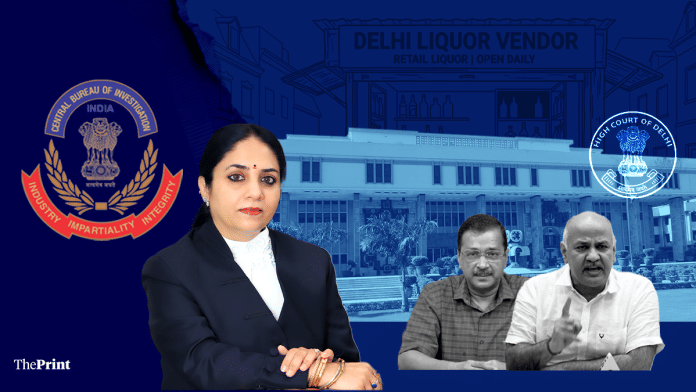


New Delhi: Former Delhi chief minister Arvind Kejriwal’s refusal to appear either in person or through counsel before Justice Swarana Kanta Sharma in the excise policy appeal case may have escalated tensions in the judicial recusal dispute, but it does not stop the case from proceeding.
A day after Kejriwal, Manish Sisodia also announced his refusal to appear at the Central Bureau of Investigation’s (CBI) appeal hearing against a trial court order discharging Kejriwal and 22 others in the politically charged Delhi excise policy case in February.
Despite Kejriwal and Sisodia’s absence, experts say the Delhi High Court can still hear and decide the CBI’s criminal revision petition, as judicial precedent shows that criminal appeals cannot be dismissed merely because an appellant or counsel is absent; the court must examine the record and decide the case on the merits.
Kejriwal had sought Justice Sharma’s withdrawal from the case, alleging ideological bias and conflict of interest, and argued the application himself in highly publicised proceedings.
However, Justice Sharma refused to recuse herself, saying that entertaining such pleas on “unfounded allegations” would undermine judicial independence and set a dangerous precedent. This led Kejriwal and Sisodia to refuse to appear for the hearing and invoke a Gandhian ‘satyagraha’.
While six people have sought recusal, only Kejriwal and Sisodia have refused to appear so far.
Also Read: Arvind Kejriwal is paying the price for the politics he created
What the law says
Legal precedent shows that courts are not barred from proceeding with a case in the absence of parties.
In the case of Mahabir Prasad Singh vs. Jacks Aviation (1999), the Supreme Court said, “It is the solemn duty of every court to proceed with the judicial business during court hours. No court should yield to pressure tactics or boycott calls or any kind of browbeating.”
Similarly, in Ex-Capt. Harish Uppal v. Union of India (2002), a five-judge Supreme Court bench held that courts are under an obligation to continue judicial work and should not adjourn matters merely because of strikes or boycott calls.
Importantly, the court also held that “the right to appear and conduct cases in the Court is a matter on which the Court must and does have major supervisory and controlling power”.
While these cases dealt with lawyers’ strikes and a litigant’s right to a speedy trial, the principle holds: the case must go on.
With criminal appellate procedure, the court in K. Muruganandam v. State (2021) held that “It is well settled that if the accused does not appear through counsel appointed by him/her, the Court is obliged to proceed with the hearing of the case only after appointing an amicus curiae, but cannot dismiss the appeal merely because of non-representation or default of the advocate for the accused”.
Also, in Bani Singh v. State of Uttar Pradesh (1996), it was held that a criminal appeal cannot be dismissed merely because the appellant or counsel is absent; the court must examine the record and decide the case on the merits.
Based on these cases, in the absence of a party and counsel, the court may see fit to appoint an amicus curiae (friend of the court) for assistance before proceeding.
What happens next
A senior lawyer, who did not wish to be named, says the most likely scenario is that the case will proceed.
With 23 respondents in total, experts say that Justice Sharma may give Kejriwal and Sisodia a final chance to appear, and if they do not, proceed to decide the matter.
Kejriwal can approach the Supreme Court in appeal against the refusal to recuse and seek a stay on the High Court proceedings.
However, they say that such a boycott of court proceedings is unlikely to be well received, and since Justice Sharma has already refused to recuse, it is doubtful that she will allow this route to a de facto stay on proceedings.
They add that by refusing to appear, the respondents effectively acquiesce to the conduct of proceedings in their absence.
The trial court order, the CBI’s grounds of challenge, and the broader record of the case are all already before Justice Sharma. If Kejriwal refuses to appear, the court can still hear the CBI and any other appearing parties, and then decide on the discharge order.
Kejriwal may well prefer an appeal.
“I reserve my right to challenge the judgment rejecting recusal. I am also free to pursue such remedies against the order of this Hon’ble Court in this Revision Petition as may be available before the Hon’ble Supreme Court of India after consultation with my legal counsels and well-wishers,” he said in his letter of refusal to appear, posted on X.
Mehaak Jaggi, a criminal lawyer at the Supreme Court, said the proceedings now hinged on whether Kejriwal chooses to challenge the order passed by Justice Swarna Kanta Sharma before the Supreme Court, and the outcome of any such appeal.
“Should no challenge be mounted, or if the impugned order withstands scrutiny, the legal position is well settled: a criminal revision petition cannot be dismissed for default or non-prosecution,” Jaggi told ThePrint.
“In such circumstances, even in the absence of the petitioner or their counsel, the revisional court is duty-bound to adjudicate the matter on merits. It may, where necessary, appoint an amicus curiae to assist in ensuring that the issues raised are adequately addressed. Crucially, the court must independently assess the legality, correctness, and propriety of the order under challenge; a mechanical dismissal on account of non-appearance would be impermissible in law,” she added.
Experts said it was unlikely that mere refusal to appear, even if deliberate and framed as a protest, will attract contempt charges. Contempt law is commonly triggered by wilful disobedience of a specific judicial order or conduct that obstructs or scandalises the administration of justice.
If the court finds that non-appearance amounts to wilful evasion, criminal procedure under the Bharatiya Nagarik Suraksha Sanhita (BNSS), can permit summons, warrants, proclamation, and attachment.
Kejriwal acknowledged the legal risks in his letter, saying, “I shall not participate in the further proceedings. I am fully conscious that by doing so, I may prejudice my own legal interests. I am prepared to bear those consequences. That is the burden which every conscientious act of Gandhian satyagraha must bear, and my conscience leaves me no other dignified course.”
Saumya Sharma is an alum of ThePrint School of Journalism, currently interning with ThePrint.
(Edited by Sugita Katyal)
Also Read: ‘Cloud of grave, unresolved questions’—Why Kejriwal won’t appear in Delhi HC judge Sharma’s court