





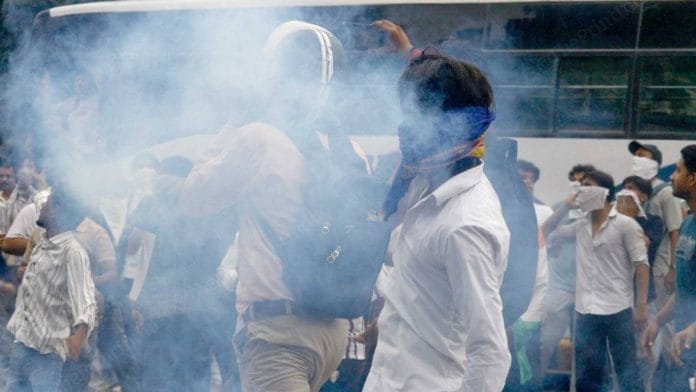


New Delhi: Acting on a plea that raised concerns over the police’s use of violence and force against protesters during the CJP-led march to Parliament in Delhi last month as well as in other states, the Supreme Court Monday said that states have the legal authority to close or withdraw FIRs.
A three-judge bench of Chief Justice of India Surya Kant, Justice Joymalya Bagchi and Justice V. Mohana said it is “clarified that different states and the National Capital Territory of Delhi shall be at liberty to close or withdraw FIRs against protesters”.
Expressing concern over the withdrawal of FIRs against protesters with criminal history, Solicitor General Tushar Mehta told the court that the government had given serious consideration to the issue, and was hoping to get in touch with the leaders behind the protest to resolve the matter of “semantics”.
He also told the court that he was in touch with senior advocate Vrinda Grover who was appearing in the matter against the use of pellet guns on protesters.
In response to this, Justice Bagchi said that under the prevailing criminal law, withdrawal of FIRs is permitted. “The public prosecutor has the authority to withdraw. Closure reports can be filed in this FIR. It cannot hang over the students’ heads,” the court said.
In response, Mehta said that closing all FIRs will lead to a situation where cases filed against more than 2,700 people with criminal antecedents, including grave and heinous offences, will be dropped.
At this, the CJI orally remarked that there are two types of FIRs in this matter. “The first is against students while the other is against hardened criminals. First, these have to be segregated,” he said.
Grover raised the issue of FIRs filed in Bihar, where one named 152 people while also saying that 5,000 unknown persons were involved. “We need to work a mechanism, along with the government, for quashing the FIRs,” she said.
On 20 July, hordes of students and professionals from all walks of life marched to Parliament to demand accountability for exam paper leaks and the resignation of Dharmendra Pradhan as education minister. The protests across India came in the aftermath of the NEET-UG 2026 paper leak.
Prior to this, on 28 July, the top court had underlined the need for a fair and independent investigation into the allegations of violence towards both students and police officials during the protests.
Towards this, it said it may constitute a Special Investigation Team headed by a former SC judge, and seek responses from states like Bihar, West Bengal, Maharashtra and Kerala, among others.
Monday too, after senior advocate Gopal Sankaranarayanan presented a note flagging how even lawyers’ children were beaten up during the protests and 300 videos were shared with the court, the bench said that “we have to form an independent SIT to look into all of this”.
Sankarayaranan also told the court that they had identified individuals without uniform committing excesses on the students, and flagged the need for a proper inquiry into the matter, along with a direction to the Commissioner of Police, Delhi, and the RAF on why the police used pellet guns.
Also Read: The pressure cooker life of a 16-year-old Indian student
28 July order clarified
Sankaranarayanan, appearing for the petitioners, told the court Monday that its 28 July order suffered from ambiguity and needed clarification.
The order had, among other directions, allowed states and the Delhi government to probe the FIRs registered over the protests but instructed that no coercive measures be taken against those with no criminal antecedents. It also directed states to release those aged below 18 with no criminal antecedents, who were arrested or detained simply over their participation in the protests.
“There is an ambiguity in the 28 July order. It allows the state to proceed with the investigation but says coercive action cannot be taken,” he said.
Senior advocate Abhishek Manu Singhvi also said the “earlier order needs clarification. Criminal antecedent is a broad word which can include petty offences too”.
The court then clarified that the word “criminal antecedents” in the 28 July order will be read as grave and heinous offences, while adding that it was not asking the Centre to drop charges against murderers.
“Delhi and other states may proceed with the investigation of the FIRs registered. However, no coercive measures shall be taken against the protesting students. Such protection, nonetheless, shall not be extended to persons with criminal antecedents,” the CJI-led bench had said on 28 July.
(Edited by Nida Fatima Siddiqui)
Also Read: Delhi, Mumbai, Kolkata—women are facing ugly pushback after CJP protests