



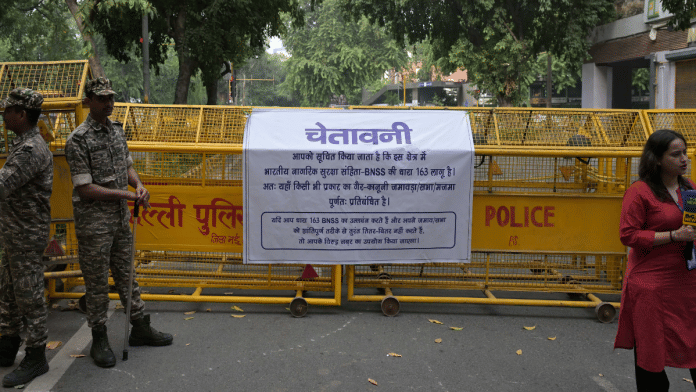
New Delhi: For the last 30 years, the Delhi Police has used prohibitory orders under Section 144 of the Code of Criminal Procedure (CrPC), now Section 163 of the Bharatiya Nagarik Suraksha Sanhita (BNSS), to restrict public meetings, processions, demonstrations and gatherings around Parliament House and its adjoining areas.
Although each order was limited to 60 days, fresh orders were issued as the previous ones expired, keeping restrictions in place over successive periods.
The practice was challenged before the Supreme Court in 2017 by the Mazdoor Kisan Shakti Sangathan, which argued that the repeated orders effectively turned large parts of central Delhi out of bound for peaceful protests.
The case, decided in July 2018, brought into focus a question that remains relevant today: can a provision meant to deal with urgent threats to public order become a routine means of regulating demonstrations in the national capital?
The issue resurfaced during the recent protests against Chief Election Commissioner Gyanesh Kumar, when Section 163 was imposed ahead of the proposed demonstrations and the permission for a protest at Jantar Mantar was denied.
The two-month cycle
Section 144 of CrPC empowered an executive magistrate to issue written orders when immediate prevention or a speedy remedy was necessary to prevent danger to human life, health or safety, a disturbance of public tranquillity, or other specified threats.
The provision allowed an order to remain in force for a maximum of two months. The state government could extend it for a further period of up to six months through a notification, subject to the statutory conditions.
Instead of relying on the formal extension provision, the Delhi Police repeatedly issued fresh orders after the previous ones expired. In its petition, the Mazdoor Kisan Shakti Sangathan cited orders dated 24 January, 25 March, 24 May, 23 July, 22 September and 31 October 2017.
Similarly worded, the orders prohibited public meetings, assemblies of five or more people, slogans, speeches, processions, demonstrations and dharnas without written permission.
The orders cited heavy vehicular and pedestrian traffic, the risk of obstruction and concerns about public safety and tranquillity in and around Parliament House, North and South Block, and the now revamped Central Vista lawns.
This meant that the expiry of one order did not necessarily bring an end to the restrictions. A fresh order could take effect, continuing the restrictions for another period.
However, the legal distinction is important. The two-month limit applies to an individual order (i.e., which concerns specific parties or participants); the law also provides for a state-government extension of up to six months. Repeated fresh orders are a separate practice and cannot automatically be treated as lawful merely because each new order carries a different date.
Also Read: SC to hear more pleas over Delhi protest curbs, prohibitory order & ‘police excesses’ in focus
What SC said
In Mazdoor Kisan Shakti Sangathan v. Union of India, the petitioners challenged the repeated imposition of Section 144, arguing that they curtailed the fundamental right to peaceful assembly guaranteed under Article 19(1)(b) of the Constitution.
The petition referred to a Delhi High Court proceeding in which the police stated that the continuous prohibition on assemblies in parts of New Delhi had been discontinued. Despite that assurance, the petitioners said, repeated orders had resumed.
The Supreme Court considered the challenge alongside appeals concerning restrictions on protests at Jantar Mantar. The case also involved complaints by residents about noise, pollution and the prolonged occupation of public space by demonstrators.
The judgment discussed previous judicial rulings which held that Section 144 was intended to address emergencies and that successive orders could not be used to make temporary restrictions semi-permanent. The court’s consideration highlighted the need to balance the right to protest with public order and the rights of residents.
While the Supreme Court ruled that there cannot be a blanket ban on protests in Central Delhi, it did not establish an unrestricted right to demonstrate anywhere.
Authorities can regulate the location, size and conduct of assemblies, but restrictions must operate within the law and cannot be justified solely by treating peaceful protest as a continuing public-order problem.
The judgment directed the Delhi Police to frame guidelines for regulating protests, leading to a system of permitted gatherings subject to a prior police permission and conditions to balance the right to peaceful assembly with public order and resident concerns.
Why permission became necessary
The prohibitory orders around Parliament required written permission for activities including public meetings, demonstrations, processions, and dharnas. The requirement was linked to security concerns in areas housing Parliament and key government offices, as well as the possibility of traffic disruption.
Jantar Mantar functioned as a designated protest site, but organisers were still required to obtain police permission. Being a designated venue did not mean that every demonstration could proceed automatically. The police could consider the proposed gathering, its timing, crowd size, and security implications.
Section 163 of BNSS, which replaced Section 144 of CrPC in 2024, retains the central preventive power. Its use must still satisfy the statutory requirements; it is not a blanket authority to prohibit peaceful assembly indefinitely.
In the midst of questions over the use of the prohibitory order, the police removed Jantar Mantar from the list of designated protest sites on Monday. Ramlila Ground, Burari Ground and CBD Ground in east Delhi were named as alternatives. That said, administrative change is separate from the legal question surrounding successive prohibitory orders.
The continuing concern is whether emergency powers are being used to address specific and immediate threats, or as a recurring mechanism to regulate dissent. The answer lies in the Supreme Court’s 2018 proceedings that highlighted the need to maintain public order without curbing the right to peaceful protest.
Aditya Edara is a TPSJ alum, currently interning with ThePrint.
(Edited by Tony Rai)