



New Delhi: The Supreme Court Monday agreed to hear a fresh petition challenging restrictions imposed on protests in Delhi after senior advocate Gopal Sankaranarayanan raised allegations of police excesses during the demonstrations against Chief Election Commissioner Gyanesh Kumar and the Special Intensive Revision (SIR).
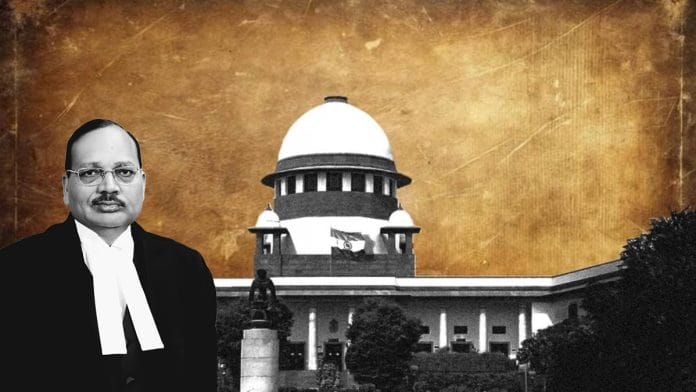
Sankaranarayanan said the petition challenged the absence of a publicly available prohibitory order under Section 163 of the Bharatiya Nagarik Suraksha Sanhita (BNSS), as well as the constitutional validity of a provision in it. Chief Justice of India Surya Kant, part of a three-judge bench including Justices Joymalya Bagchi and V. Mohana, said the matter would be listed on Tuesday along with related petitions.
The petition filed by advocate Ashima Mandla on behalf of Samriddhi Das challenges the 9 October prohibitory order under Section 163 of the BNSS and the constitutionality of Section 172 of the BNSS, empowering the police to detain or remove people for disobeying directions. It also challenges restrictions on public transport and mobile internet imposed ahead of the 10 October protest at Jantar Mantar, arguing that they infringed fundamental rights to free speech, peaceful assembly and movement.
Sankaranarayanan told the bench that senior advocate M.R. Farasat had been dragged through the streets, while two other advocates had been detained in buses. He also alleged that private individuals carrying sticks and lathis had attacked children, including hitting them in the head, while the police failed to intervene. He said he would show the court videos of the alleged incidents.
“I would hope that the court says the same to the police,” he said, referring to repeated calls for lawyers to exercise restraint.
The CJI said every lawyer and member of the Bar had the right to participate in peaceful activities at designated locations, but the Supreme Court could not be allowed to become a site of disruption.
Separately, Rajya Sabha member and Democratic Youth Federation of India (DYFI) national president A.A. Rahim has filed a writ petition under Article 32 of the Constitution, alleging that DYFI members were detained and assaulted by police at Connaught Place on October 11.
According to Rahim’s petition, protesters marching towards Jantar Mantar were allegedly dragged into a bus around 12.30 pm and taken to a secluded area before being transferred to a police vehicle divided into five compartments. The petition alleges that detainees were beaten inside the vehicle and later taken to Surajmal Stadium, where they were held until around 7.30 pm.
Rahim claims that no arrest memos were prepared, the detainees were not informed of the grounds for their detention, and they were not produced before a magistrate. The petition seeks an independent, court-monitored inquiry, preservation of surveillance footage and vehicle location records, identification of the personnel involved, compensation and guidelines governing detention during protests.
The plea also refers to the Supreme Court’s 11 October directions against illegal detention of peaceful, unarmed assemblies beyond areas where Section 163 of the BNSS was in force.
These petitions join others related to the ongoing protests in the Capital, including those related to contempt and habeas corpus.
Also Read: Delhi protests, mass detentions put SC’s suo motu powers in focus: When does top court step in
The Form 6 issue
Meanwhile on Monday, a Supreme Court bench of the same composition clarified that it has neither approved nor disapproved the Election Commission’s revised Form 6 for voter registration while hearing a new petition against the alleged unilateral decisions of Chief Election Commissioner Gyanesh Kumar related to the SIR exercise.
Form 6 is filed by first-time voters. It has been introduced, in a modified format, during the ongoing SIR in various states.
The Supreme Court has already issued notice on petitions that seek to invalidate the CEC’s decision to modify Form 6 on the ground it did not conform to the rules.
Also on Monday, the bench said revised Form 6 did not exist when the Supreme Court had adjudicated the petitions on SIR in Bihar. The CJI’s remarks made on 5 October that it never approved of modified Form 6, therefore, cannot be construed as court’s approval or disapproval of the modified Form 6, since the issue has not yet been brought before it, it said.
“What was said was that when the Bihar SIR matter was before us, the new Form 6 was not there. That does not mean it was either approved or disapproved by the Supreme Court,” Justice Bagchi said.
He made this remark when the lawyer, appearing in connection with the new petition, addressed the issue of Form 6 and recalled the 5 October observations of the CJI to insist that move to introduce a new version of the Form did not have the Supreme Court’s approval and, hence, the court should look into this issue.
“On 5 October, this court had already declared that Form 6 was not approved by the Supreme Court of India. But the Election Commission has published that the altered Form 6 has been approved by the Supreme Court. This is very important. I am seeking a direction regarding this,” submitted the lawyer.
At this, the CJI said: “There was no application concerning the new Form 6. That is all we have said. whether approved or not approved. Don’t pick up words like this only for yourself, please.”
(Edited by Nardeep Singh Dahiya)
Also Read: Don’t use hammer to kill fly—SC cautions govt against blanket metro, train curbs ahead of CJP protes