





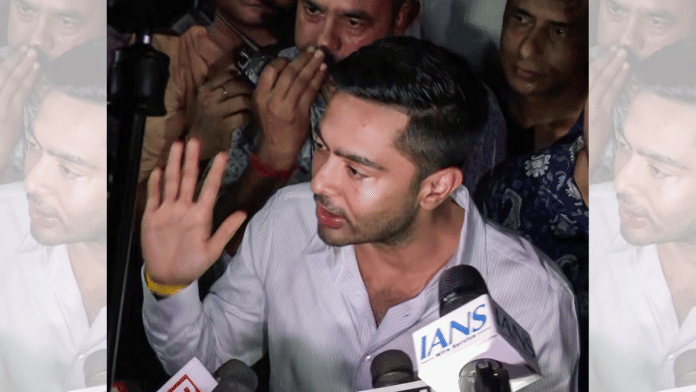


New Delhi: The Supreme Court Monday allowed TMC MP Abhishek Banerjee to travel abroad for eye treatment, criticising the West Bengal government for opposing his request.
“Every individual has the right to go abroad; every individual has the right to choose the medical care,” said Justice Joymalya Bagchi.
Justice Bagchi was part of a three-judge bench led by Chief Justice Surya Kant hearing Banerjee’s appeal against the Calcutta High Court’s 5 August order, declining him permission to travel abroad.
Banerjee is facing a criminal case relating to an alleged provocative speech during the 2026 assembly elections.
The restriction on Banerjee’s foreign travel was one of the conditions the high court had imposed on him while granting the TMC leader pre-arrest bail.
The CJI-led bench, also comprising Justice V. Mohana, gave permission subject to Banerjee’s assurance that he would travel only on his diplomatic passport.
Further, he has to share his itinerary and place of stay with the investigating agency.
Additional Solicitor General S.V. Raju, who represented the West Bengal government, opposed the plea, contending 16 cases were pending against Banerjee. There was a fear that he may not come back if he is allowed to travel, he said.
The bench, however, was not inclined to entertain the state’s opposition.
“Every individual has the right to choose his medical treatment. That is not for you to decide,” the bench said. “Let him travel abroad. You have so many cases. I am sure you will find something else, and then another FIR can be filed,” Justice Bagchi said, as the bench dictated its order allowing Banerjee’s plea.
Senior Advocate Gopal Sankaranarayanan, representing Abhishek Banerjee, argued that he only had a diplomatic passport now, which was issued to him for Operation Sindoor outreach.
Embassies, he said, would be able to monitor his movements when he travels on the diplomatic passport. This will address the state’s apprehension that Banerjee will abscond, he explained.
Sankaranarayanan further submitted Banerjee was an MP, a General Secretary of a national party, and has his family back in India. Hence, the apprehension was unfounded.
Besides, the cases against him were registered after the change of government in the state, he said, imputing political motives behind the criminal prosecutions.
Raju rebuffed the allegations, saying the previous government did not dare to file the cases. He submitted that before Banerjee is allowed to travel, it must be ascertained whether his need is genuine and for that medical evaluation was necessary.
“If he is not appearing for a medical evaluation, then an adverse inference must be drawn,” the ASG contended.
As the bench allowed Banerjee to travel, it directed the state not to disclose the MP’s itinerary in public. This was done pursuant to Sankaranarayanan’s request.
In a previous round of litigation, Banerjee had moved the Supreme Court, challenging the High Court’s 20 July order, which refused him travel permission, and instead asked him to undergo treatment at the state-run SSKM Hospital and the Institute of Post Graduate Medical Education & Research (IPGME&R).
On 3 August, the Supreme Court asked him to go back to the high court, while asking the latter to decide the matter expeditiously.
Two days later, the high court rejected the MP’s plea to travel abroad because he had declined to appear before a medical board constituted to assess whether he required treatment overseas.
The high court wanted the MP to appear before the board whose medical opinion could have enabled the court to determine whether he required treatment abroad.
This direction was issued with an observation that the court was not a medical expert and that a medical board was competent to ascertain whether Banerjee required treatment.
Banerjee’s argument that he had an absolute right to choose the doctor or medical establishment for treatment was rejected.
(Edited by Sugita Katyal)
Also Read: Behind NCPI, the refuge of TMC rebel MPs: A lawyer, ‘famous mathematician’ & motivational speaker