



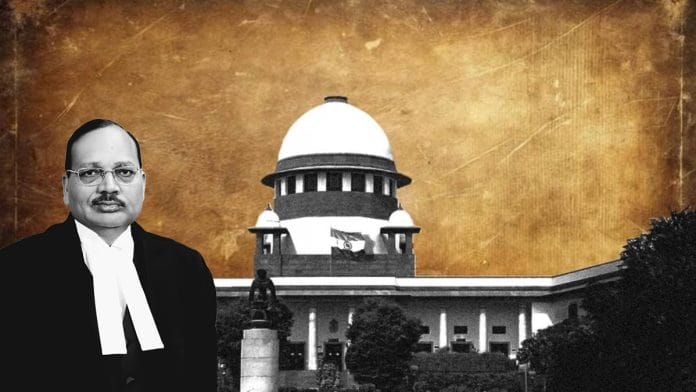

New Delhi: As it closed its suo motu proceedings over a Class 8 NCERT textbook containing a reference to “corruption in judiciary”, a Supreme Court bench led by Chief Justice of India (CJI) Surya Kant emphasised in its order that the distinction lies not between criticism and silence, but between responsible discourse and uninformed assertion.
The bench closed the case last week after a government-appointed expert panel replaced the chapter containing the section. The order was uploaded to the Supreme Court website on Tuesday.
“Judiciary, as an institution, is not, and cannot be, averse to criticism. Fair, informed and constructive critique of judicial functioning is a legitimate and necessary feature of a vibrant constitutional democracy, contributing to institutional accountability and self-correction,” the order said.
It added that “what is required, however, is that such criticism be voiced through the appropriate forum and in a fair, rational mechanism, and not find its way, without verification, into a school curriculum meant for impressionable minds”.
The matter first made headlines in February after CJI Kant slammed the “corruption in the judiciary” reference in the Class 8 NCERT textbook, saying he would not allow anyone to defame the institution. A much-discussed case, it sparked a debate on criticism of the judiciary, after the top court issued contempt notices to Professor Michel Danino, Suparna Diwakar and Alok Prasanna Kumar—who were involved in the drafting of the chapter—and barred them from associating with any future academic projects of public institutions.
On 1 September, the CJI-led bench closed the civil suo motu writ petition after Solicitor General Tushar Mehta informed them that the new textbooks with the new chapter were in circulation. The expert panel constituted by the Modi government was headed by Supreme Court (Retired) Justice Indu Malhotra. It also included Senior Advocate and former Attorney General for India K.K. Venugopal and Professor Prakash Singh, who worked in collaboration with the National Judicial Academy, Bhopal, and the reconstituted NSTC.
Taking into consideration of the apologies tendered by NCERT officials and remedial measures, and “satisfactory completion” of a review by the expert committee resulting in a “revised and balanced text already in use”, the court disposed of the case as it felt that the “object underlying these suo motu proceedings stands substantially achieved”.
(Edited by Gitanjali Das)
Also Read: NCERT adds Emergency of 1975 to Class 9 textbook for first time, calls it ‘challenge to democracy’