



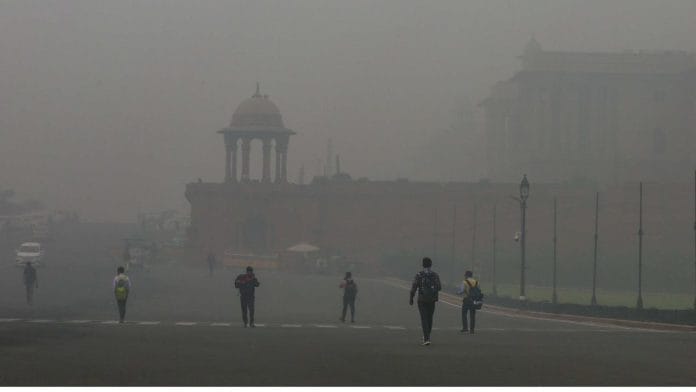
New Delhi: Holding that Diwali celebrations cannot come at the cost of public health, the Supreme Court has permitted limited use of certified green crackers in Delhi-NCR.
The court passed the order on 29 October, but uploaded it officially Monday afternoon. The 23-page order underscored that religious practices cannot override public health concerns. But it did not order a blanket prohibition on firecrackers and opted for a tightly regulated, temporary relaxation.
Under the strict conditions—intended to balance religious sentiments with constitutional right to a pollution-free environment—the order allows green firecrackers only between 6 am and 7 am and 8 pm and 10 pm on 7 and 8 November. A complete ban will be restored from 9 November.
Use of firecrackers is completely barred within a 300-metre radius of hospitals, nursing homes, primary and district health centres, old-age homes, notified silence zones and educational institutions. These areas will be declared no-cracker zones, the order said.
Those manufacturers who have valid verification from CSIR-NEERI (Council of Scientific and Industrial Research-National Environmental Engineering Research Institute) and PESO (Petroleum and Explosives Safety Organisation) can sell approved green crackers between 2 and 6 November.
Firecrackers joined in a series, commonly known as ‘laris’ and ‘garlands’, those containing barium and not approved by CSIR-NEERI as green crackers will not be sold, as per the order.
To prevent the sale of conventional firecrackers under green labels, every box must carry a product-specific QR code displaying details of the manufacturer, NEERI registration, PESO or District Magistrate licence, formulation and test certificate, the court said.
Police and district administration teams will undertake inspections, verify QR codes and confiscate illegal or conventional firecrackers. Offending manufacturers and traders will be prosecuted if they are found violating court orders.
The court also directed the authorities to identify designated locations for the sale of green crackers. There will be no sale anywhere else, including on online platforms.
The order also addresses the concern over recurring failure of authorities to enforce its directions. It directed state governments and authorities to ensure manufacturers and traders furnish substantial monetary security. In the event of a violation, this security shall be forfeited, the court added.
Directions have been issued to the Central Pollution Control Board and State Pollution Control Boards of states whose areas fall within the Delhi-NCR jurisdiction to prepare separate air-quality reports for both pre-Diwali and post-Diwali period. Besides, they will also collect samples of sand and water for comparative analysis and submit reports on the impact of firecrackers on hospital admissions across Delhi-NCR.
The court fixed 14 December for filing all compliance reports and affidavits. In case the deadline is flouted, the court warned, it would initiate contempt proceedings against officials responsible for non-compliance. Making it clear that it will continue to monitor the implementation of its directions, the bench listed the matter on 16 December.
The order focused on the need for a change in public behaviour and called upon members of the Bar and other prominent personalities including celebrities and sportspersons to participate in public-awareness campaigns to encourage environmentally responsible celebrations. It stressed on building awareness and informative programmes to sensitise children about the harmful consequences of pollution.
With its underlying theme that religious celebrations and environmental responsibility need not be mutually exclusive, the order recognised the deep religious, social and emotional sentiments associated with Diwali. At the same time, however, it reminded that the right to celebrate doesn’t mean compromising with the health and well-being of others.
The court’s order came on a batch of applications filed in a pending case related to pollution during Diwali. While some sought a complete ban on the firecrackers, asking the court to have a relook at its last year’s order when it allowed regulated use of crackers, some urged the court to allow the sale of green crackers.
Before it issued the directions, the court examined the cultural and religious importance of Diwali, and how it had acquired the character of a national and international festival. It noted that the festival is celebrated by people irrespective of caste, community or religion and brings joy and prosperity.
The order referred to ancient Hindu scriptures, including the Skandapurana and Padmapurana, observing that lamps were traditionally an integral part of Diwali celebrations. However, with the introduction of gunpowder, there was a change in the manner of celebration, leading to the widespread use of firecrackers.
Though bursting of firecrackers constitutes a religious practice under Article 25(1)of the Constitution, it is subject to public order, morality and health, the court pointed out. And the right to a healthy, safe and pollution-free environment is promised under Article 21, the court held.
“Allowing the environment to degrade, which results in a health hazard to all living beings, defeats the very purpose of the festivities, and the celebrations would be rendered nugatory (futile),” the bench observed.
The court expressed concern over the serious environmental consequences of firecrackers, particularly the release of particulate matter into the atmosphere.
At the same time it expressed that states had failed to comply with these directions and had not furnished the necessary assessment. But it also noted that despite a complete ban, the pollution levels had risen.
More importantly, it also said since conventional firecrackers continued to be sold under the guise of green crackers, the complete ban was not only facilitating the illegal sale of firecrackers but also preventing consumers from purchasing legitimate green crackers and next-generation joined green crackers that were approved following the requisite tests.
While allowing regulated use of firecrackers, the court clarified that its order was based on the need to balance competing interests and ensure the regulatory framework was effectively implemented.
(Edited by Viny Mishra)
Also read: Delhi’s AQI enters ‘very poor’ category for first time this season at 312