


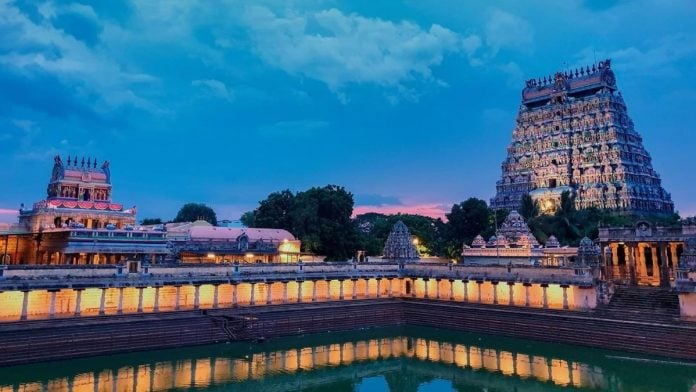
New Delhi: Identifying multiple administrative issues under Podhu Dikshitars, Vedic Shaiva Brahmin hereditary priests and trustees, at the Sri Sabanayagar (Nataraja) temple in Chidambaram, Tamil Nadu, the Madras High Court last week placed the administration under a five-member Board of Management “till the ill is cured”.
The “exclusive control” of the priests over daily rituals and festivals has, however, been preserved.
A division bench of Justices G. Jayachandran and E. Manoharan, on 30 October, held that the situation “imminently warrants judicial interference to rectify the evil of mal-administration”.
The court said, “We have no hesitation to record that the manner in which the ancient structure of the temple has been damaged and ill-maintained under the management of the Podhu Dikshitars is disheartening.”
The ruling came on a batch of writ petitions, one of which was filed by the temple priests themselves against a government order, while the others related to heritage structure damage and temple accounts.
The current case highlights two competing constitutional principles—the state’s duty to prevent mismanagement of public charitable and religious institutions, and a religious denomination’s rights under Article 26. It also fits into a wider pattern of temple disputes in Tamil Nadu.
Also Read: Madras HC puts end to caste discrimination at Kancheepuram temple, says ‘all equal in eyes of God’
The legal framework
Temples in Tamil Nadu are subject to the Hindu Religious and Charitable Endowments (HR&CE) Act 1959, whereby the commissioner has general superintendence and control. Under the HR&CE Act, the commissioner also has the power to pass orders to ensure proper administration and income usage.
Temple trustees are bound to obey lawful orders and are required to administer a temple as a ‘prudent person’.
It is clarified within the HR&CE Act that no power in contravention of a denomination’s Article 26 rights is conferred. Article 26 of the Constitution gives a religious denomination the fundamental right to manage its own affairs and to own and administer property “in accordance with law”. This right is subject to public order, morality and health.
In the landmark 1954 Shirur Mutt case, the Supreme Court held that while Articles 25 and 26 protect religious beliefs and practice, they do not shield the secular and economic administration of religious properties from lawful regulation. Tamil Nadu’s HR&CE Act operates within this distinction.
Chidambaram temple’s legal history
The Dikshitars’ conflict with the State over administration dates back to 1951. In the succeeding decades, the temple priests have repeatedly fought the appointment of an Executive Officer under the HR&CE Act in the Madras High Court and the Supreme Court.
In 2014, the Supreme Court seemingly settled the immediate question with its ruling in Dr. Subramanian Swamy v. State of Tamil Nadu. The apex court held that the Podhu Dikshitars were a religious denomination with the constitutional right under Article 26 to administer the temple’s property.
While accepting the state’s limited right to intervene in case of maladministration, the bench of Justices B.S. Chauhan and S.A. Bobde held that such intervention is regulatory in nature and exists for a limited time only – until the evil is remedied. Perpetual state supervision, it held, would violate Article 26(d).
The current case before the high court involved a petition filed by the Dikshitars against a government order of 2022 which allowed devotees to climb upon the raised stage in front of the sanctum. The bench framed and answered three questions relating to Article 26 rights, heritage structures and proper accounting & auditing. Importantly, the court also revisited aspects of the Dikshitars’ religious denomination status.
While constituting a “Board of Management consisting of domain experts”, the court held that “a transparent administration which can eradicate the prevailing mal-administration is necessary” in order to “rectify the malady in the administration of the temple, which is revered by all Hindus”.
The five-member board comprises of two retired judges as chairman and co-chairman along with a retired Indian Administrative Service (IAS) officer, secretary of the Podhu Dikshitars, and a HR&CE officer as members. The board’s expenses are to be funded by HR&CE. The Court specifies no fixed timeline for the board but uses the term “till the ill is cured”.
Justices Jayachandran and Manoharan also acknowledged the precedent of Subramanian Swamy and other cases. “In none of the judgments, the courts have endorsed, Podhu Dikshitars have right to violate the fundamental right of others under the guise of protecting their institutional denomination character or give a right to mal-administer,” the court said.
It further added that “In fact, the right of the State to interfere in case of mal-administration is explicitly protected by the Supreme Court of India in Dr. Subramanian Swamy’s case. There cannot be any restriction on the State to interfere whenever the Constitutional rights of citizens are infringed and public peace is involved.”
Also Read: Temple lands under the scanner in Tamil Nadu: The Meenakshi case, Palani row & Karur controversy
Temple disputes in Tamil Nadu
The friction between temple and state is not unique to the Chidambaram temple. HR&CE Act matters often reach the Madras High Court, and sometimes the Supreme Court. Temples are governed by a mix of custom and statute while holding valuable land, receiving large public donations and employing staff.
In an earlier case in 2026, the Madras High Court held that an executive officer may administer the temple’s properties and income but cannot interfere with religious or customary activities. The court also emphasised the importance of an officer being familiar with the temple’s customs.
The longstanding Karthigai Deepam dispute in Madurai has also reached the Supreme Court. In this case, the conflict between the state of Tamil Nadu, the temple authorities, and the Madras High Court led to the deployment of security forces to maintain order. Most recently, the Supreme Court refused an interim stay and issued notice in the matter.
In the 2003 Nallor Marthandam Vellalar case, a community’s claim for denominational status granting exemption from HR&CE control failed before the Supreme Court in 2003. A denomination, the court said, requires a common faith, a common organisation and a distinctive name, held together by religion and not merely caste or community.
It is unclear whether the Madras High Court’s latest order will be challenged before the Supreme Court. If it is, the contours of denominational status under Article 26—which the apex court has discussed at length during the Sabarimala temple hearings—will come to the forefront once again. Further, the implications of such an appeal will go beyond the Chidambaram temple case alone and help define the delicate balance of state intervention and religious autonomy.
(Edited by Nardeep Singh Dahiya)
Also Read: 2 Vaishnava sects, 200-year-old dispute—why SC referred case involving TN temple for mediation