



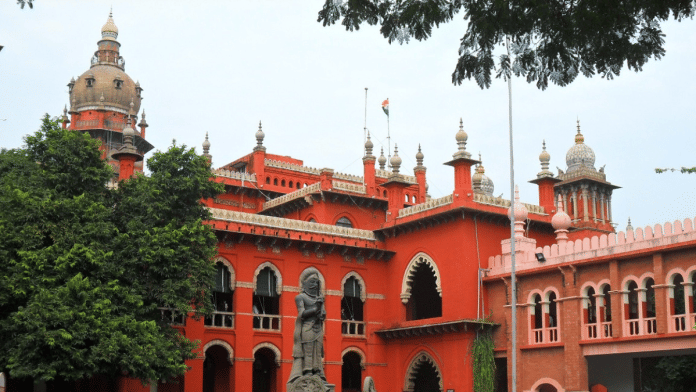

New Delhi: Religious traditions cannot be used as a shield for caste-based exclusion in places of worship, the Madras High Court has ruled while putting an end to discriminatory practices against non-Brahmin devotees at the Arulmigu Devarajaswamy temple in Tamil Nadu’s Kancheepuram dedicated to the Hindu deity Vishnu.
The division bench affirmed that “in the eyes of God, all living beings are equal” and that “there is no room for discrimination in a place of worship”.
The case was initiated as a Public Interest Litigation (PIL) in 2019 by Madhavan Ramanuja Dasan, a resident and devotee who alleged systemic discrimination against non-Brahmins, particularly members of the Thenkalai sub-sect. Before the court, Dasan sought a writ of mandamus—a court order to a government official—to prohibit unequal treatment in distribution of prasadam (sacred food), theerthams (sacred water), and placement of “satari” (holy crown), particularly within the Sri Manavala Mamunigal shrine.
The petitioner brought several startling allegations to the court’s attention.
He stated that while Brahmin devotees were permitted to use the main entrance of the Sri Manavala Mamunigal shrine, “non-Brahmin devotees (are) not permitting…to enter through the main entrance and that they are asked to use the side entrance only”.
He also alleged that non-Brahmins were made to stand outside the shrine where they received prasadam, but “no satari will be placed on them”. The petitioner further claimed that non-Brahmin devotees were barred from reciting sacred Tamil hymns (Nalayira Divya Prabandhams) in the various shrines of the temple complex.
These practices, the petitioner said, were most prominent during the 10-day birthday celebrations of Sri Manavala Mamunigal.
The petitioner also stated that he is a Thenkalai Vaishnavite and devotee of the deity Devarajaswamy (an avatar of Vishnu). He also submitted that the Sri Manavala Mamunigal shrine is very important for the Thenkalai sub-sect.
On the other side, the executive trustee of the Devasthanam and the Hindu Religious and Charitable Endowment (HR&CE) Department countered these claims by citing logistical constraints. They argued that the sub-shrines are “small structures” and that it is “practically impossible to allow all public inside” during service periods as even the official service holders cannot be fully accommodated. They also told the court that the rendition of certain hymns is a “statutorily secured right” (Adhyapaka Mirasi) conferred specifically on the Thenkalai sub-sect, which carries remuneration and preferential honors.
However, they maintained that the administration “does not prevent either the petitioner or any other person… from reciting of Nalayira Divya Prabandham…at any time if they want to worship”.
Also Read: The sacred & the State: How Indian courts have redrawn boundaries over use of temple funds
Court’s verdict: Equality in devotion
The division bench, comprising justices Dr G. Jayachandran and E. Manoharan, grounded their decision in both legal and spiritual principles.
Their 11-page order quoted Chapter 9, Verse 29 of the Bhagavad Gita: “I am equally disposed to all living beings. I am neither partial to anyone nor do I hate anyone. But those who worship me with devotion, they are in me and I am in them.”
The court, on 17 August, disposed of the writ petition after recording a formal undertaking from temple authorities. It ordered the HR&CE Department to “ensure that there is no discrimination in the distribution of the Theertham, Satari and Prasadams”.
While the traditional Adhyapaka Mirasi rights are preserved for specific rituals, the court ruled that “the petitioner nor any other person or any group will not be prevented (from) recital of Prabandhams in any shrines of the temple for the purpose of their worship”.
The bench also noted that the petitioner’s intention is not to disrupt any of the traditional rituals performed in praise of the deity. Since he himself has stated that he worships Devarajaswamy, if he also gets his chance to recite hymns in the shrines, it does not amount to discrimination, the court said. The court concluded that by preserving an arrangement where every devotee has the chance to participate in hymns and receive honors, the temple ensures “there is no discrimination occurring by following any tradition”.
(Edited by Amrtansh Arora)