





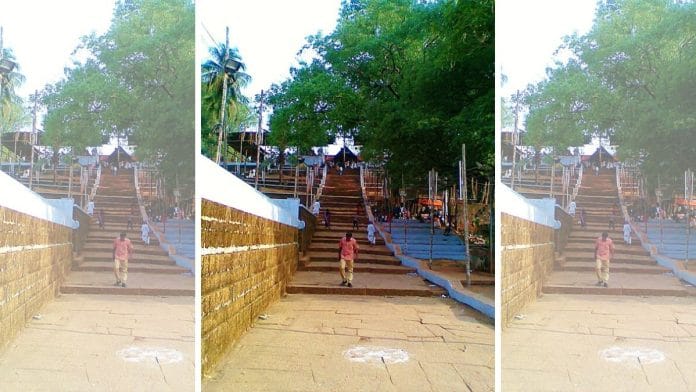


New Delhi: The Kerala High Court has delivered a landmark judgment, exposing a long‑festering crisis of corruption, misappropriation of temple funds and administrative decay at the historic Sree Thirumandhamkunnu Bhagavathy Temple in Angadippuram.
What began as a dispute over the appointment of an executive officer unfolded into a comprehensive judicial inquiry into the temple’s governance, revealing a disturbing pattern of illegal appointments, unauthorised financial transactions, and structural weaknesses in the decades‑old administrative scheme.
The court’s decision, delivered by a division bench comprising Justices Raja Vijayaraghavan V. and K.V. Jayakumar, not only scrutinises the past but also charts a new administrative future by directing the framing of a modern, transparent governance scheme under the Madras Hindu Religious and Charitable Endowments Act, 1951. The judgment stands as a significant intervention in the ongoing debate over accountability in temple administration and the limits of hereditary trusteeship under statutory regulation.
At the heart of the controversy lies the 1966 Scheme governing the temple, which vests administrative authority in the senior‑most male member of the Valluvanadu Swaroopam, traditionally known as the Valluvanattukara Vallabha Valiya Raja.
Also Read: Why Sukhu govt plan to fund schemes using temple contributions may be the perfect weapon for BJP
From faith to court
Valluvanadu Swaroopam is the lineage of four families entrusted with hereditary control of the temple. The 1966 Scheme established a clear framework for the administration of the temple, ensuring preservation of hereditary rights, regulation of temple management and preventing misuse of power. The scheme was intended to preserve hereditary customs, but the court found that it had, over time, become a vehicle for unchecked concentration of power.
The hereditary trustee, often an elderly member of the Swaroopam holds primary authority over appointments, finances, and day‑to‑day administration.
The court recorded that this arrangement had led to complaints of irregularities and maladministration, especially when the trustee began delegating his powers through a power of attorney, an arrangement the court held to be legally impermissible under the Madras Hindu Religious and Charitable Endowments Act, 1951.
The trustee’s reliance on a power of attorney holder to run the temple’s affairs resulted in a series of questionable decisions, including the appointment of over 40 employees without sanctioned posts, proper selection procedures, or approval from the Malabar Devaswom Board.
The financial irregularities uncovered during the proceedings were even more alarming.
Audit reports between 2013 and 2019 revealed that transactions exceeding Rs 1 crore had been carried out without the mandatory sanction of the board. The reports also showed gross violation of the provisions of the law.
The court noted that various repair and construction works were executed without tender procedures, technical estimates, or administrative sanction, raising serious concerns about the diversion and misuse of temple funds.
Compounding the problem was the Malabar Devaswom Board’s own conduct. In 2013, the board appointed an executive officer to the temple, citing an administrative vacuum following the death of the previous trustee. While the board claimed this was a temporary measure, the officer continued in his position for years, effectively displacing the hereditary trustee without following the procedure mandated under the scheme.
The court held that the board’s action, though initially justified as a stopgap arrangement, became illegal once it extended beyond a reasonable period.
The court’s intervention was triggered not only by the writ petitions filed by the trustee and temple employees but also by a suo motu Devaswom Board petition registered on the basis of complaints from devotees. These complaints alleged widespread corruption, illegal appointments, and misuse of temple resources.
In response to the systemic failures revealed during the proceedings, the high court issued transformative directions. Foremost among them is the order to frame a new administrative scheme to replace the outdated 1966 arrangement under Section 58(1) of the Madras Hindu Religious and Charitable Endowments Act, 1951.
The court directed the Deputy Commissioner to prepare a draft scheme that ensures transparency, collective decision‑making and financial accountability. The new scheme must involve all major branches of the Valluvanadu Swaroopam, thereby preventing the concentration of power in a single individual. It must also incorporate safeguards for appointments, financial transactions, and administrative decisions, ensuring compliance with statutory requirements and protecting the interests of devotees.
The draft scheme is to be submitted to the Devaswom Bench for approval.
The court also upheld the termination of employees appointed to non‑sanctioned posts, reinforcing the principle that temple appointments must adhere strictly to statutory norms.
While acknowledging the hardships faced by the employees, the court held that appointments made in violation of the scheme and without board approval cannot be regularised.
The judgment represents a turning point in the governance of Sree Thirumandhamkunnu Temple, and also contributes to the broader legal discourse on the limits of hereditary trusteeship and the role of statutory bodies in safeguarding temple administration.
(Edited by Nardeep Singh Dahiya)
Also Read: Temple war in Noida society — Mahagun Maple now split over ‘democracy’ and devotion