





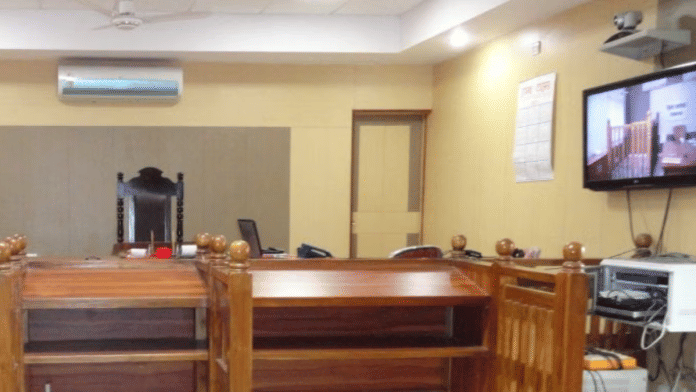


Gurugram: A routine complaint by a lawyer about not being able to speak privately with his jailed client on videoconference has led to a Punjab and Haryana High Court order directing every prison in Punjab, Haryana, and the Union Territory of Chandigarh to install soundproof rooms for lawyer-client meetings by 30 June.
The 17 April order by a bench of Justices Anoop Chitkara and Sukhvinder Kaur goes well beyond the case and turns a single lawyer’s grievance into a landmark directive covering all undertrial prisoners and convicts across three jurisdictions.
The matter first came up during a criminal appeal when convict Sunil Kumar’s lawyer told the court on 1 April that jail authorities had not allowed him to interact with his client through videoconference.
When the case came up again on 17 April, the lawyer pressed the point, saying he still needed a proper, uninterrupted, and secure videoconference to consult with his client, despite the state filing affidavits denying any obstruction.
The bench decided to treat the request as an opportunity to examine the larger issue of problems faced by lawyers while interacting with their clients lodged in jails.
The problem
The court noted a “fundamental irony” in how technology had changed the circumstances of undertrial prisoners.
Earlier, they were brought physically to court, where they could briefly consult with their lawyers in person and even assist in cross-examination.
But with videoconferencing, prisoners are cut off from any meaningful interaction with their counsel. As a result, lawyers, sitting alone in court, are left with no option but to cross-examine prosecution witnesses relying only with the police report, without any instructions from the accused.
“In the absence of soundproof rooms, these prisoners become real losers,” the bench observed.
The court also clarified that recording any such conversation, whether in person or through videoconference, would violate Article 20(3) of the Constitution, which protects an accused from being compelled to be a witness against themselves.
Also Read: SC aspirant in Haryana missed shot at civil judgeship by a hair. Top court gives her another chance
What order says
The bench directed that every prison must have soundproof rooms where inmates can meet their lawyers, both in person and through videoconference, with attorney-client privilege fully protected.
The videoconferencing rooms in jails must be remodelled to ensure that no one else can hear the conversation. Courts must provide headphones to defence lawyers so that prosecutors or witnesses sitting nearby cannot overhear instructions being passed during proceedings.
The bench made it clear that the videoconferencing facility is strictly for the accused and their counsel; family members cannot participate.
Compliance reports must be submitted to the Principal District and Sessions Judge of the district concerned, and copies of the order are to be sent to the Home Secretaries of Punjab, Haryana, and Chandigarh for immediate implementation.
The bench also separately directed the superintendent of the concerned prison to immediately arrange a videoconference between convict Sunil Kumar and his advocate. The connected appeals have been listed for final hearing on 1 July.
Legal framework the court drew on
The bench drew on an unusually wide range of legal sources, including Section 134 of the Bharatiya Sakshya Adhiniyam, 2023, analogous to Section 129 of the Indian Evidence Act, 1872, which protects confidential communications between a person and their legal adviser.
It also referred to the United Nations International Covenant on Civil and Political Rights, the Nelson Mandela Rules for the treatment of prisoners, the Rome Statute of the International Criminal Court, and the UN Basic Principles on the Role of Lawyers.
In addition, the bench cited the Supreme Court’s 1978 constitutional bench judgment in Sunil Batra v. Delhi Administration, which held that no “iron curtain” could be drawn between a prisoner and the Constitution and that conviction does not reduce a person to a non-person whose rights are subject to the whim of prison administration.
The Model Prison Manual, 2016, prepared by the Ministry of Home Affairs (MHA), had already stipulated that interview rooms in prisons should have soundproofing on walls and ceilings.
Both the Haryana Prison Rules, 2022 and the Punjab Prison Rules, 2022 require that lawyer-client meetings take place within sight but out of hearing of prison staff. The court found that in practice, these requirements were simply not being met.
The bench also noted practices in the US and France, where private, soundproofed attorney rooms in prisons are standard and conversations between lawyers and inmates are not subject to auditory supervision by prison staff.
(Edited by Sugita Katyal)
Also Read: Haryana bans ‘kachi parchi’ in grain markets—a scrap of paper that cheated farmers of crores