





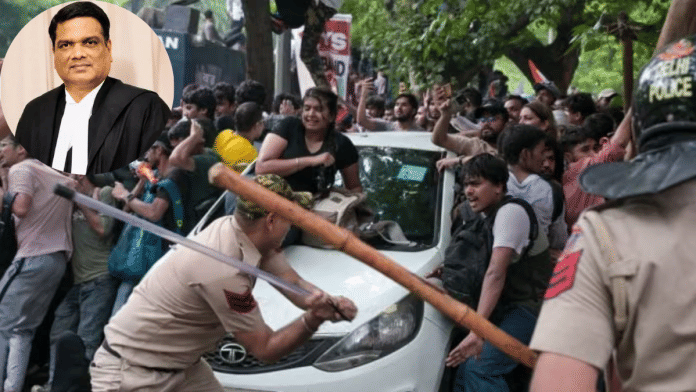

New Delhi: The Supreme Court has set up a five-member high-powered enquiry committee (HPEC) for an ‘independent and impartial’ probe into the ‘excess and disproportionate’ use of force by the police on protesters during the 20 July march called by the Cockroach Janta Party (CJP).
Former Supreme Court judge R. Subhash Reddy will head the panel whose other members are Ravi Shanker Jha, former Chief Justice of Punjab and Haryana High Court, former Delhi High Court judge Shalinder Kaur, former CBI director Rishi Kumar Shukla, and former Meghalaya Police chief L.R. Bishnoi.
From Reddy’s 38-month tenure at the Supreme Court to the Punjab and Haryana High Court’s Bar Association calling for Jha’s transfer to Kaur’s Umar Khalid bail ruling, ThePrint looks at the judicial records of the three retired judges.
Justice R. Subhash Reddy
Elevated to the Supreme Court in November 2018, Justice Reddy had a little over a three-year stint before he retired in January 2022. After enrolling as an advocate in 1980, he specialised in constitutional law practice and was the first judge from Telangana to be appointed to the top court.
Justice Reddy was elevated as an Additional Judge of the Andhra Pradesh High Court in February 2002 and made a permanent judge in June 2004. After almost 12 years there, he became the Chief Justice of the Gujarat High Court in 2016 for the next 2 years.
At the apex court, Justice Reddy wrote 99 judgements, mostly on issues of criminal and constitutional law. He was part of four important Constitution Bench hearings—the Sabrimala review, the entry of women into mosques, the Parsi women excommunication, and the challenge to abrogation of Article 370.
In 2019, Justice Reddy was the lone dissenting judge in the case of Ravi v. State of Maharashtra. The other two judges—Justices R. F. Nariman and Surya Kant—upheld the death sentence of the convict.
Justice Reddy was part of the three judge-bench which addressed the legality of 2G mobile internet speed restrictions during the Covid pandemic, in the Foundation for Media Professionals v. Union Territory of J&K (2020) case.
The court balanced national security concerns against fundamental rights like education, health, and speech, ordering a Special Committee to review the restrictions.
HC judgements
In 2018, a division bench led by Chief Justice Reddy affirmed that courts must exercise judicial restraint and not interfere with expert academic bodies or university regulations unless clear mala fides or arbitrariness are proven. Justice Vipul Pancholi, later elevated to the apex court, was part of the Gujarat HC bench.
Two years earlier, he led a division bench that quashed the Gujarat government’s ordinance granting a 10 percent quota for the Economically Backward Classes (EBC) among the unreserved (upper caste) categories.
The bench held that the additional quota breached the mandatory 50 percent reservation cap fixed by the Supreme Court in the historic Indra Sawhney case. The government introduced the reservation as a political response to the Patidar agitation without collecting any quantifiable or scientific data to prove economic backwardness, it said.
In 2009, a five-judge bench, including Justice Reddy, of the Andhra Pradesh HC ruled that the police must register a First Information Report under Section 154 of the erstwhile Code of Criminal Procedure of India (CrPC) whenever a death occurs during an encounter. This is to be done naming the police officer, it held.
Also Read: Plainclothes policemen deployed to assist people during Sansad Chalo March, Delhi Police tells SC
Justice Ravi Shanker Jha
Enrolled as an advocate in Madhya Pradesh in 1986, Justice Jha was appointed as an additional judge of the High Court there in 2005 and became a permanent judge in 2007. He was appointed as Acting Chief Justice in June 2019.
Two months in, the Supreme Court Collegium recommended him to head the Punjab and Haryana High Court.
But two years on, in 2021, the HC Bar Association called for Chief Justice Jha’s transfer because of his “disinterested and non-cooperative” nature and attitude.
“The Chief Justice has not cooperated with the Bar and has also taken the least interest in the problems faced by the general public of Punjab, Haryana and Chandigarh. Despite various requests and offers of viable solutions, the Chief Justice has remained adamant and has done nothing for the growth of the institution, legal fraternity and the general public,” the Bar statement read.
The Bar Council of India intervened, stating that the country was facing a horrible second wave of the Coronavirus and that court work was also affected. The judge retired in 2023.
Justice Shalinder Kaur
A Delhi University student in the 1980s, Justice Kaur joined the Delhi Judicial Service in 1992 and was promoted to the Delhi Higher Judicial Service (DJHS) in 2003, serving as District and Sessions Judge in Shahdara at Karkardooma Courts, and in the South-East and South Districts at Saket Courts.
In 2005, she underwent 40 hours of training in mediation and later became a Master Trainer with the Mediation and Conciliation Project Committee of the Supreme Court.
Within 10 days of retiring from the DJHS in 2023, Kaur was appointed as an additional judge of the Delhi High Court. She was later elevated as a permanent HC judge in December 2024.
The Supreme Collegium recommended Justice Kaur’s elevation to the HC, noting the “need to ensure greater representation for women” as well as her “proven track record, merit and integrity”.
In a high-profile judgment alongside Justice Navin Chawla, she wrote a 133-page verdict dismissing the bail appeals of student activists Umar Khalid and Sharjeel Imam and seven co-accused charged with the Unlawful Activities (Prevention) Act in the 2020 Delhi riots larger conspiracy case.
Holding that a prima facie offence under the UAPA was made out, the HC in September 2025 ruled that “conspiratorial violence under the garb of protests cannot be permitted”. The bench marked alleged roles of the accused as prima facie grave, noting that the events reflected a “premeditated, well-orchestrated conspiracy”.
In July that year, Justice Kaur was a part of the HC bench which upheld social activist Medha Patkar’s conviction in a defamation case filed by Delhi Lieutenant Governor V.K. Saxena in 2000.
(Edited by Tony Rai)
Also Read: Segregate FIRs against students & criminals, SC tells Centre, says states can close CJP protest FIRs