





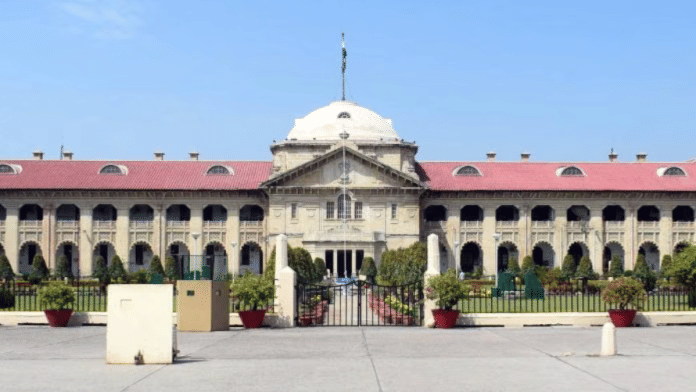


New Delhi: What happens when people meant to represent you in court become involved in criminal proceedings?
The high courts of Allahabad and Delhi have in two separate cases ordered criminal proceedings against advocates, saying they were found engaging in fraudulent practices and extortion involving Public Interest Litigations (PILs).
The rulings delivered last month signal a growing intolerance within the judiciary for misconduct in the profession, with the Allahabad High Court saying the alleged actions undermined the “noble profession” of advocacy.
Last week, the Allahabad High Court requested the Bar Council to seek the “cancellation of the licenses” of the involved counsels, setting aside a previous order obtained through what it described as “wanton corrupt practice” and “deliberate misleading” of the bench.
The case stemmed from a review petition filed by the Bareilly Development Authority (BDA) in a land acquisition dispute. The respondents in the original writ petition had sought interest on compensation for acquired land.
The court said their advocate submitted a “typed copy of a 2016 award” that included an unlawful addition: a provision for 9 percent interest for the first year and 15 percent thereafter. The bench noted that this provision was absent from the original award.
Based on this “deception”, a coordinate bench had previously issued a writ of mandamus directing the BDA to pay these inflated interest rates. A writ of mandamus is an order from a court to a government official ordering them to properly fulfill their official duties.
When the alleged fraud was uncovered, the advocates even attempted to characterise the addition as an “inadvertent or typographical error”.
A bench of Justices Atul Sreedharan and Kshitij Shailendra, however, rejected this defence. “A typographical error stands out from an act of deception… adding the same (interest rates) in the typed copy was not an inadvertent error, it was misfeasance by the counsels,” it said.
The court further noted that the advocates had even filed a contempt petition to pressure the BDA into paying the fraudulent amounts.
Taking a severe view, the bench observed: “Remorse arising from penitence for a wrong act is different from the fear of retribution from the Court upon discovery.”
Since they filed the petitions on behalf of their clients who do not “know English and neither do they understand the nuances of law”, the court directed the Registrar General to conduct an inquiry against advocates Shiv Kant Mishra and Krishna Kant Mishra for crimes of forgery and giving false declarations in court under the Indian Penal Code (IPC) and Code of Criminal Procedure (CrPC).
Uncovering an ‘extortion scam’ via PILs
Parallel to the developments in Allahabad, the Delhi High Court has exposed what it described as a “scam” involving a set of individuals, including advocates, who allegedly file petitions to extort money from property owners.
On 21 July, Justice Mini Pushkarna, while hearing contempt petitions regarding unauthorised constructions in South Delhi, found “shocking facts” indicating that the judicial process was being “misused and abused”.
Their scheme involved filing Public Interest Litigations (PILs) against properties with unauthorised constructions to obtain demolition orders. The perpetrators would then approach the owners to extort money in exchange for not pursuing the cases.
Plus, a compliance report from the Malviya Nagar SHO revealed a nexus where an email from an advocate to a property owner’s counsel contained terms relating to the withdrawal of pending cases upon settlement.
A critical turn in the case occurred when the signatory of the PIL under the name of Universal Human Right Foundation, Narayan Kumar Kashyap, appeared in court and testified that his “signatures on the contempt petitions and additional affidavits were forged”.
Kashyap stated he had been persuaded by advocates to sign an initial PIL in “good faith” regarding a personal dispute, but was kept “totally in the dark” about subsequent transactions and the filing of contempt petitions in his name.
In response to these revelations, the Delhi High Court disposed of the contempt petitions, referring the matter to the Bar Council of Delhi for investigation against advocates S.K. Shukla and Prashant Chauhan, who Kashyap claimed had taken his signatures without his knowledge to file PILs to get demolition orders.
More significantly, the court directed the Deputy Commissioner of Police (South District) to carry out criminal proceedings, including lodging a First Information Report (FIR).
A warning to the Bar
The Allahabad High Court summarised the gravity of these incidents by noting that the “angst of the average litigant is against both the Bar and the Bench”, and that letting off such conduct with a simple apology would send a wrong message.
The court emphasised that “integrity is the back bone of character for the Bar and the Bench” and that severe dealings are necessary to ensure the 153-year legacy of the Bar continues to be respected.
Last month, in a separate order, the Allahabad High Court also took note of criminal cases pending against more than 5,000 advocates in Uttar Pradesh.
Justice Vinod Diwakar noted with “grave concern” that many of these individuals are not first-time offenders, but habitual criminals.
Citing data from the Uttar Pradesh DGP, the court said that 418 advocates are involved in three or more cases, 28 advocates are facing 11 or more cases, 126 advocates have five to 10 cases, and 264 advocates have three to four cases.
In a striking example, the court cited the case of an advocate from Mathura, who is facing a staggering 46 FIRs.
(Edited by Sugita Katyal)
Also Read: No court reels, memes: Bar Council draws red lines on social media use by lawyers, law students